Spain trip: Day 2 (24-June)

Hey everyone, so if you’ve ever read or seen anything about Barcelona, chances are that you already know everything I’m going to share today. I guess some of the personal insight may be new, but everything else comes from a classic trip to Barcelona.
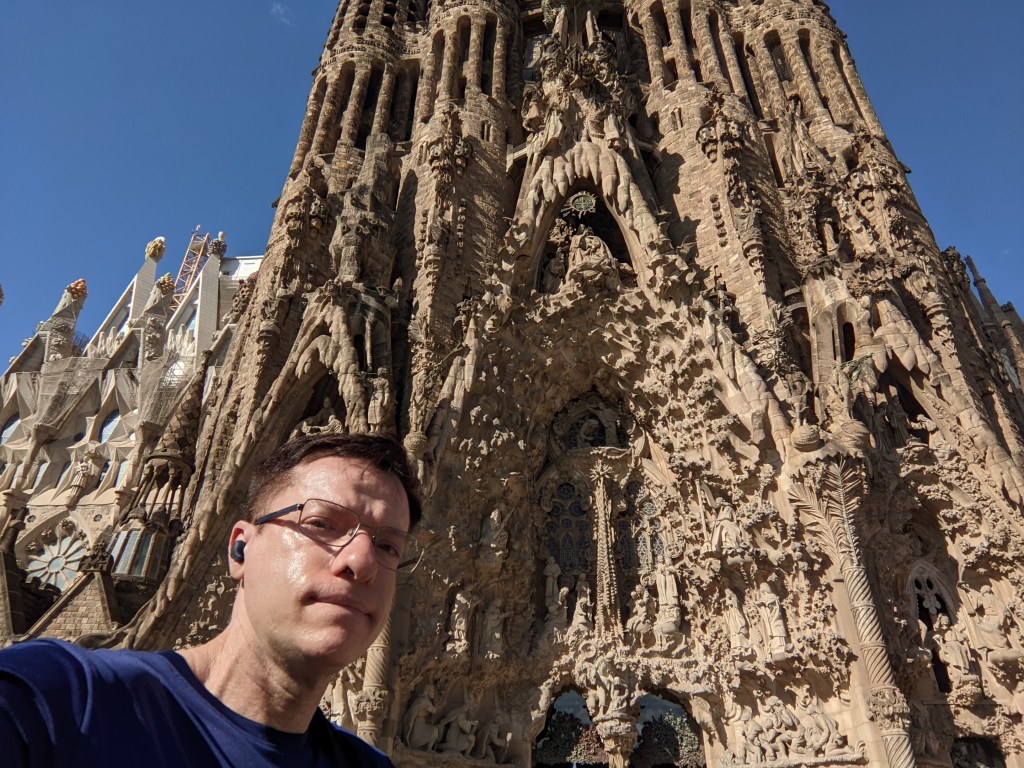
Classic selfie in front of the iglesia la sagrada familia (sacred family church). If you’ve ever seen a picture of a church from Barcelona, it was no doubt this one.

As mentioned in an earlier post, I was staying in a residential area not frequented by tourists. Nevertheless, Roquetes (where I was staying) is well connected via two different subway lines, so it was only about 30 minutes maximum to get to any main tourist areas in Barcelona. The extra 15 minutes of travel time was more than compensated by the significant savings in money. Like I’ve said before, if you are planning on visiting Barcelona, plan to spend a lot on lodging, but you can significantly cut costs by staying a bit further away. As long as where you are staying is connected to the subway, you will be fine.

As I had been advised to do, several days earlier I had bought a 9:30 AM entry ticket to the church, also opting for the self-guided (audio guide) option. The 9:30 AM option is supposed to be the least crowded according to recommendations from many people. Separately, the human guided tours have too many people for it to be a plus, and you end up having to use special hearing aids to understand the guide, so you may as well just get the pre-recorded option. I suppose it’s possible to pay a huge sum of money and get a truly personalized guide for a group of maximum 4, but that’s not what I saw happening in and around the church. My “self-guided” option had a cost of 45 USD and included access to the passion tower. The cheapest you can get is 33 USD. Again, if you are doing standard tourist stuff, Barcelona is NOT a cheap place to visit. Also, I almost forgot to mention, if you don’t buy your ticket ahead of time, most likely you won’t get in; this place is popular.
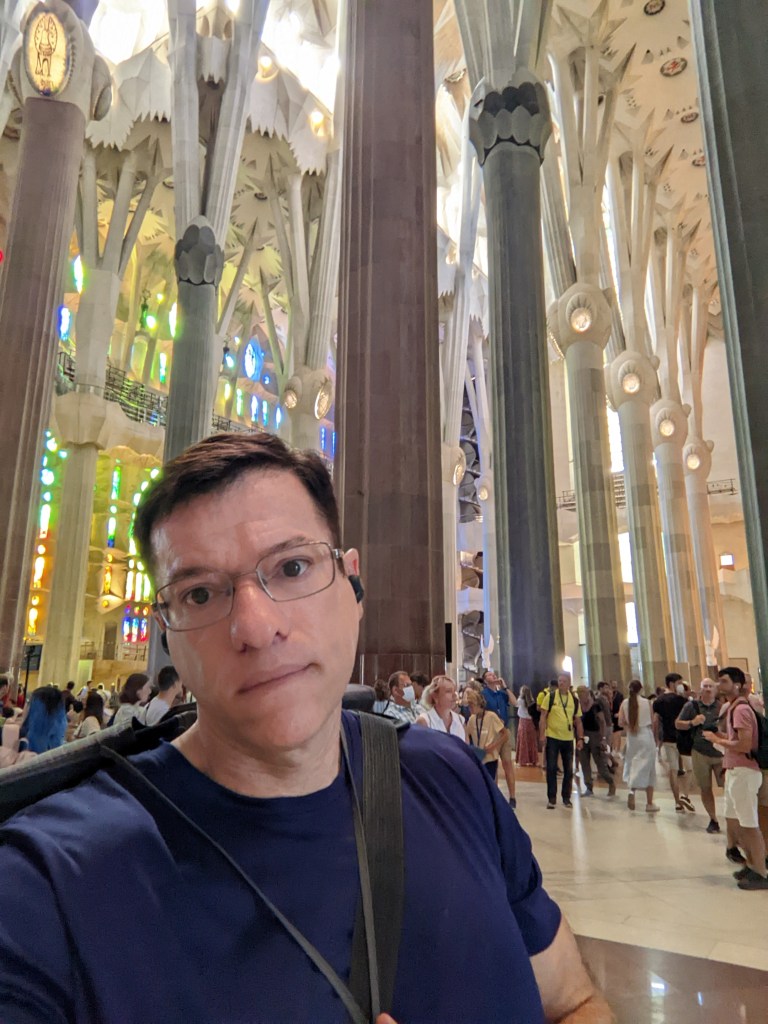
I paid a lot to get in here, so I definitely needed a selfie as proof.

So, is it worth it? Well, that’s a hard one to answer. If you’ve already specifically made a trip to Barcelona, this is pretty much an obligatory place to visit, so if that’s the case, yes, it’s worth it. Also, especially the inside of the cathedral DOES look different from other Catholic churches you probably have visited before. It’s extremely modern looking, almost like an upper class shopping mall in Asia. Yes, there are all sorts of special details such as the way the pillars are arranged, and the meaning of absolutely every single object in the whole place. However, would you notice the huge majority of these things if you weren’t directly told? No, you wouldn’t. I didn’t take that many pictures since this is probably the most photographically documented cathedral in the whole world. Still, there were a few things I found interesting.
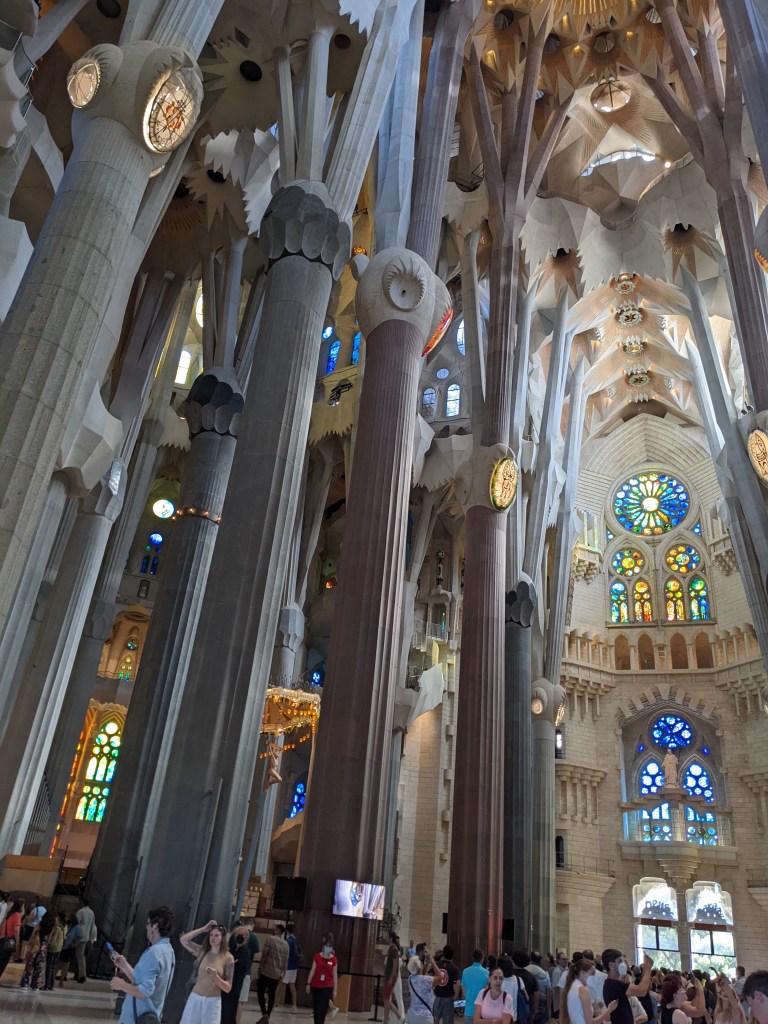
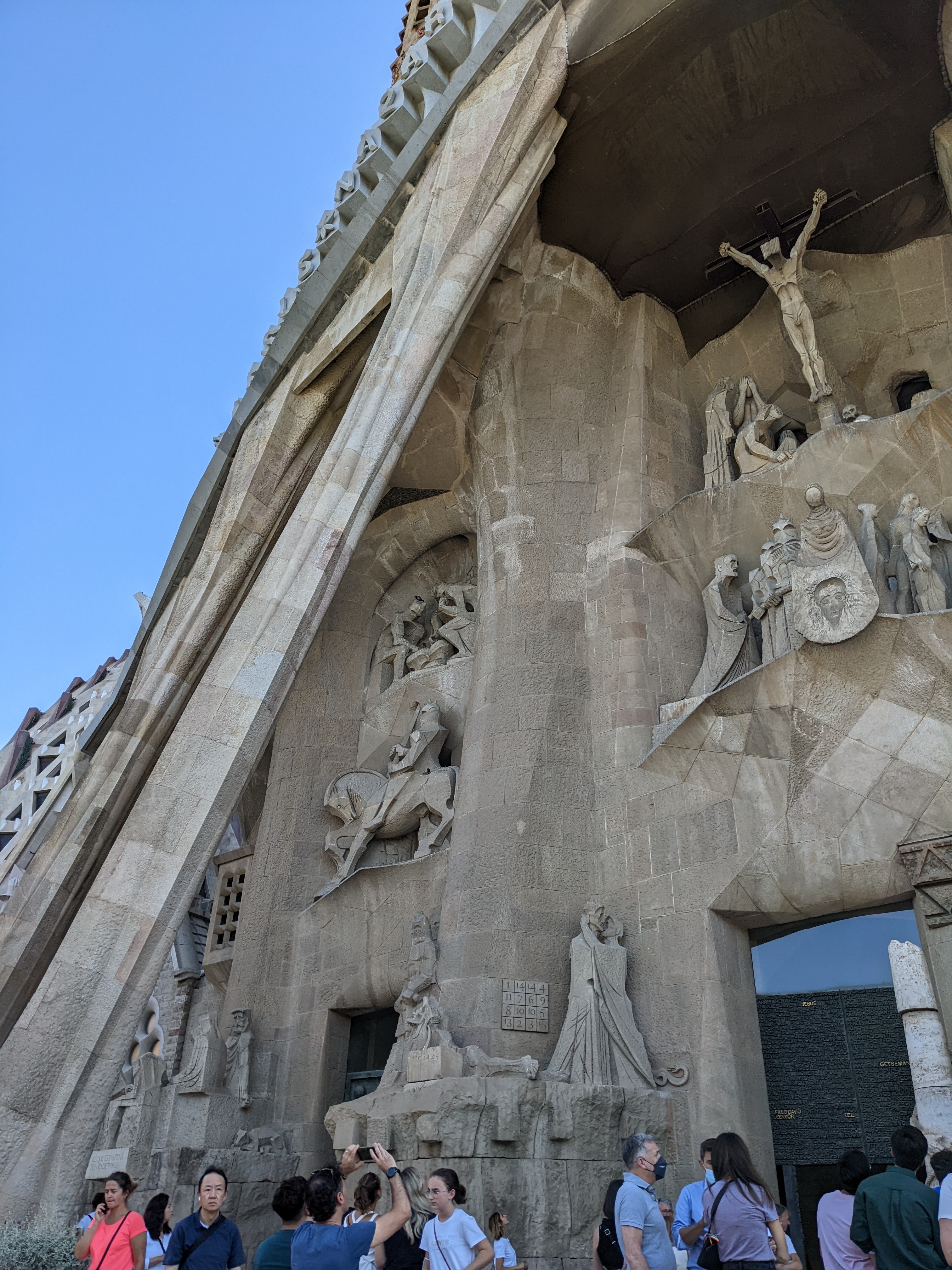
For me, probably the most impressive thing about the church is how they handled the pillars. There is some interesting physics involved for those who care to investigate.
View of the main facade. I forgot the name, but you can easily find it anywhere you read about the church.
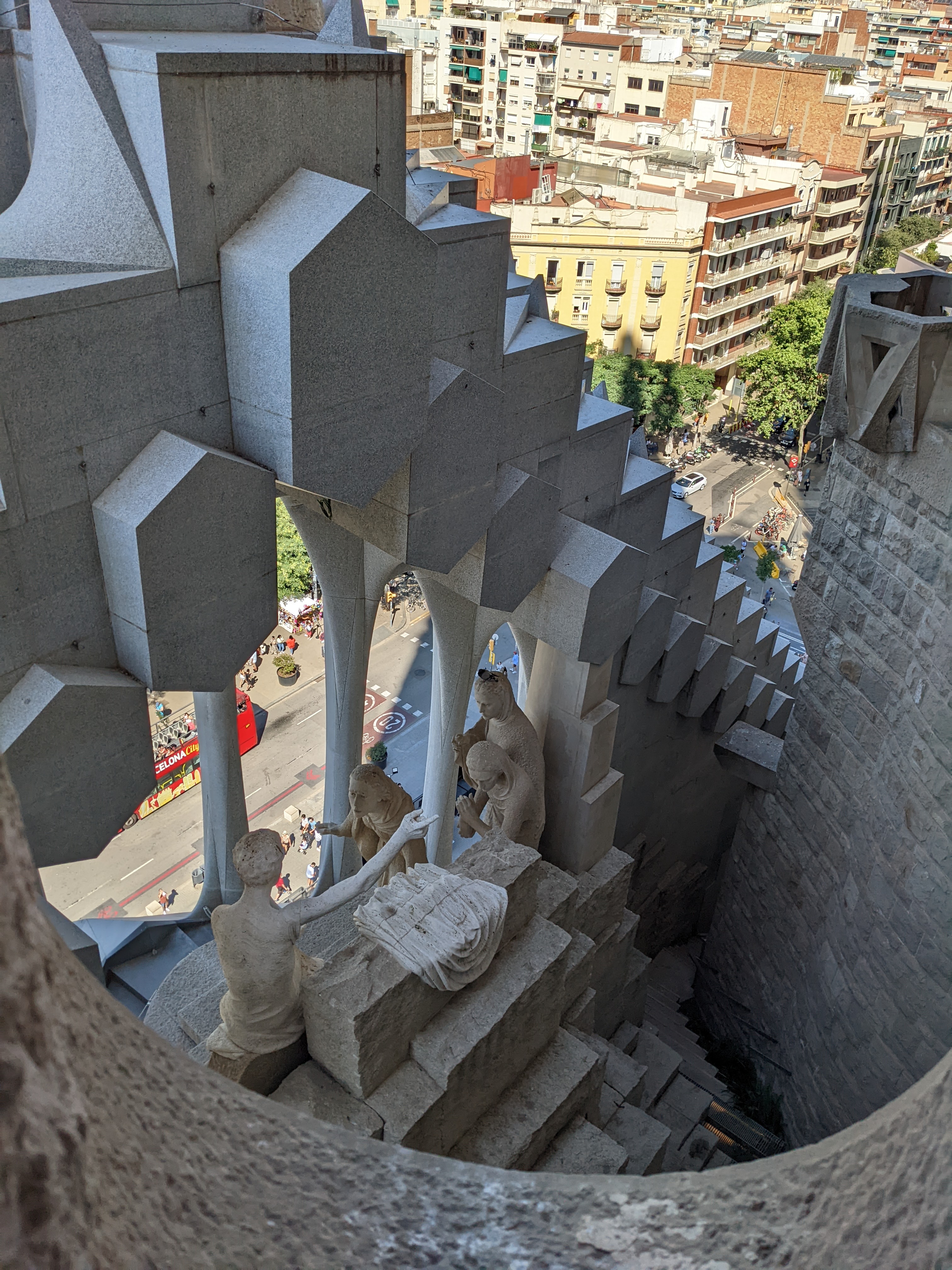
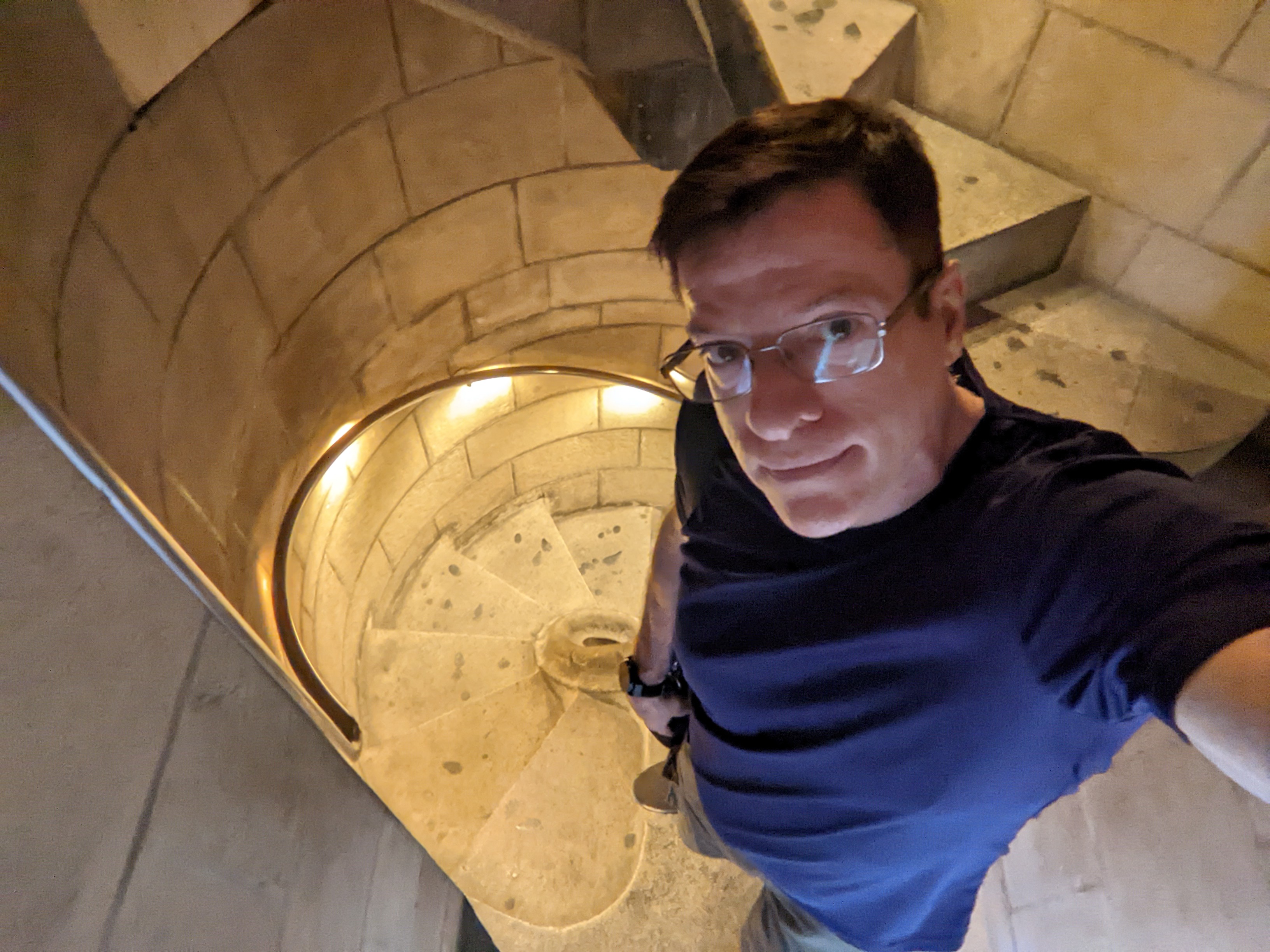
If you go up in one of the towers, an elevator takes you up, but you have to walk down. Chunky monkeys be warned, the passage can be very narrow. I imagine even some claustrophobic people would be unhappy with the tight spaces. Here was actually a very wide spot on the stairs.

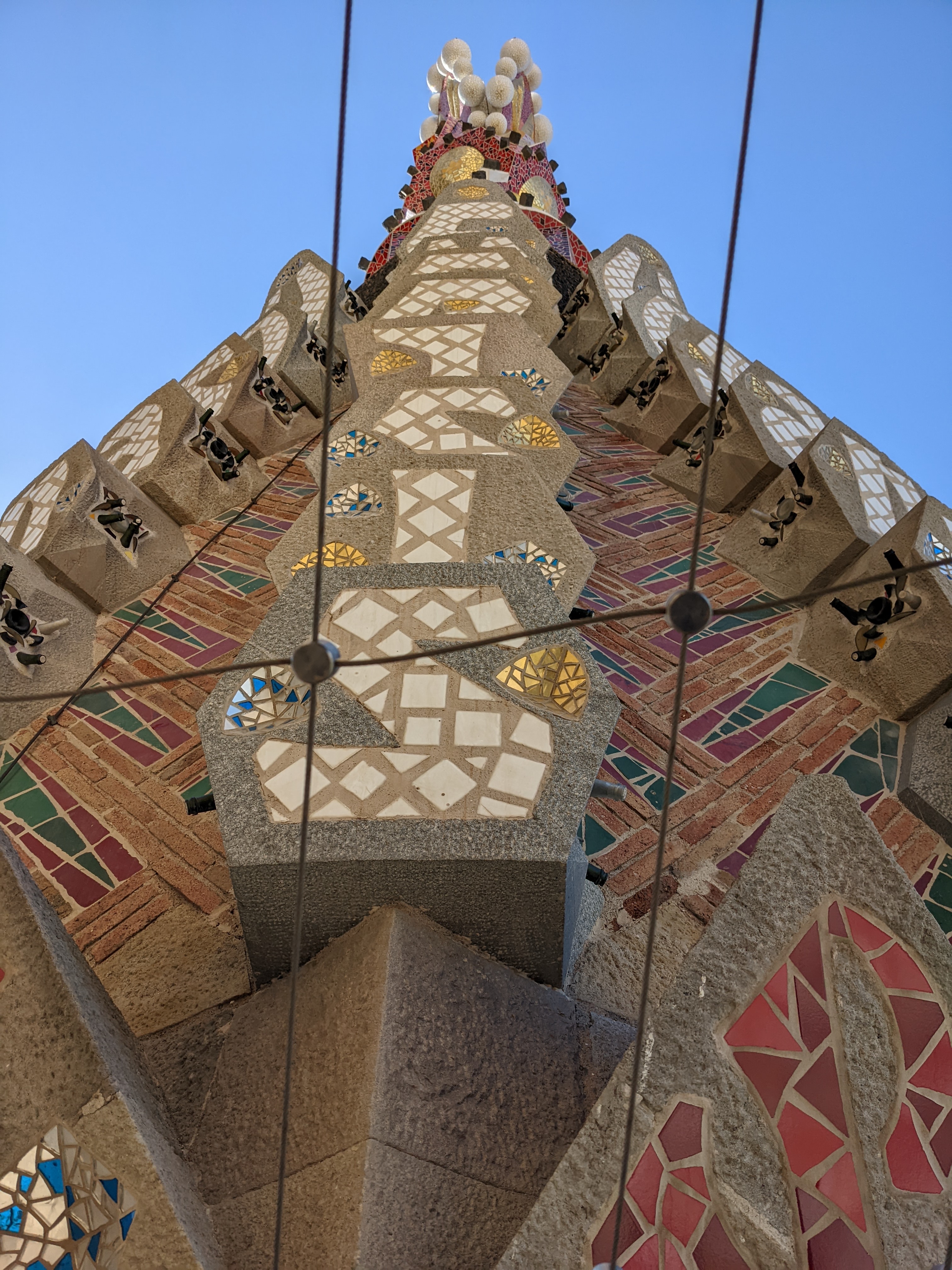
I tried to drag it out, but the whole visit took about 90 minutes. While natives of the city will probably take issue, I found the whole thing to be a bit overrated. The outside of the church is far more remarkable than the inside, so if money is tight, you will do just fine walking by and admiring it from the outside. To be certain, you could probably spend a few hours carefully examining all of the external features, but you might need a good pair of binoculars since a sort of wall keeps the unpaid casual visitor from getting too close to some of the details. Still, if you have the money, you may as well go inside, since everyone will ask you about it later on.
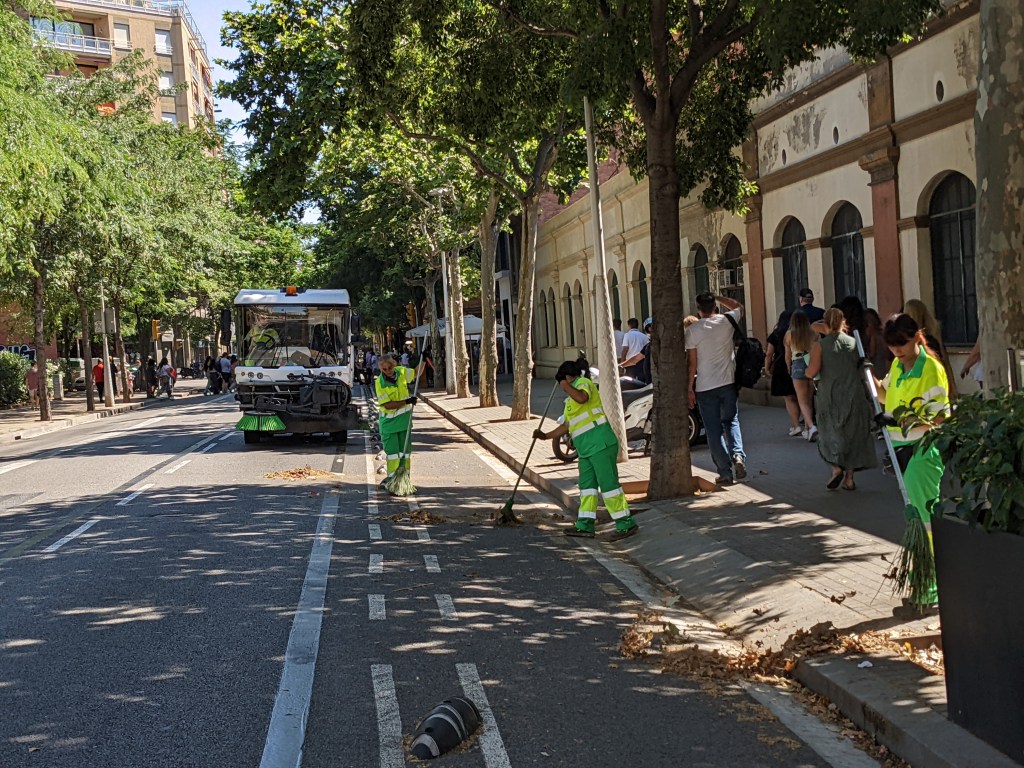
Hard working street sweepers keep things tidy throughout the city. Like in Bengaluru, almost all seem to be women

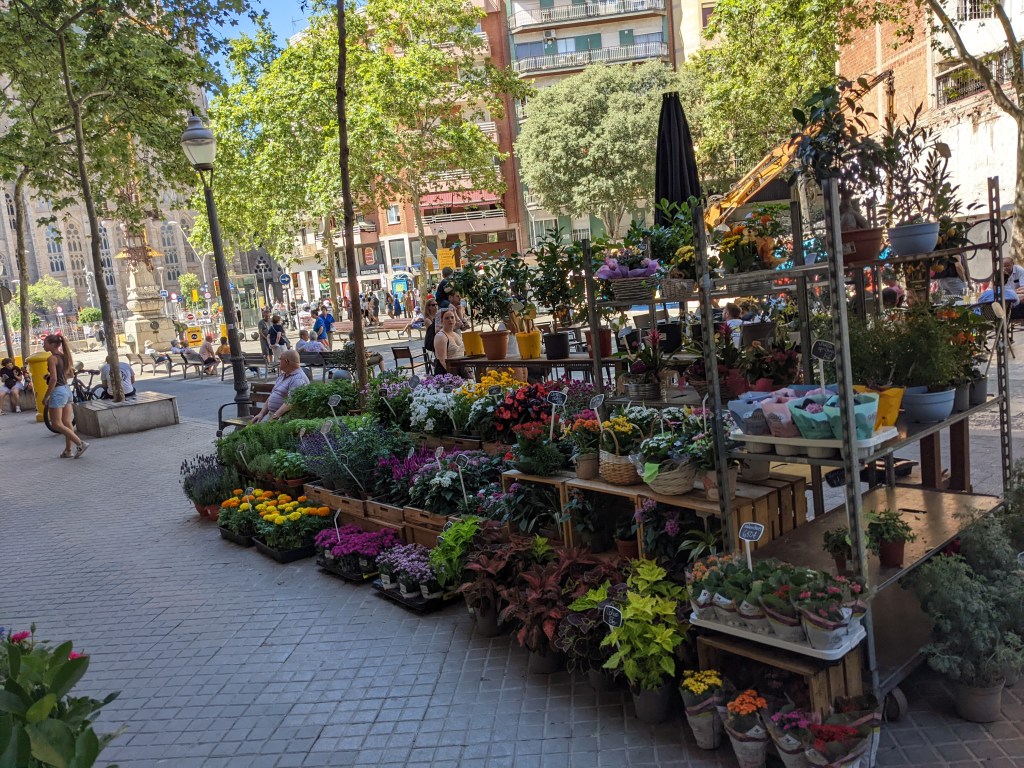
My other big plan for the day was Parque Güell, but I had read that it’s best to visit in the late afternoon. So, I needed to still fill up the rest of the day. With my trusty 72 hour metro pass (worth every penny!) I was ready to go. I first explored a bit around the general area of the church, just looking at the normal sites/life of the city.
After wandering around for a bit, I decided to visit the aquarium. At this point, I don’t remember if I had to use the metro again or not, (it really is that simple to use that you quickly don’t even notice) I decided that a visit to the aquarium would be a good idea.
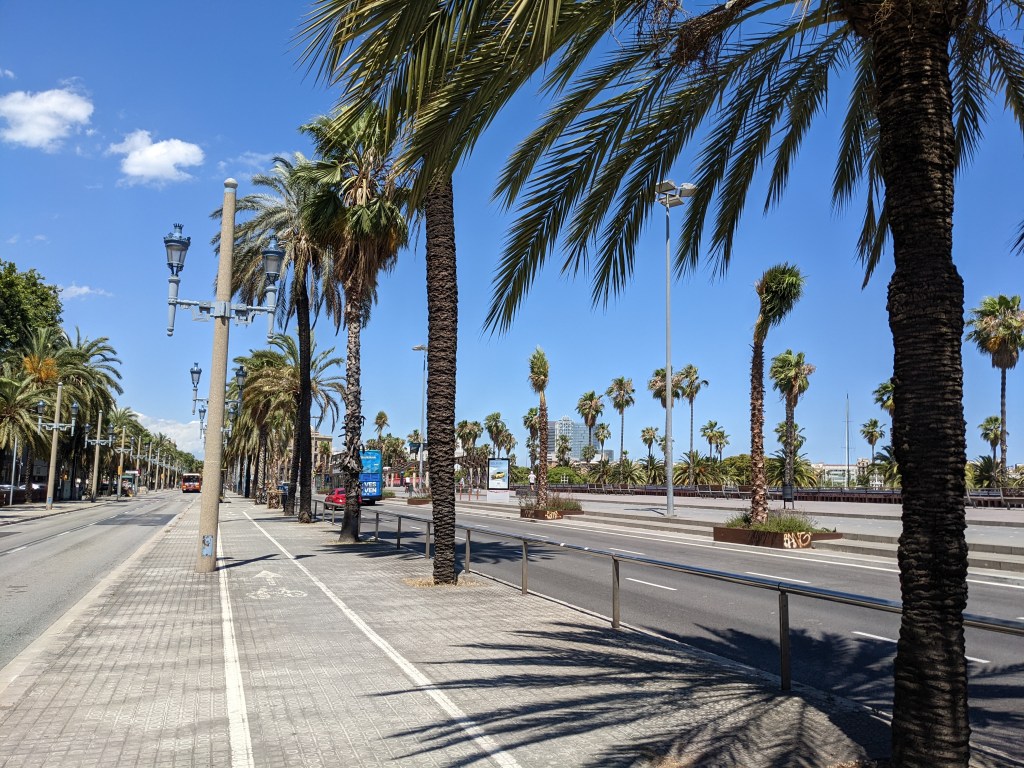
There was a bit of walking involved to get to the entry, but I found the temperature to be fine, and all around there were interesting things to see. Entrance to the aquarium itself is 24 euros for those who are 11 or older, 17 euros for children ages 5-10, and finally 10 euros for those ages 3-4. I assume entrance for infants and toddlers is free. If you want to skip the line, it’s easy to buy tickets online. I thought that this was a bit expensive, especially for those with families, but maybe they have special deals for locals.
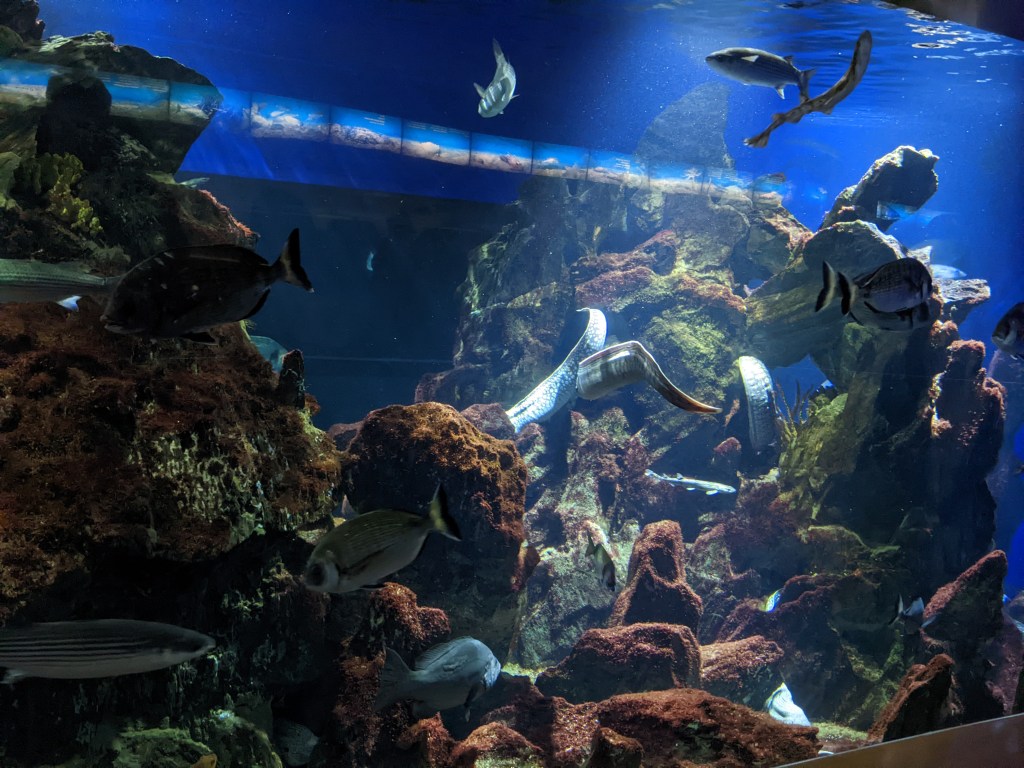
A slowly moving sidewalk ensures that people keep pace through the tunnel, but it’s slow enough to still allow one to appreciate the views.
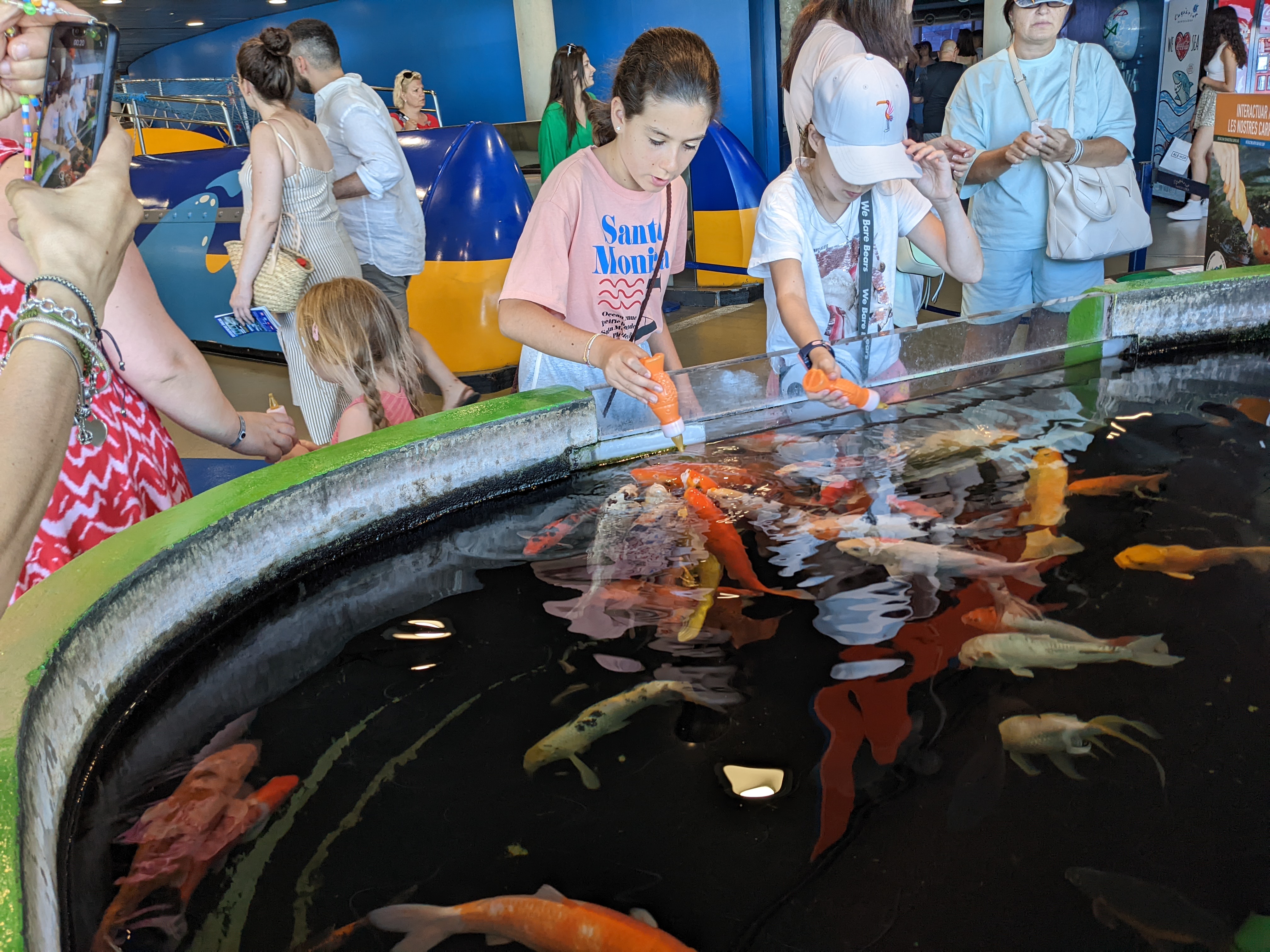
Kids were feeding the Koi with a special mixture in a small bottle
It was penguin feeding time, so it was easy to see the birds in action.
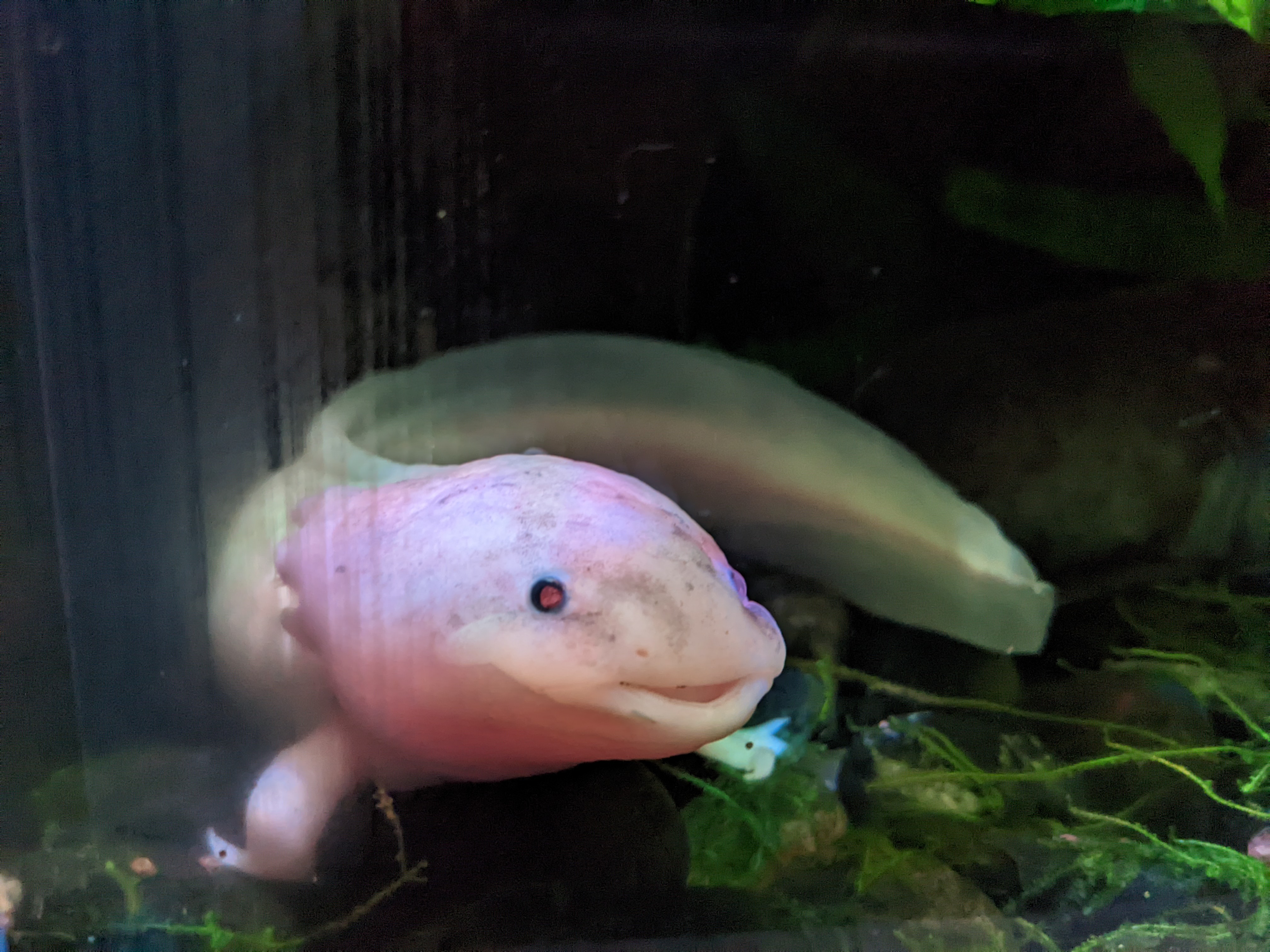
An adorable salamander which is native to Mexico

So while the aquarium was nice enough, I really can’t recommend it unless you either are trying to kill time or of course if you have plenty of money and younger children who would really be into the experience. Even really dragging things out, you would be hard pressed to spend two hours here. It’s fine, but not amazing.

If you are looking for an amazing aquarium in Spain, you would do much better to visit Oceanographic in Valencia. That one costs 32 euros for an adult and DEFINITELY is worth it. In fact, you might even be able to justify an entire two day trip to Valencia solely on visiting the aquarium there. Still, the aquarium in Barcelona was pleasant enough, but just a bit too expensive. In particular, I wish they had better deals for kids and younger teenagers, as they are the ones who are more likely to appreciate a place like this. For instance I was thinking of my brother’s family; the kids would love the aquarium in Barcelona, but paying entry for six kids and at least two adults would quickly become prohibitive. Again though, if you have extra money and don’t mind a quick aquarium trip, go ahead and head out to the Barcelona aquarium.

Since things had gone so quickly at the aquarium, I realized that I would still have time to get to Parque Güell for a late afternoon visit, even though it was already 5:15 PM. The ticket aggregators showed that there were no longer spaces available today, but by going directly to the Parque Güell website, I was still able to get a ticket for 7:00 PM. The cost was 10 euros. As is probably obvious, this is another place that you need to buy advance tickets online; otherwise, you are probably going to be turned away when you get to the entrance. Using my metro pass, there was still plenty of time to arrive, so I made a leisurely voyage in that direction.


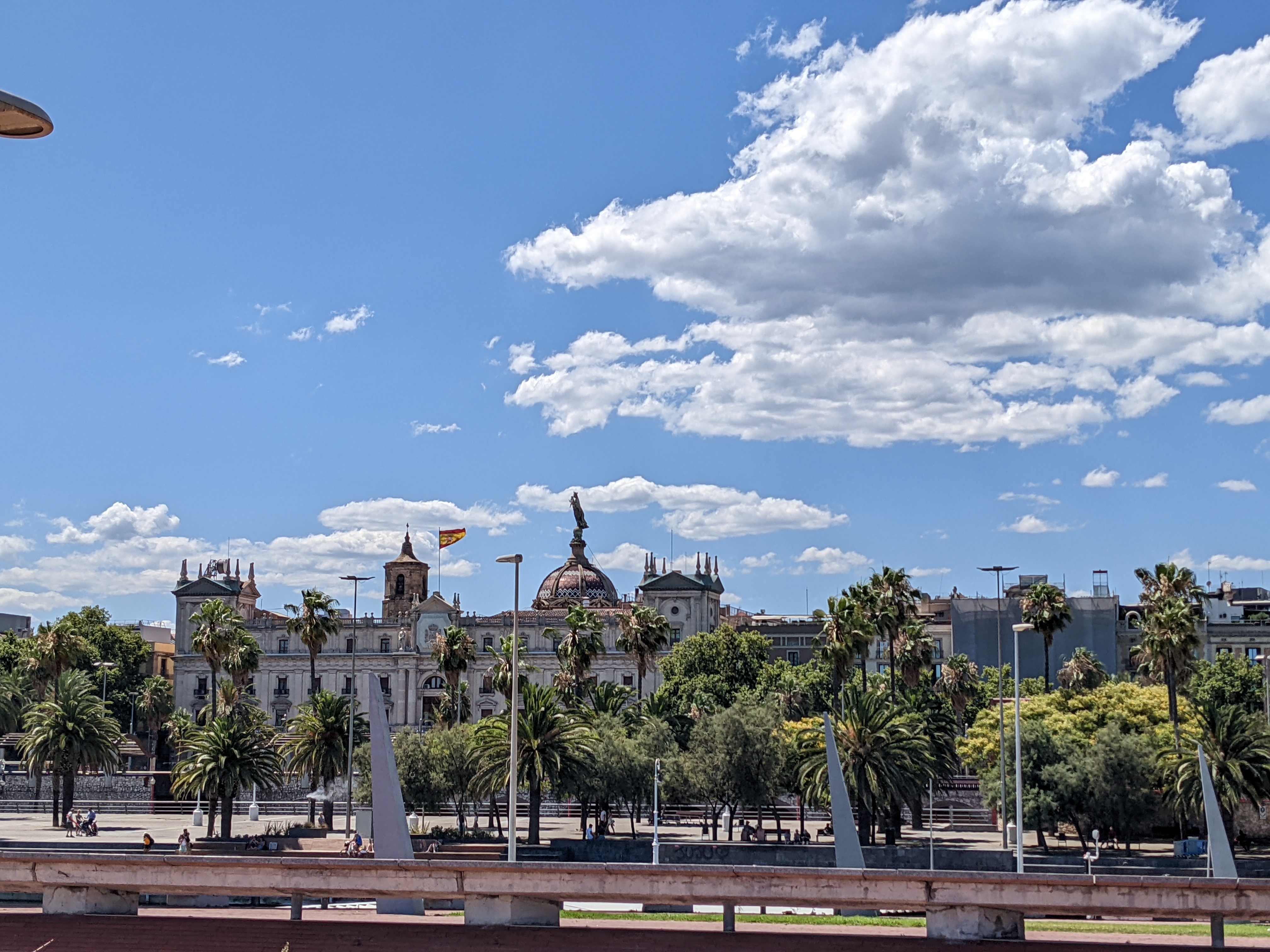
The aquarium is right next to a harbor, so there are plenty of nice boat views
Another selfie, but this one is completely different because there are boats in the background!
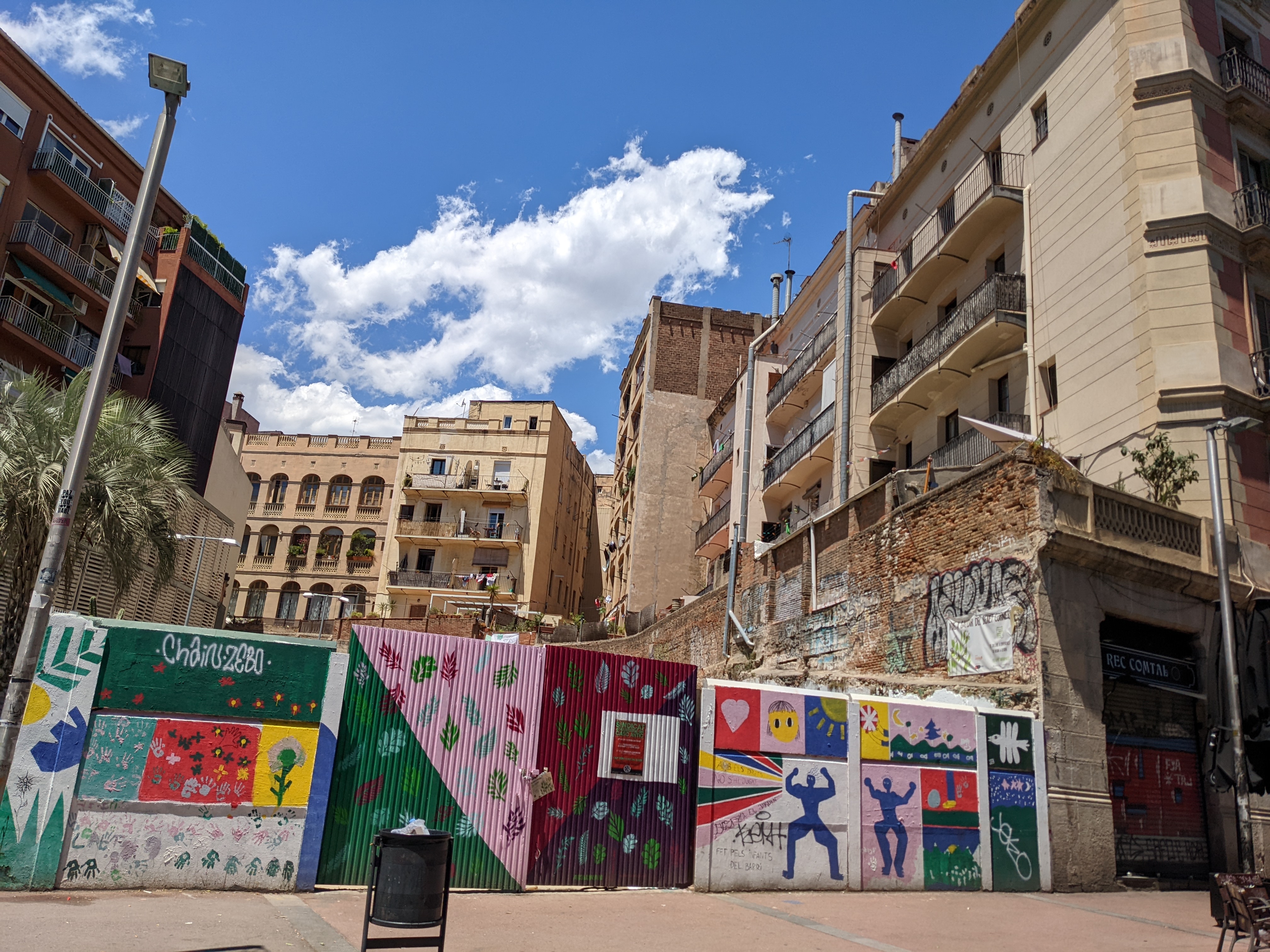
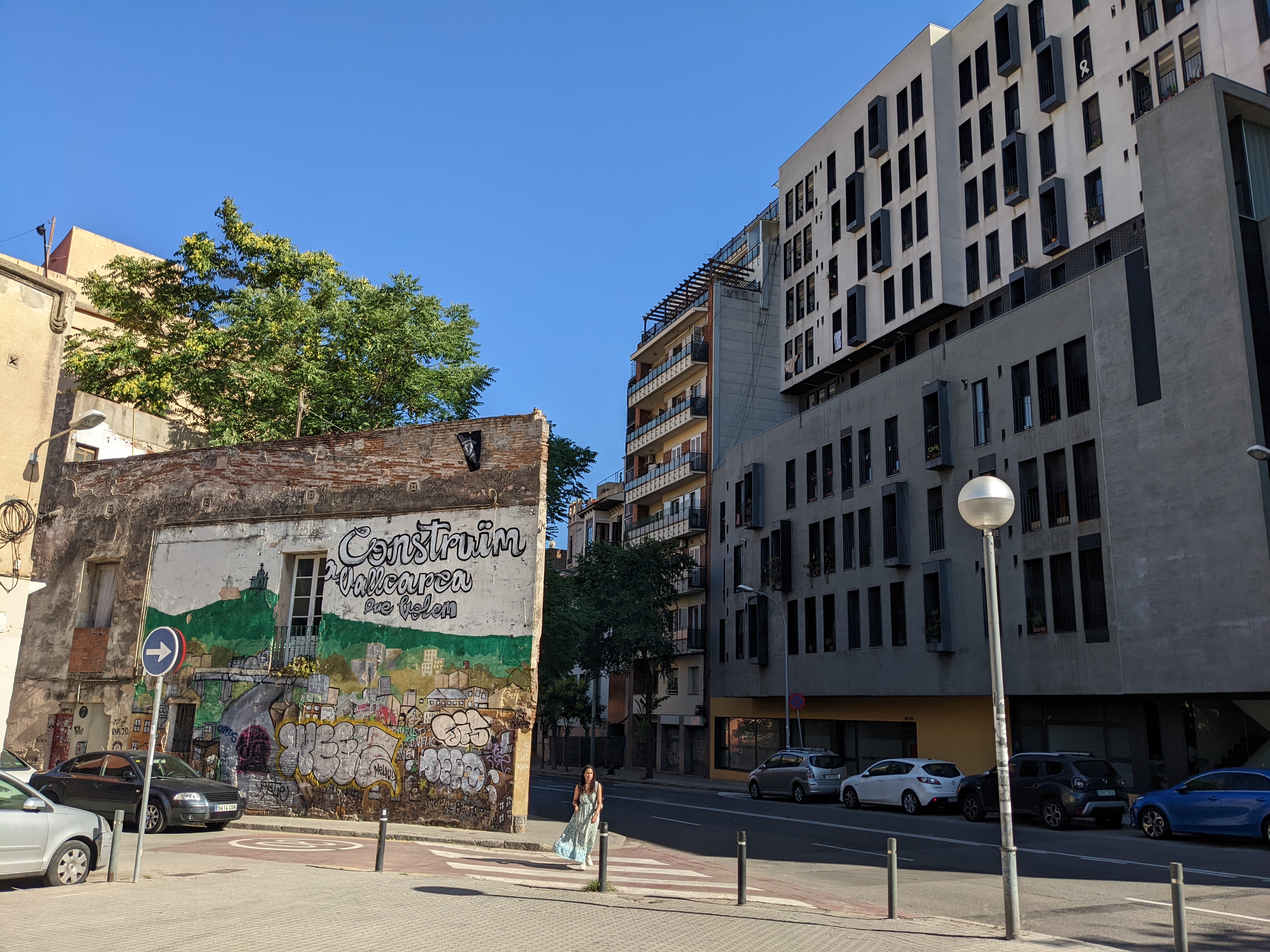
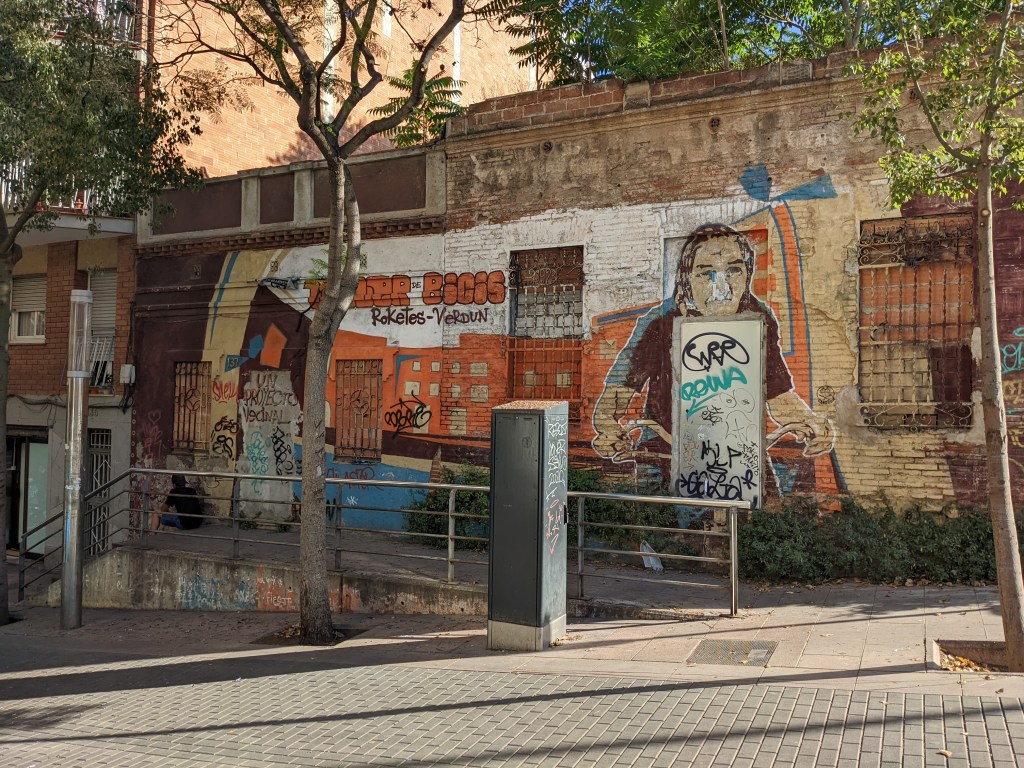
Some street art near the park
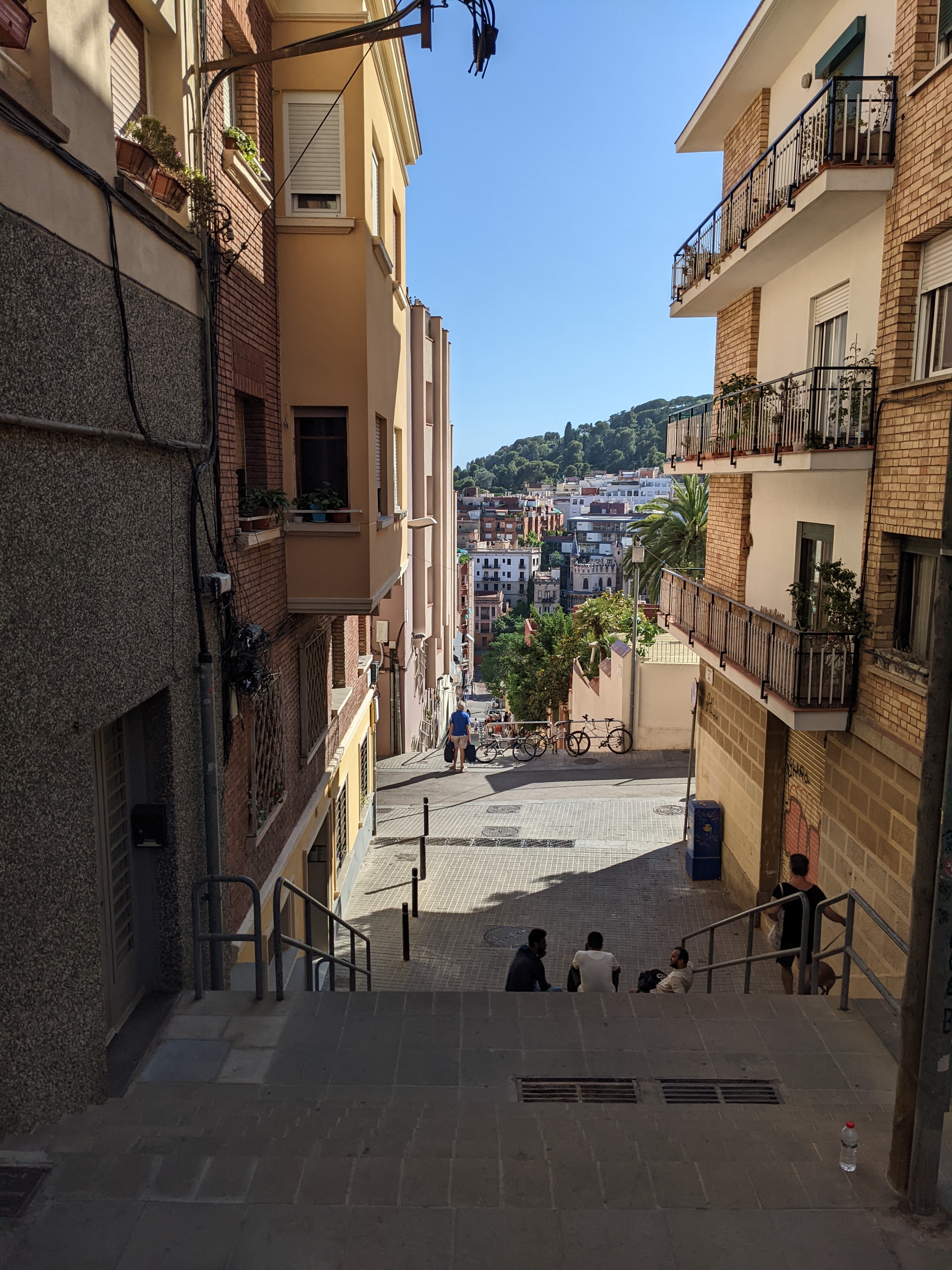
The picture doesn’t show it well, but the park is at the top of a rather steep hill; you really have to want to go there. Those with mobility issues would probably need to find another way up from the metro station. Also as I was going up, many disappointed people who had not bought their tickets online ahead of time were coming back down.
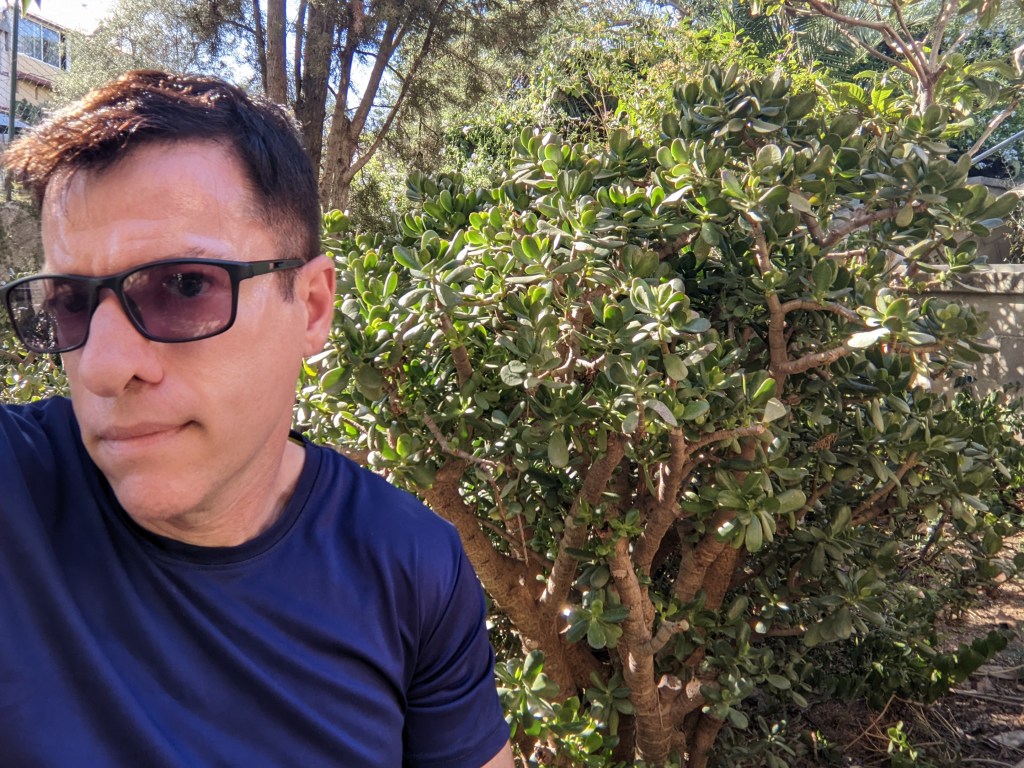
The tree shown is a Jade tree which was about two meters tall. I had no idea they could grow so large!

Using my electronic ticket, it was easy to gain entry. Even though I arrived about thirty minutes ahead of time, they let me in without any problem. I wasn’t sure what I had expected , but it wasn’t this. I guess I thought it was actually more of a plaza with different sculptures, but it’s actually a very well designed, proper nature park. There were plenty of moments of pure tranquility with an abundance of birdsong in the background, as well as the more famous sections you’ve seen in pictures.

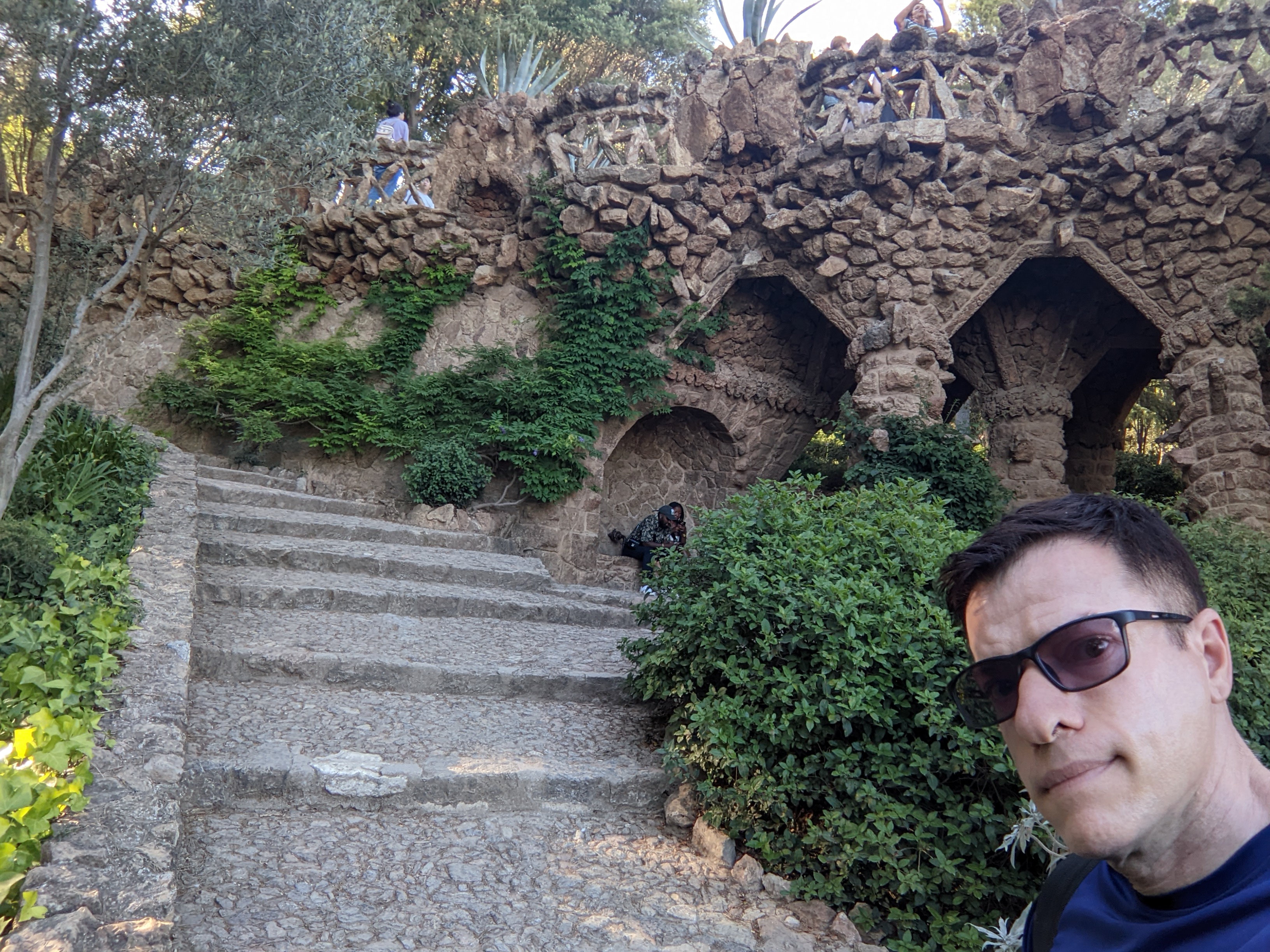
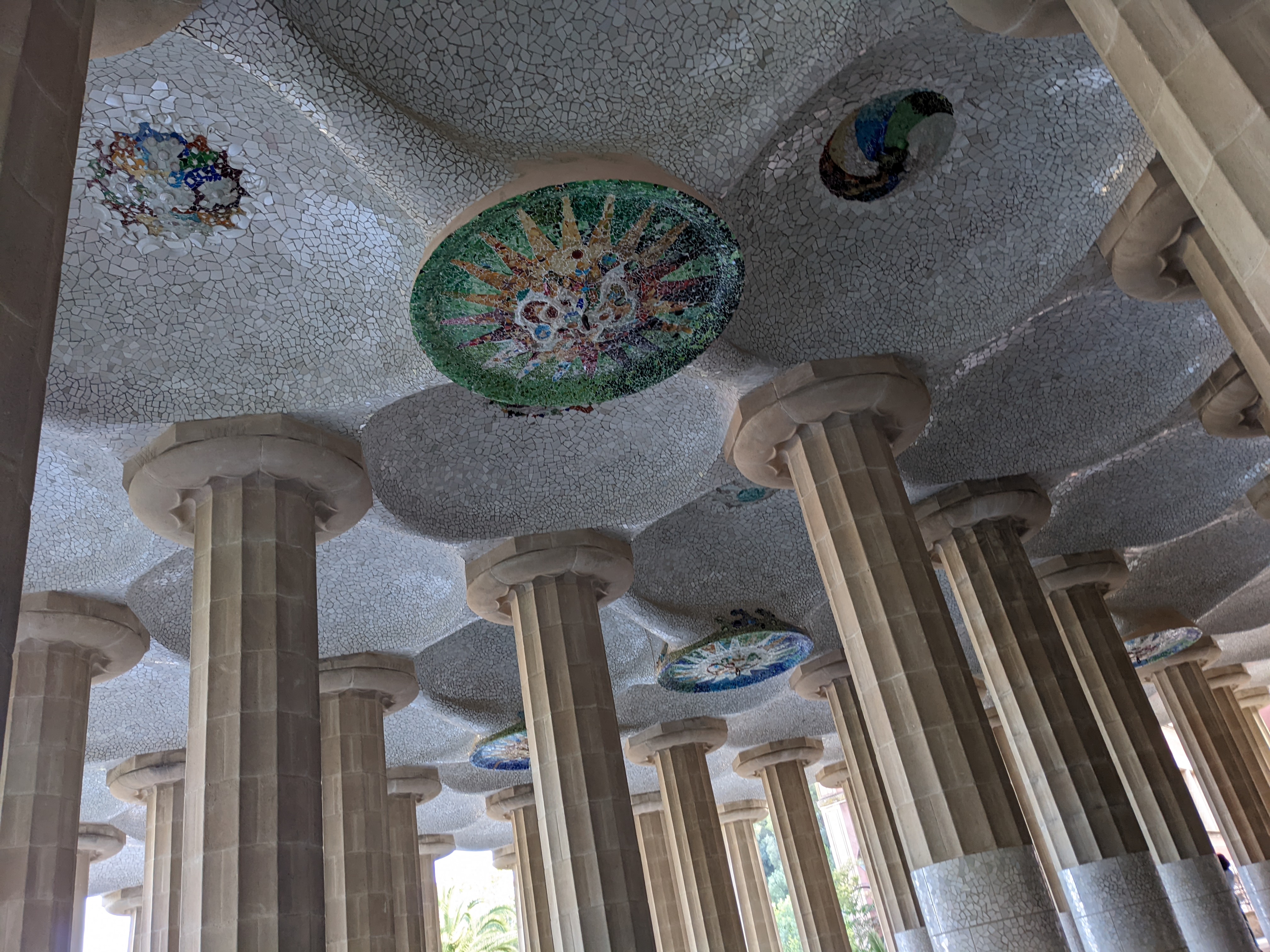
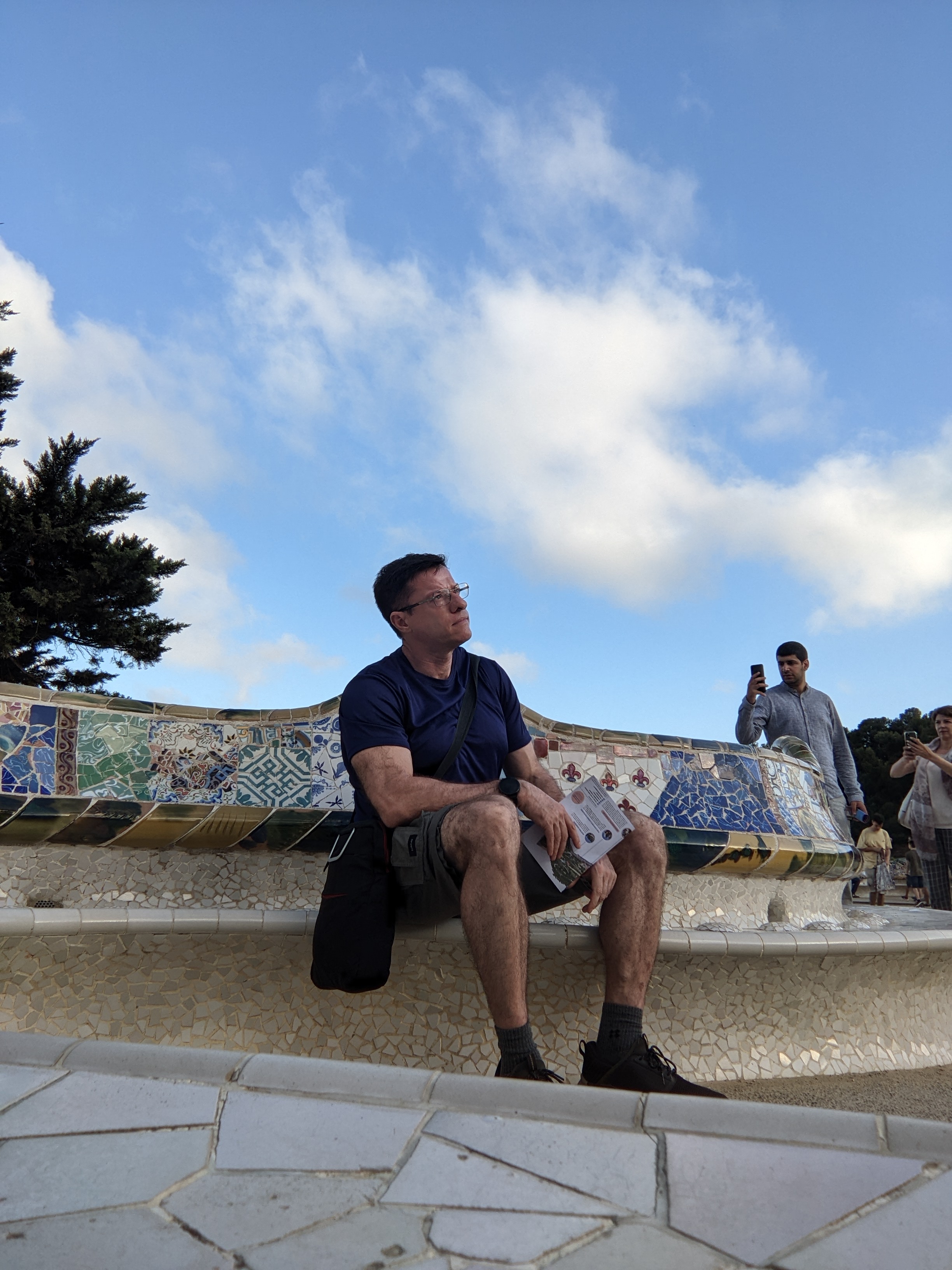
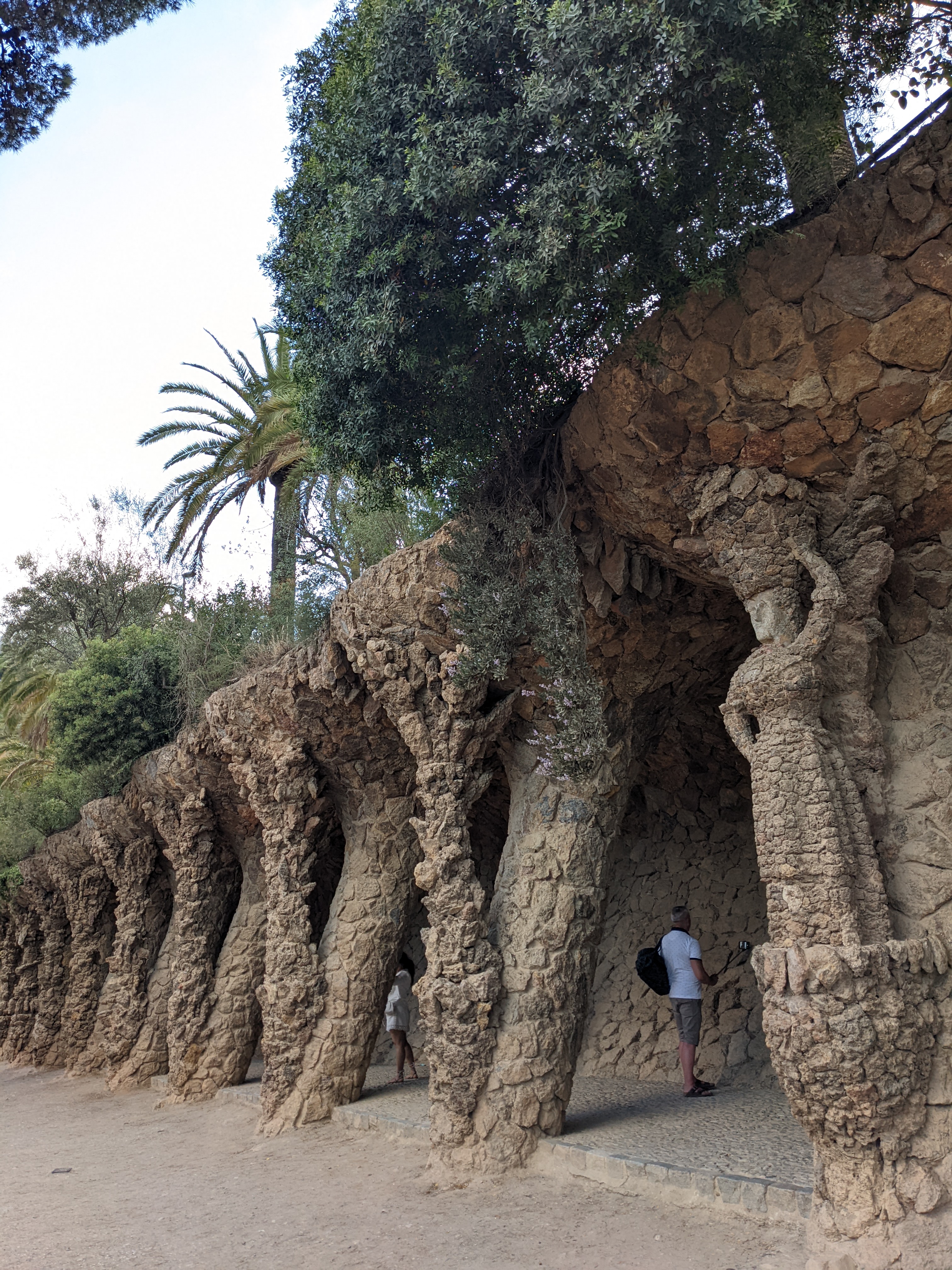
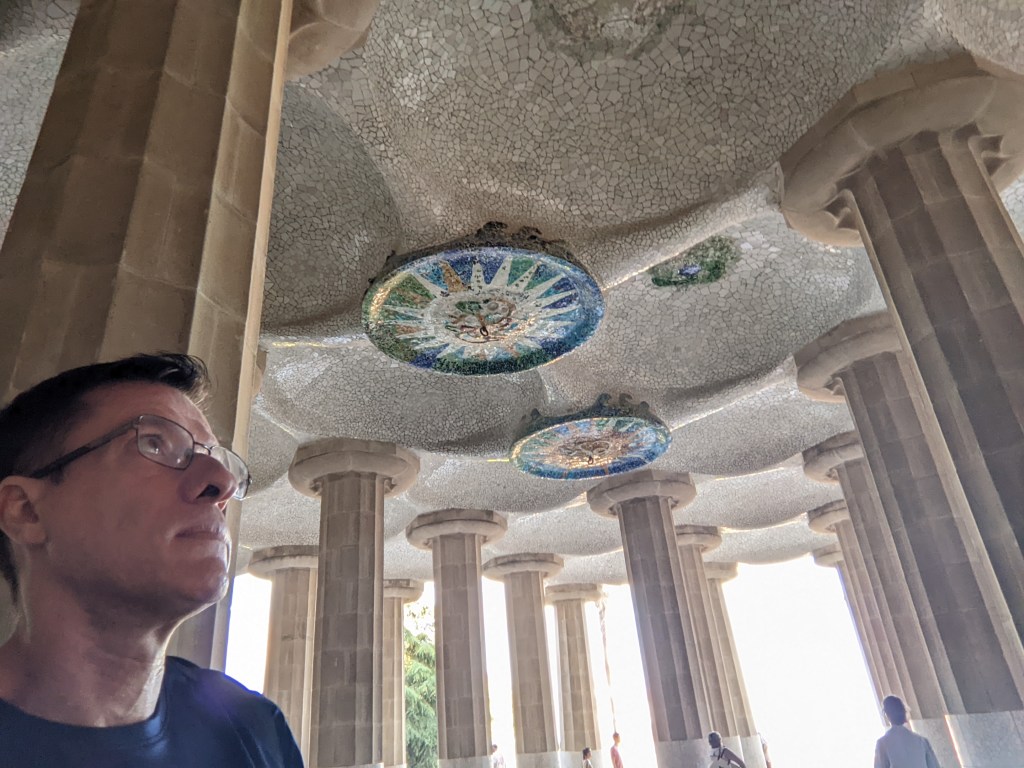
I actually spent about 30 minutes just sitting on a stone chair which was located up underneath these arches.
When I first came by, access to this area had been restricted due to excessive visitors, but a bit later it was wide open and again I could just sit for awhile and appreciate the park.
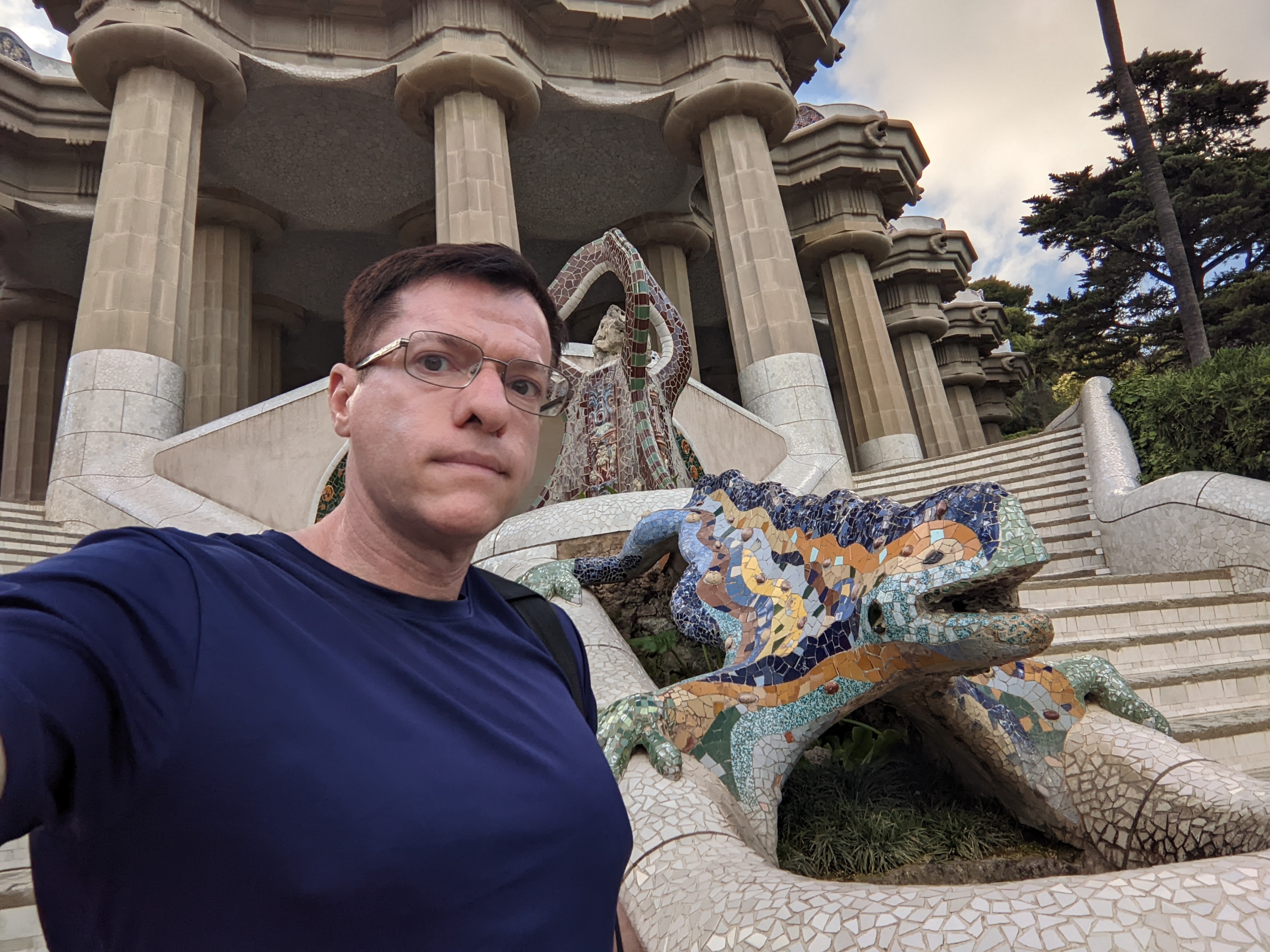
One of the more emblematic creations of the park
This could actually be easily viewed from outside.

So of the three “iconic” Barcelona sites I visited today, I would have to say that my favorite was the park. However, as it clearly was meant to be a regularly functioning park for the people of the city, I was once again a bit sad for the locals. I mean how annoying is it that you would have to pay 11 USD per person to visit your nice neighborhood park? Again though, maybe there is some special unpublished deal for local people which makes it more affordable to visit on a regular basis, just getting some nice relaxation time while they sit on a thoughtfully placed bench and chat with neighbours or read a book.

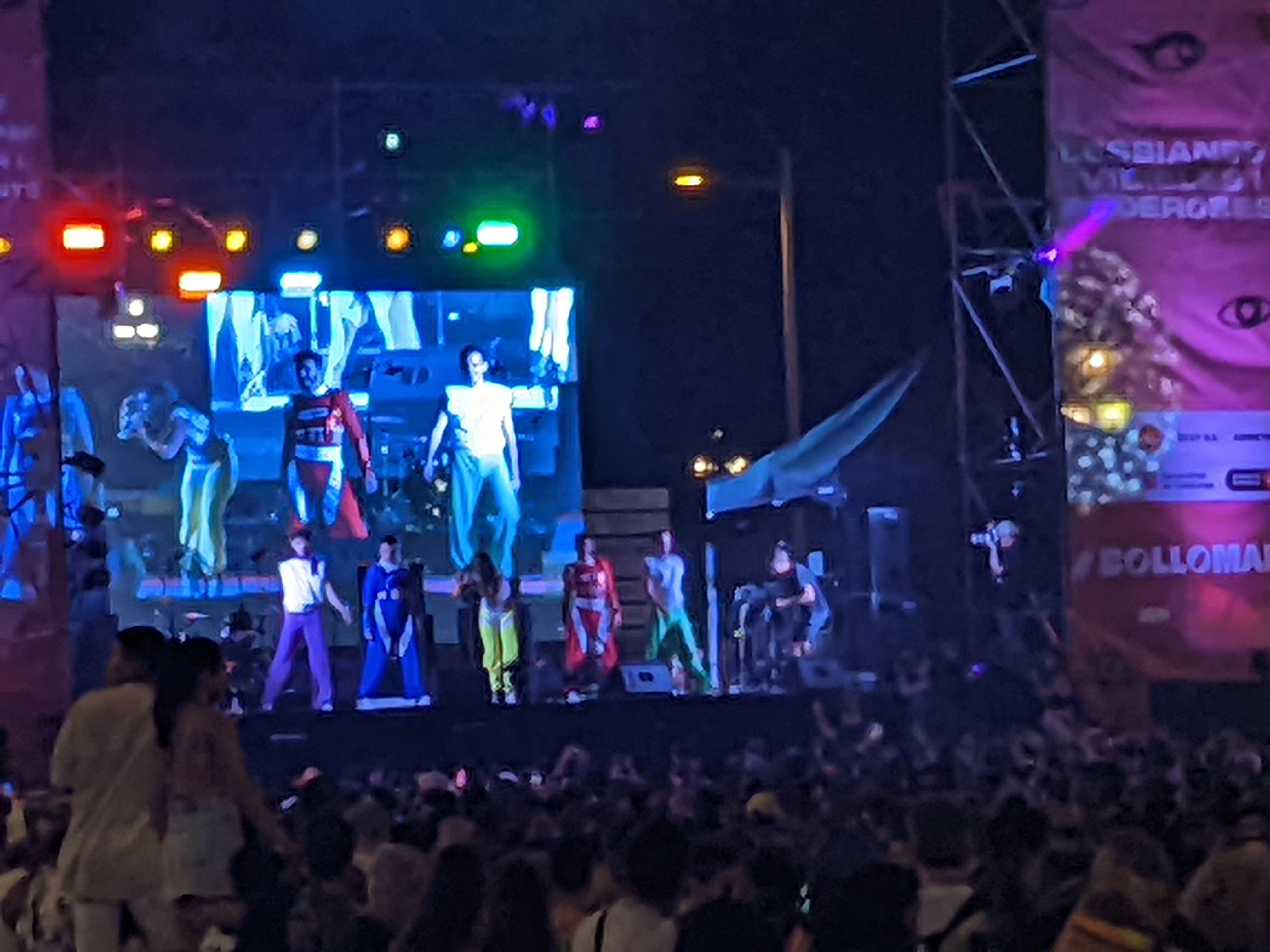
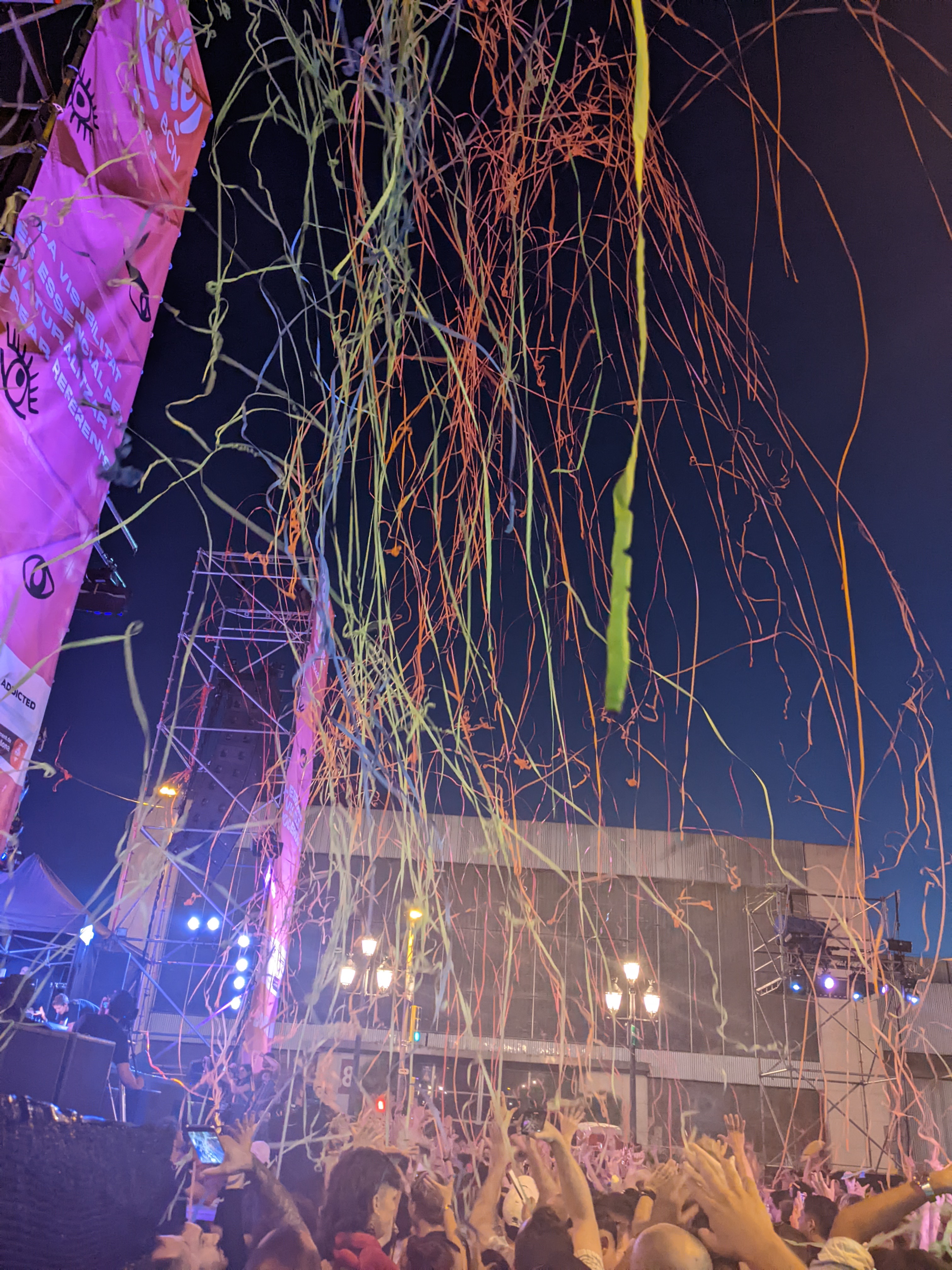
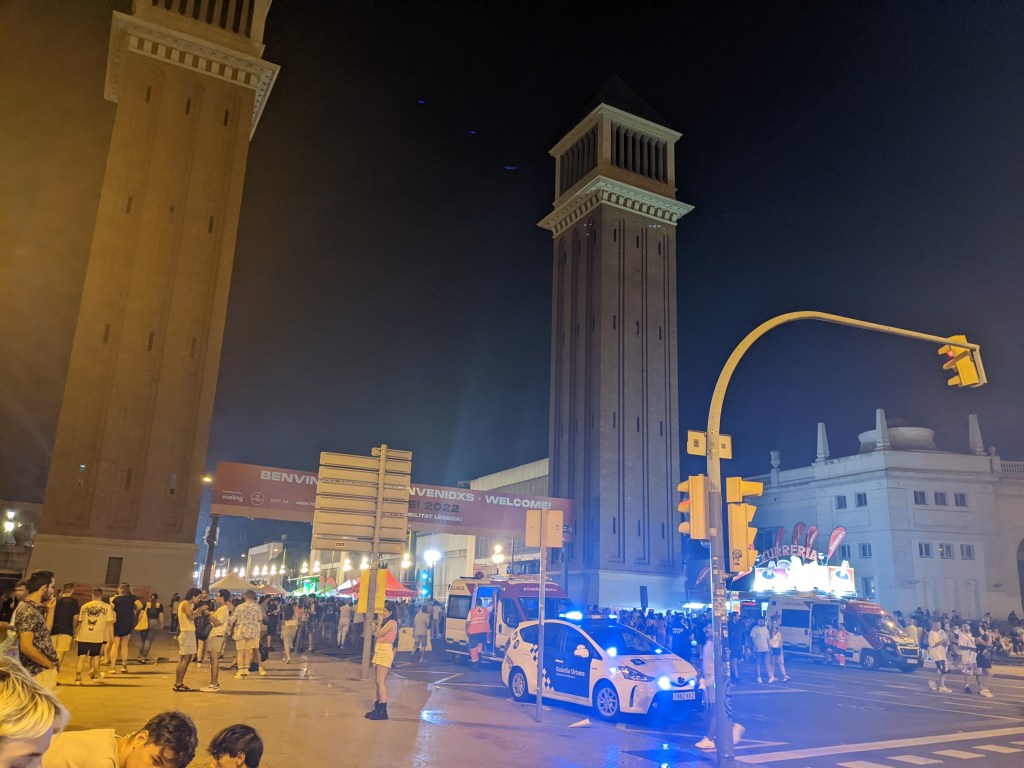
By now it was 9:00 PM, so I had to decide if I would head back to the apartment in Roquetes or do something more. I asked one of the locals if they could suggest anything, and they mentioned a free concert in Plaza España which would be going for most of the night, starting at around 10:00 PM. Evidently it’s fairly common for things like this to happen. Armed with my invaluable 72 hour metro pass, I headed that way.
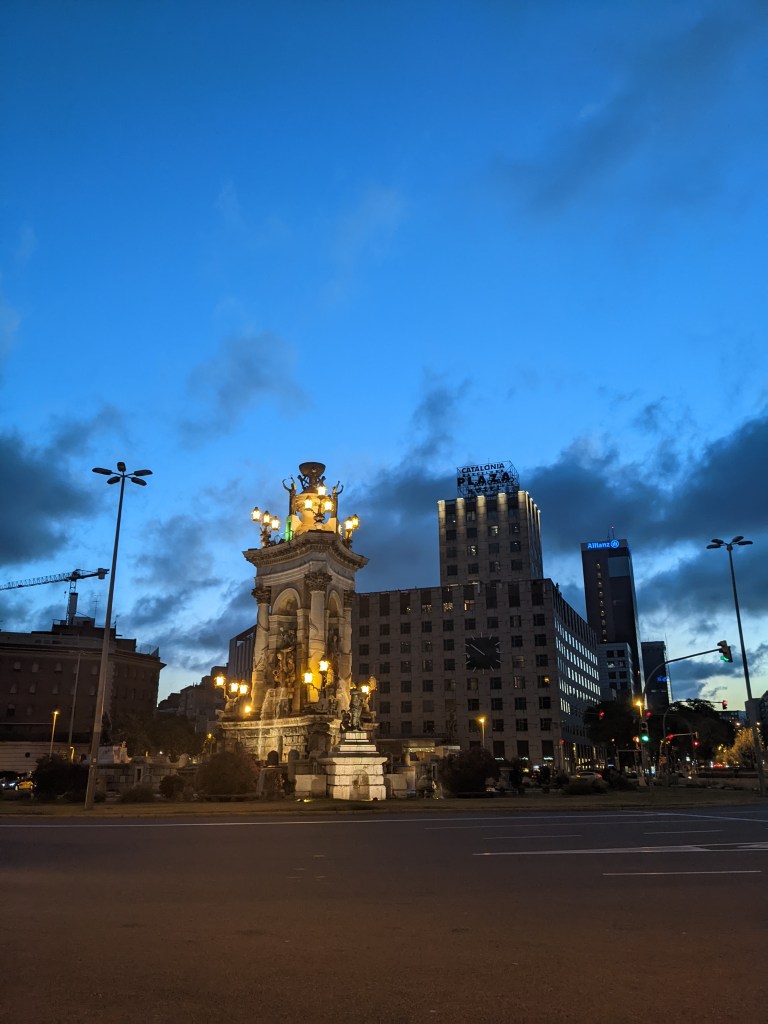
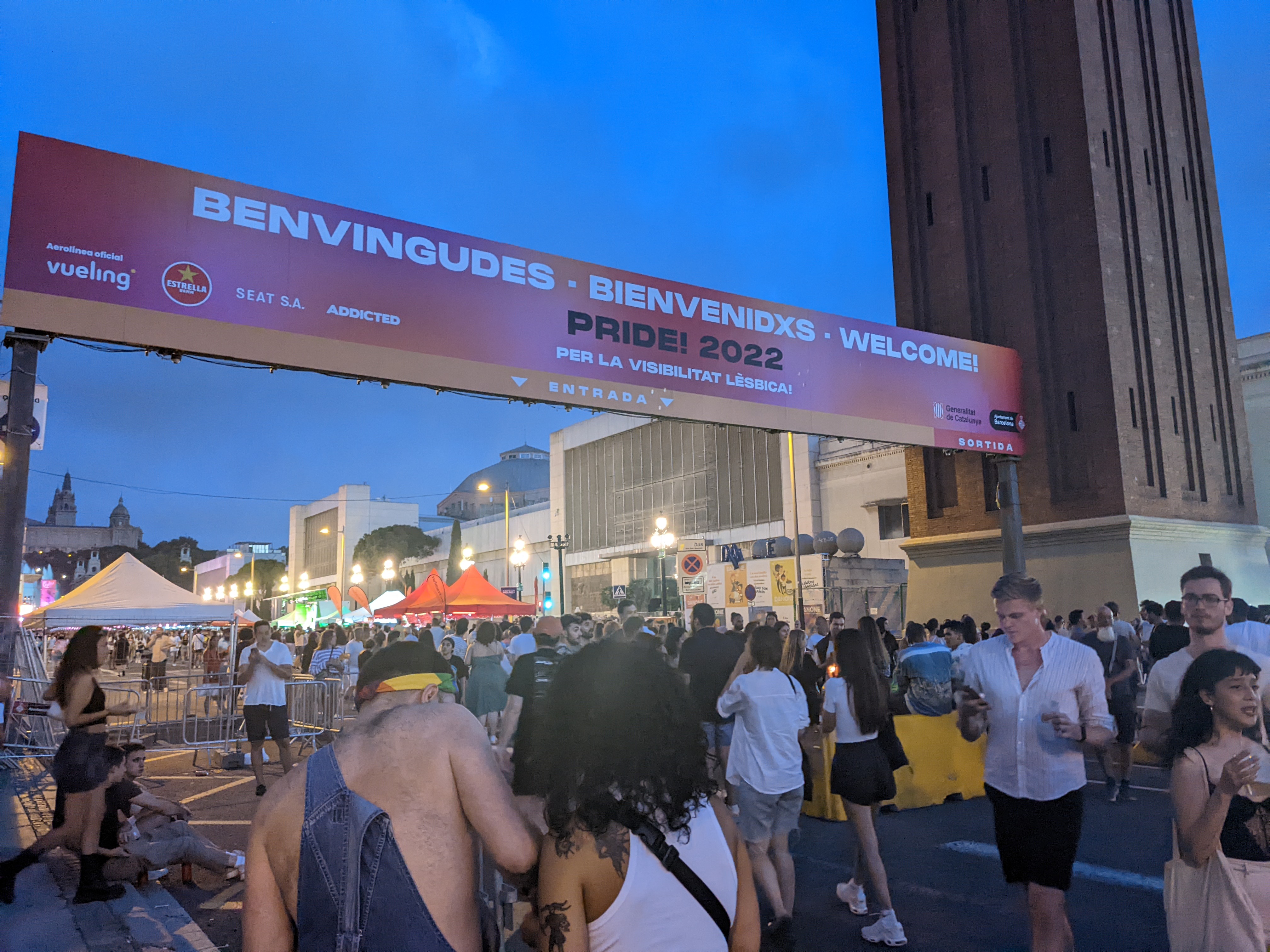
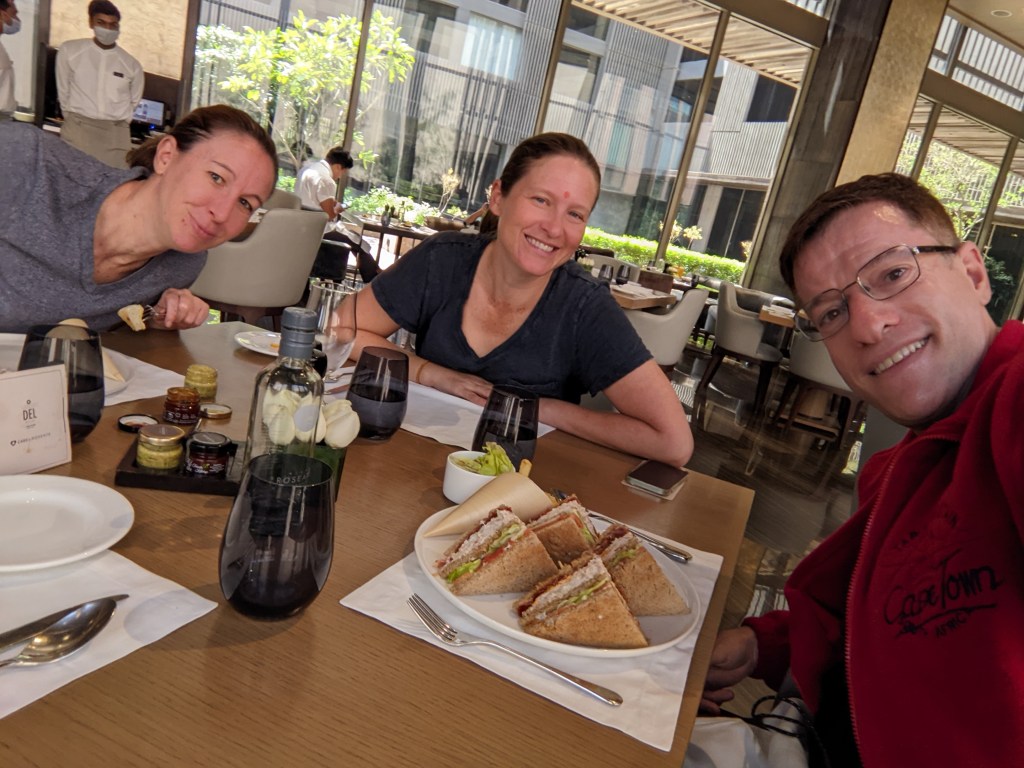
The concert went well into the night, but I was rather tired, so I left a bit after midnight. Even though I had eaten a sandwich at the concert venue, that was actually all I had eaten the whole day. Given that the Spanish tend to dine very late, I was hoping that there would be something open close to the apartment. Regardless, I understood that the trains would stop at 2 AM, and I wanted to get back safely before then. Worst case scenario, I figured I just wouldn’t eat anything else.
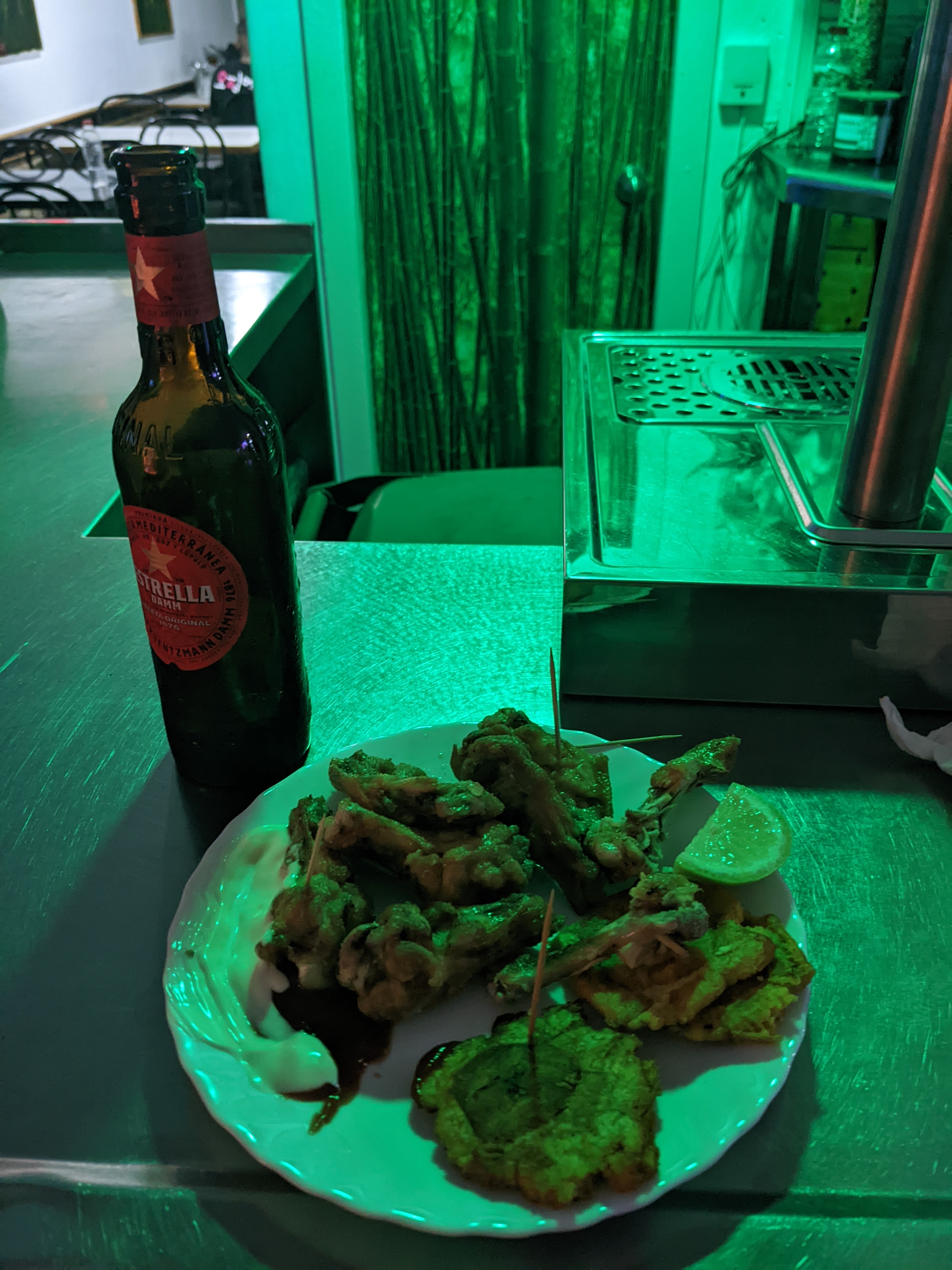
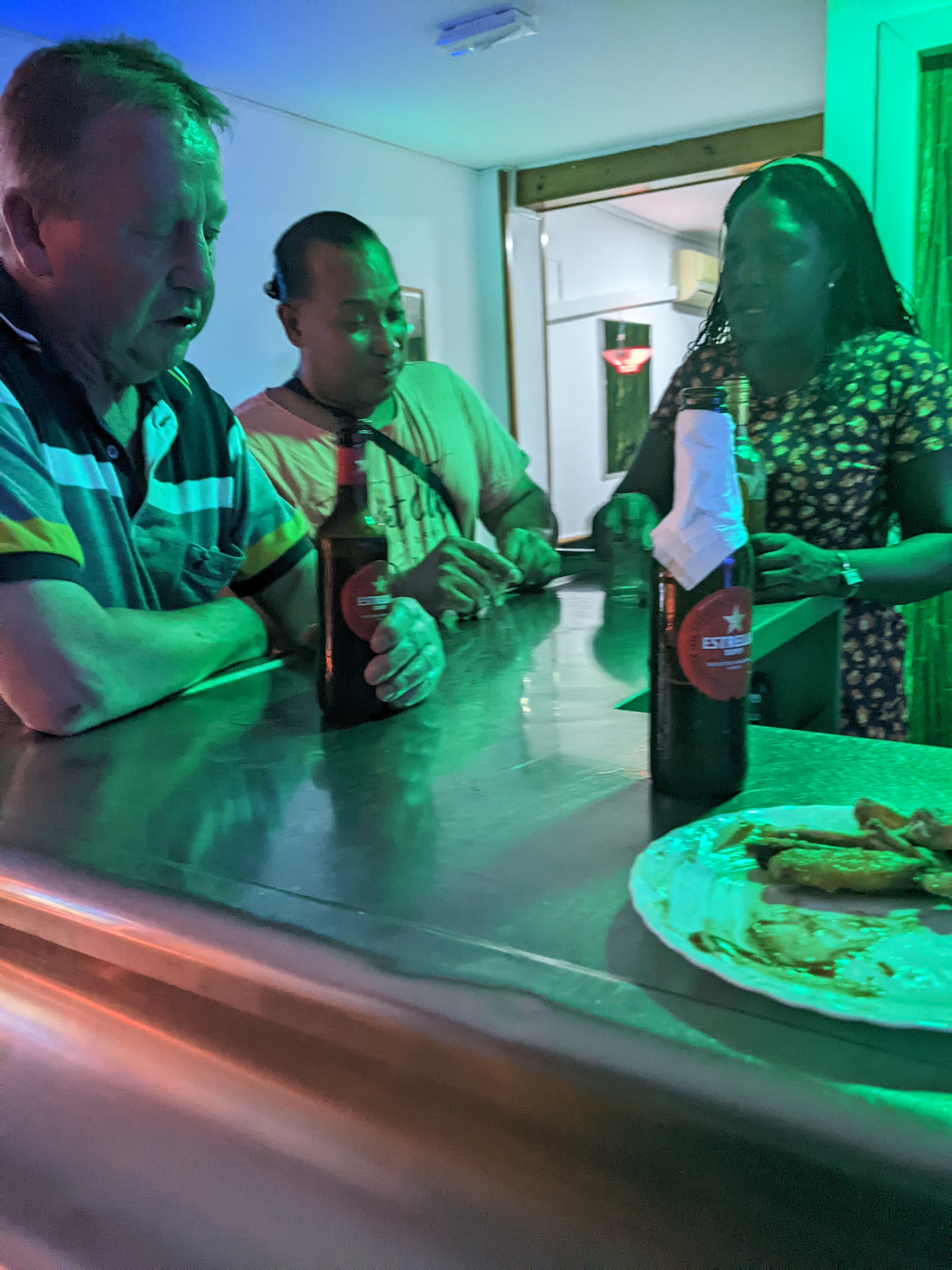
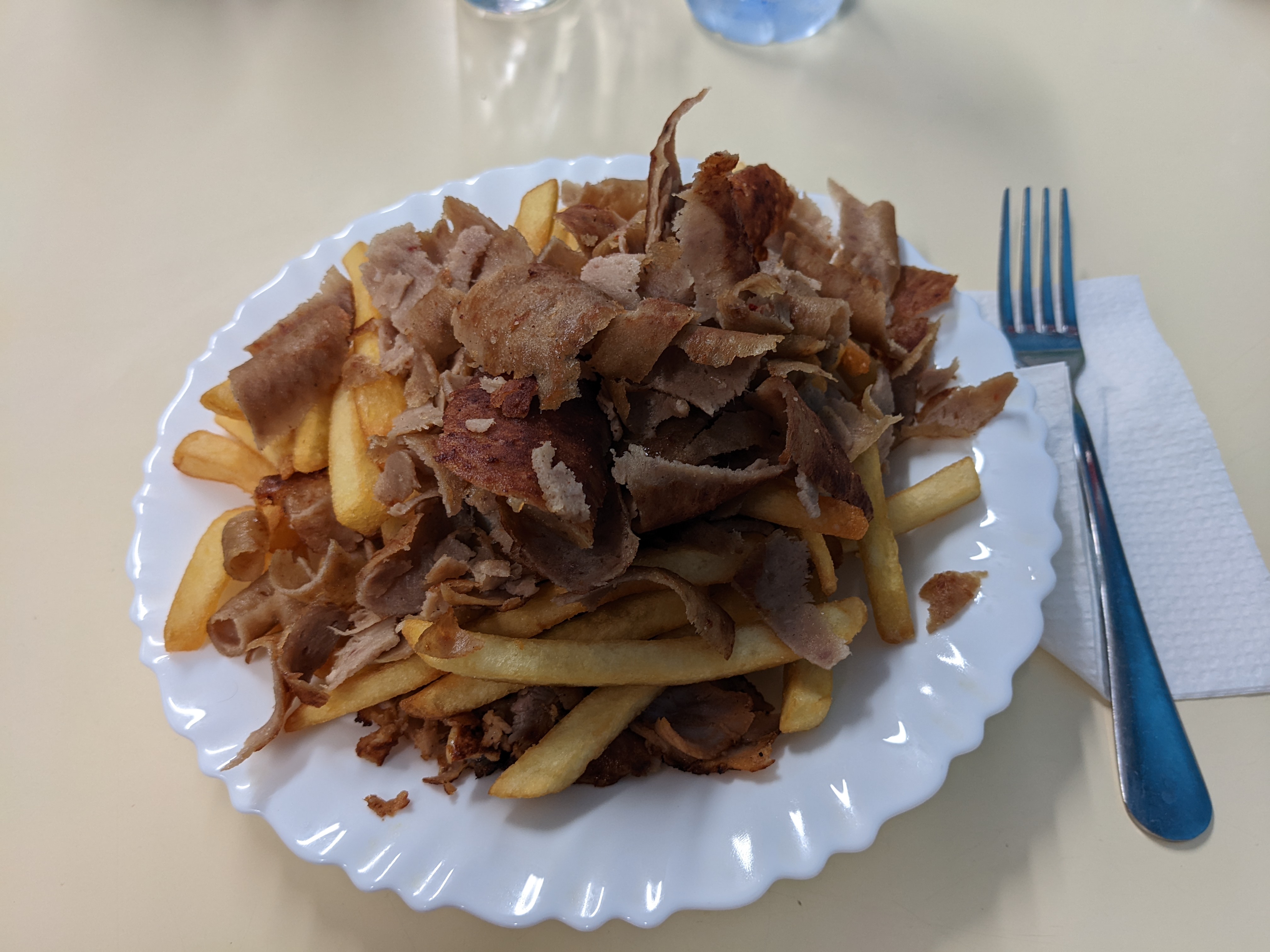
When I arrived at 1:00 AM, the only thing open was this little 24 hour bar near the apartment. They actually weren’t serving any food at this hour, but when I expressed my regrets the owner hunted around and offered me this reheated plate of leftovers from earlier in the night which she felt she couldn’t sell, so she offered me these chicken wings and patacones for free! They were delicious, and no, I didn’t get sick.

These two men at the bar and the owner were very friendly. Some other guy even included me in a round of drinks before heading off for the night. So I had four beers, a plate of chicken and patacones, and great conversation for only 6 euros! I did however leave a 2 euro tip in recognition of the food which she wouldn’t sell.

Finally at 2:30 AM I was back in my room and already falling asleep on my feet. With no particular plans for the next day, I figured I would just pull the blackout shades and sleep until I awakened on my own, no matter what the time would be. It was a great first full day in Barcelona, and whenever I get up tomorrow, I’m sure I’ll still discover plenty of interesting things to do and see. Thanks for continuing to follow along with me, and I will write again soon.
Spain trip: Day 1 (23-Jun)

Hey folks, so I know that by immediately following up my Ladakh trip with a trip to Spain, it makes me look like some sort of glamorous world traveler, but that’s really not the case. It’s just that travelling home from India to Costa Rica is a really long trip, so if possible, I try to do at least a couple of days layover in western Europe before continuing on my way. In the past I’ve stuck to Madrid, but this time around I’m changing things up a bit by spending a few days in Barcelona.

In case you are curious, due to the distance, the combined airfare is actually usually cheaper this way, but yes, there is the added expense of lodging, food etc… I guess if I had someone in the city to visit with, that cost would also disappear, but for now that’s the case. Regardless, I’m still really excited to get to spend a few days in Barcelona; I’ve never been before, and there will be plenty to see. For sure I’m planning on visiting the Sagrada familia church and Parque Güell. Aside from that, I’m still not sure.

So anyways, my trip started at 12 midnight, as I got an Ola (It’s basically an Uber clone from India) from Yelahanka New Town (northern Bengaluru) to the KIA (Kempegowda International Airport). Although it’s frequently hard to get a car from there, it was very easy this time around, only costing 800 INR ( 10.20 USD) but I gave a 100 INR tip due to the time and the good driving.

Happily, things went very quickly with Qatar Airways check-in, immigration and security. This time around I’m traveling with very little luggage since my later flight from Madrid to San Jose, Costa Rica will be with the rather sketchy sounding IberoJet airline. I’ve never flown with them before, and their baggage allowance is tiny (with massive checked baggage fees) especially for a cross Atlantic flight. Still, I will make it work. Separately, this is also my first time to travel with Qatar Airlines, and I just say that I’m impressed!

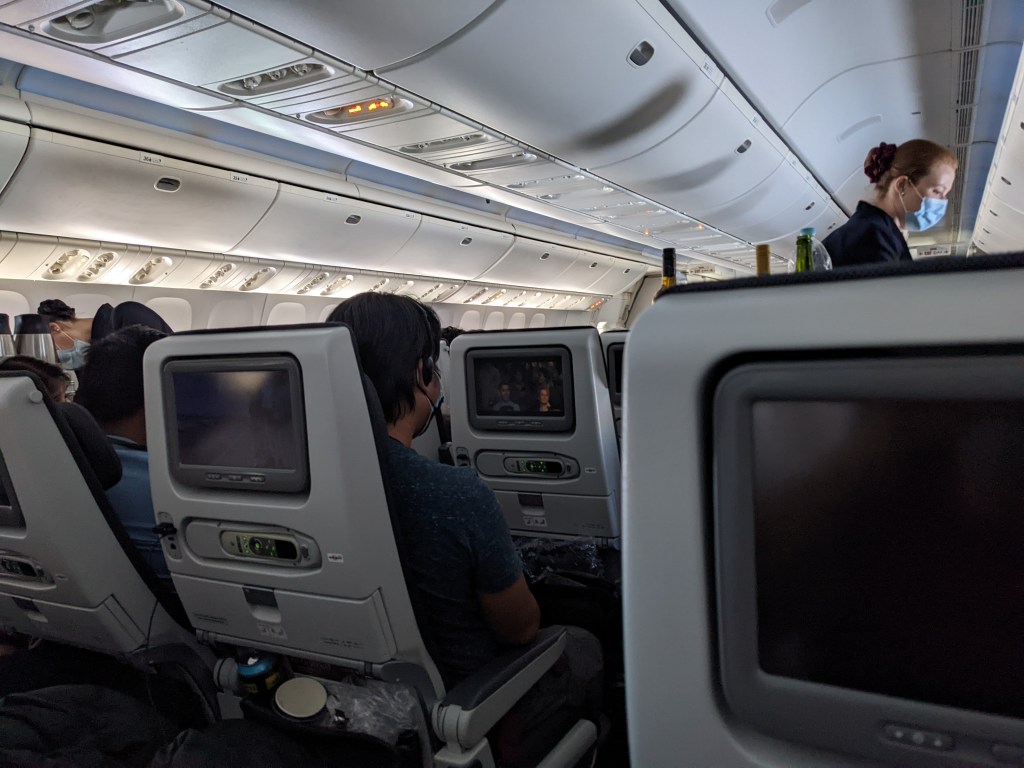
Even in economy, the seats were comfortable and the service very good
I don’t usually care about these things, but the screens on the flight from Bengaluru to Doha were very large, I think at least ten inches, with an impressive array of entertainment options, including front and downwards camera views, a rather common inclusion now which I really enjoy.
I know it’s trendy to trash talk airline food, but this was an amazing meal. It’s hard to tell with the lighting, but there was a yummy frittata with lamb sausage, potatoes, fresh cut fruit, delicious creamy yogurt, and some sort of greens.

My flight was 4 hours and thirty minutes. With the exception of when I was eating, I slept most of the way. The adjustable head rest makes it easy to get comfortable. My only criticism would be that as is the norm on airplanes, the temperature was quite chilly. However, the sealed blankets provided were more than large enough and made for a comfortable cover as I slept  through the majority of the flight.

This was also my first time to transit through Doha and I’ve got to say, it’s pretty amazing. I know this will make me look like some sort of a country bumpkin, but everything about this hyper organized airport seems to be constructed to transmit a feeling of serenity. Even going through security was a pleasant experience with incredibly polite attendants throughout. No needless screaming at people to hurry up here!

The view shortly after exiting security

I only had a little over ninety minutes before boarding my next flight, so I didn’t really take advantage of most of the comforts of the airport, but still, it was such a pleasant ninety minutes. Layovers tend to be something to be endured, but this one actually added to the joy of the trip itself. In contrast, when I’ve previously transited in nearby Sharjah, I’ve felt like I was in a holding cell. Why can’t all airports be as nice as Doha?

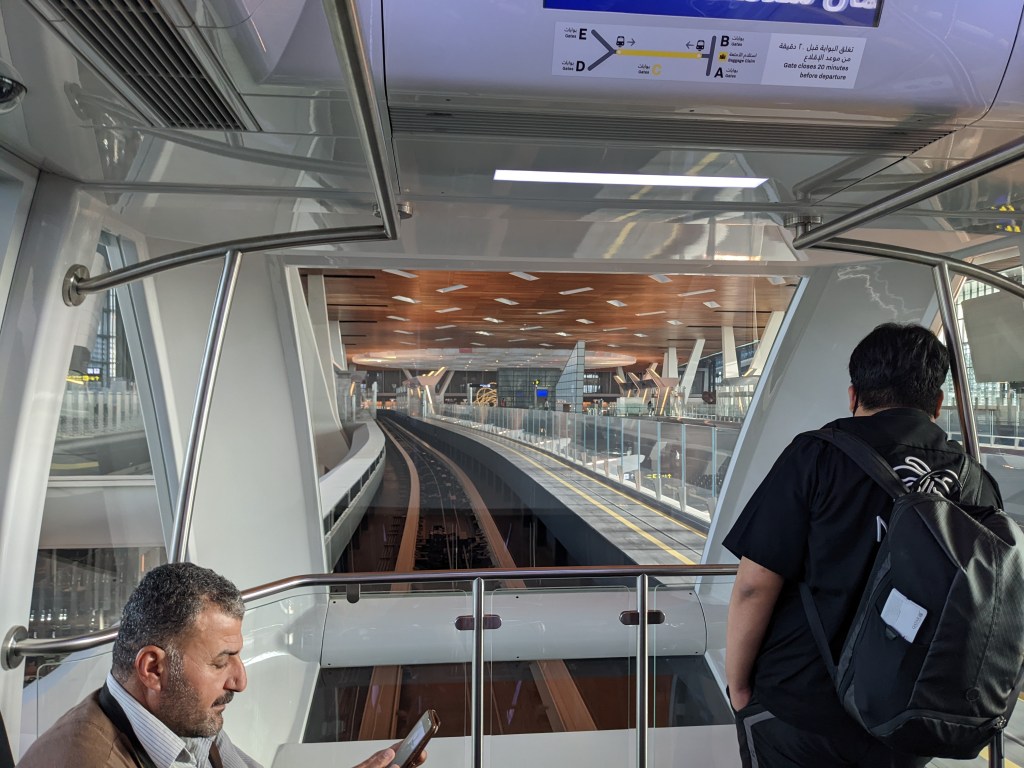
Even the ride in the transit train to D gate area was super smooth and quiet
The chairs were comfortable, and there to the left you can see a bit of a video art installation relating to the upcoming World Cup in Qatar

Well, everything had been going so well. On the next flight I got my do gooder points for the week. I willingly gave up my aisle seat so that a mother could sit with her son. I wasn’t thrilled about this, but I figured that someone was going to get stuck with this, so it may as well be me. Like pretty much everyone, I detest the middle seat, but I figured I would live. This plane was notably less luxurious than the previous one, but I was sure it would still be fine. Happily, just before take off, they relayed that an alternative solution had been found, so I was able to return to my original seat. So I still got my do gooder points but was also able to return to my original aisle seat!

We were a bit late taking off, leaving at 8:55 AM rather than at 8:15 AM, because we were waiting for some other connecting flights which had not come in on time. This also happens in some other countries;  it’s a bit inconvenient, but this seems to be a better solution than making a bunch of people miss their connecting flight due to no fault of their own. The flight itself went smoothly, taking just over 7 hours for us to arrive to Barcelona.
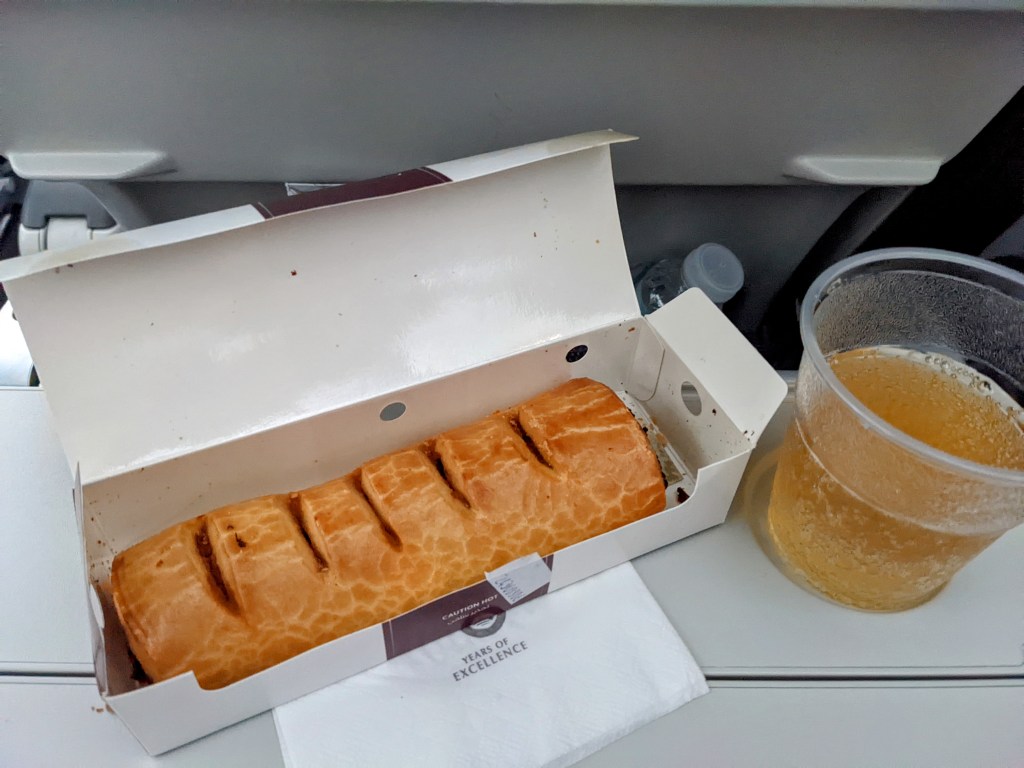
A tasty chicken snack which was served shortly before our arrival to Barcelona.

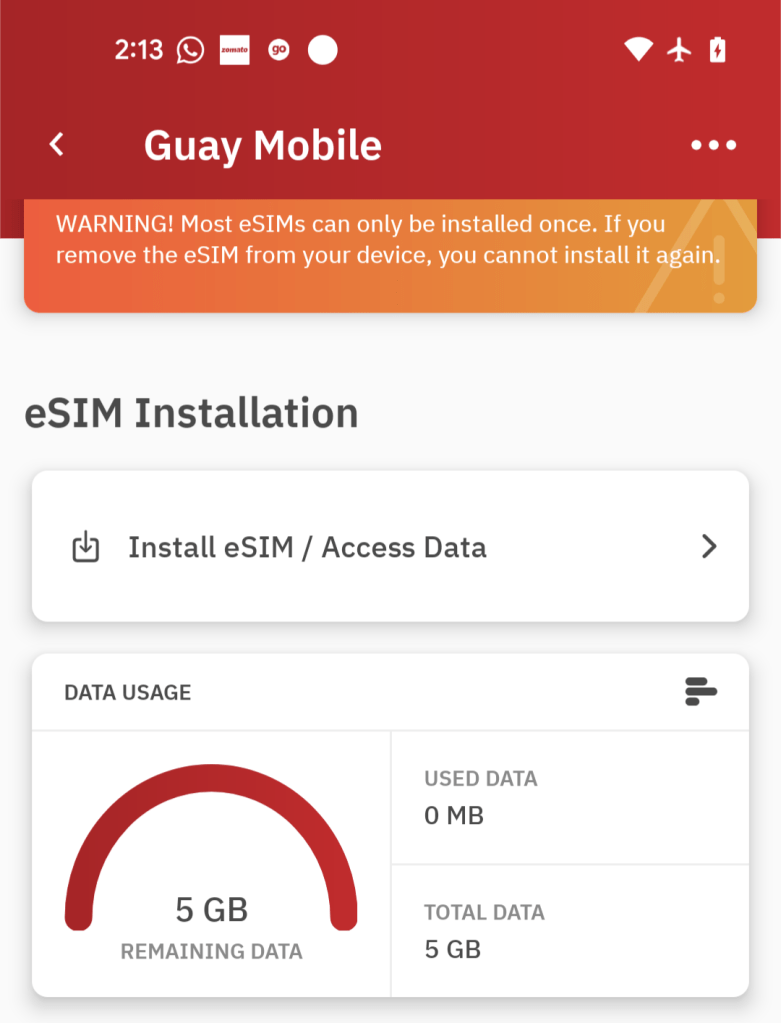
For a phone connection in Spain, I had decided to try something new based on a travel blog I had seen online. So, before departure, I installed the Airalo app and downloaded an esim which would give me 5 gigas of data for only twelve USD, with a validity of 30 days; the process for installation on my Pixel 4a was very simple. Yes, I could have opted for 10 gigas of data for only eighteen USD, but I figured that with WiFi, I didn’t really need that much data for a six day trip.  Honestly, with phone data being so cheap and access generally very good in India, I’ve become very spoilt, not really having much of a realistic idea of how much people in the rest of the world use. 

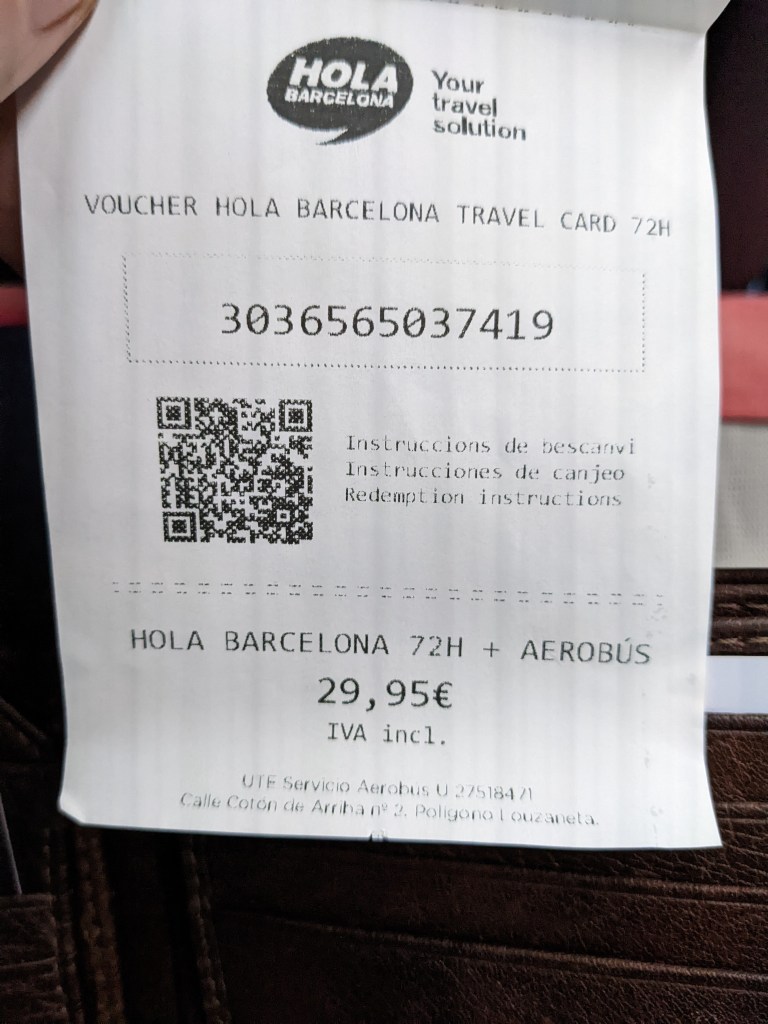
Right within the airport, getting a three day Barcelona pass was easy, but I wished I had purchased via the TMB app instead of on paper since all they give you is a flimsy sheet of heat printed paper. Later on I realized that you are supposed to use a code on that same sheet in order to get a more durable cardboard pass. One of the metro workers kindly helped me with that once I had gotten off the airport bus, but then couldn’t figure out how to use the paper to get on the metro. Overall, even though I was staying at an Airbnb outside of the more central part of the city (Lodging in Barcelona is expensive! Staying a bit further away but still well connected via subway helps reduce costs considerably.), it was still easy to get to my lodging using public transport and Google maps.

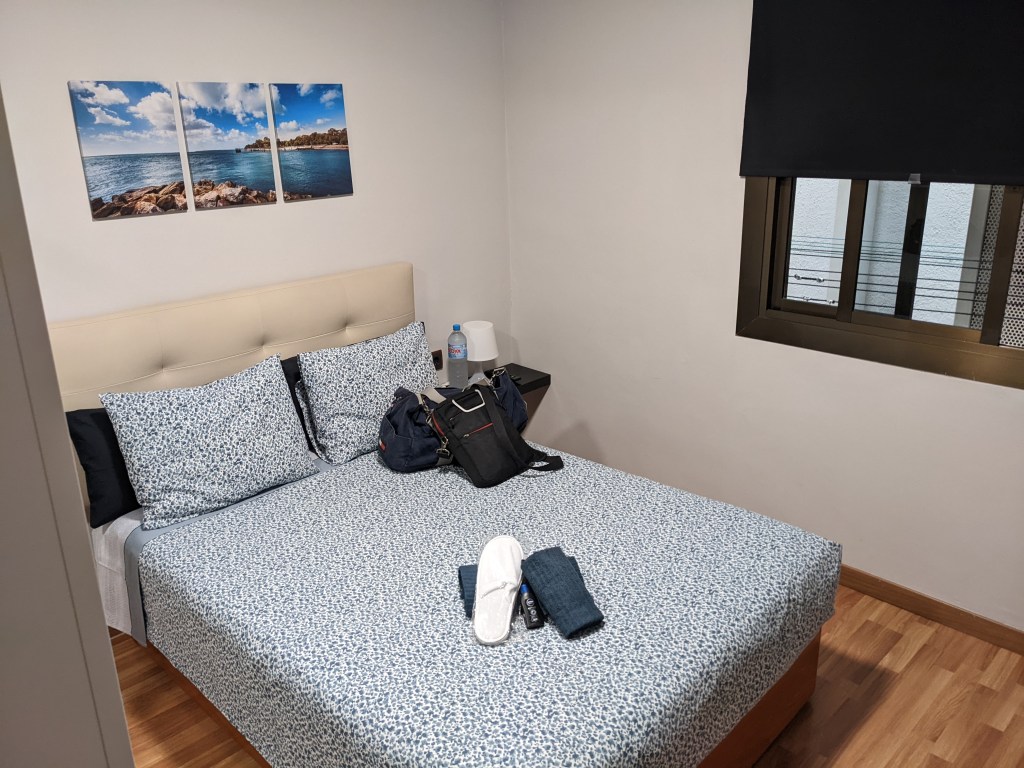
The neighborhood was clean and quiet, not at all a tourist area, but as mentioned earlier, it was well connected via nearby subway lines. For less than what I would have had to pay for a more centrally located bed in an eight person mixed dormitory, I had a very pleasant private bedroom with my own bathroom.

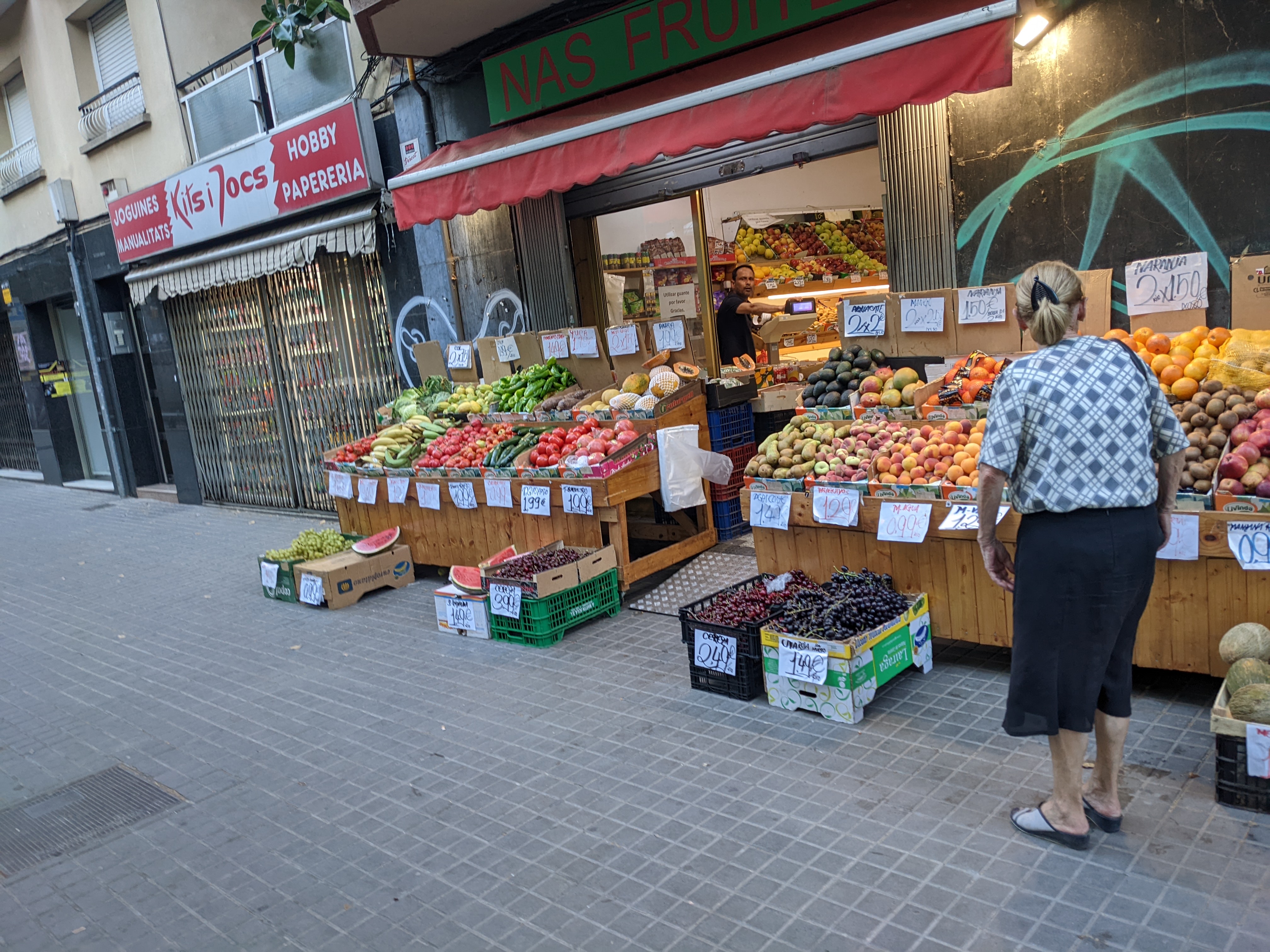
It was now around 5:00 PM, so I decided to wander around the neighborhood a bit. I was also a bit hungry and needed a better plug adapter as my normal travel one wasn’t working well. Since I wasn’t in a tourist area, I was able to get a delicious meal for only 5 euros and also find a better adapter for one 1.25 euros. I thought that maybe tomorrow I would stop in to one of the local bars for some tapas and a beer.

After I had confirmed that the new power adapter worked well, I rested for about 30 minutes before once again heading out to see what was going on with the Sant Joan festival. My host Victor had suggested that either Plaza España or Barceloneta would be ideal spots for the festivities. Since Barceloneta was a bit closer, I decided to go there. Evidently the party goes all night, starting at about 10 PM. However, since I was a bit tired from my travels and also had a 9:30 AM entry to La Sagrada Familia, I decided that I would only stay until 11:30 and then head back to sleep. Even with such a short time out, it was great to see how all the locals and many visitors were participating.

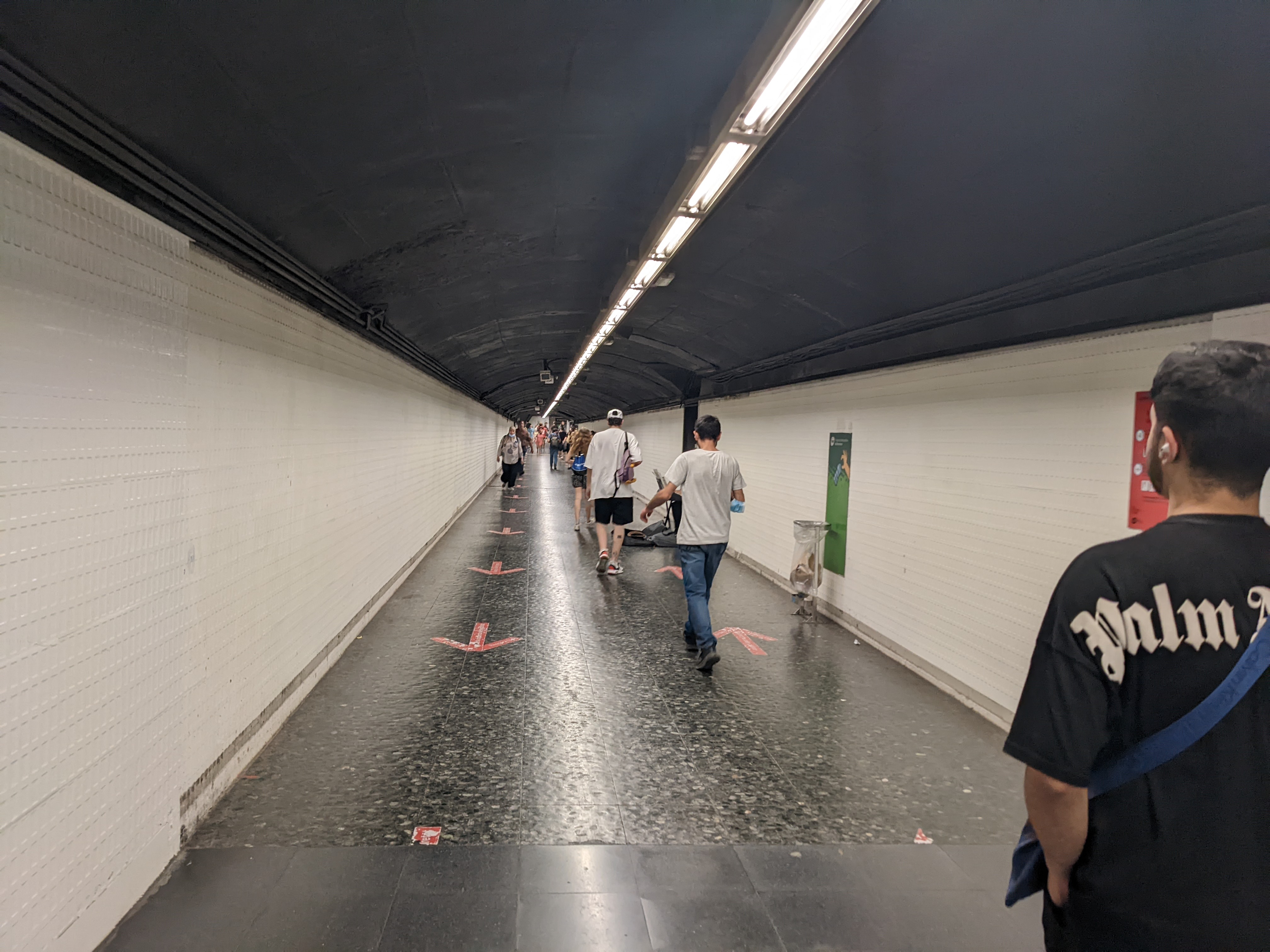
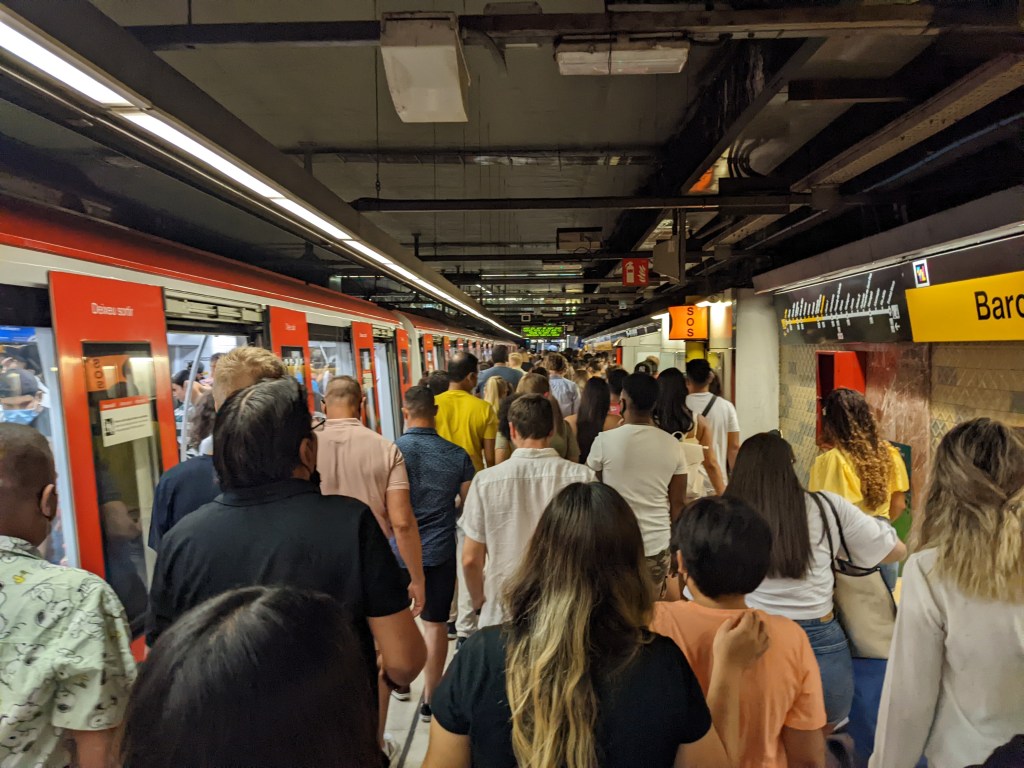
While not much of a crowd by Indian standards, there were quite a few people in the subway, so I just followed the crowd.
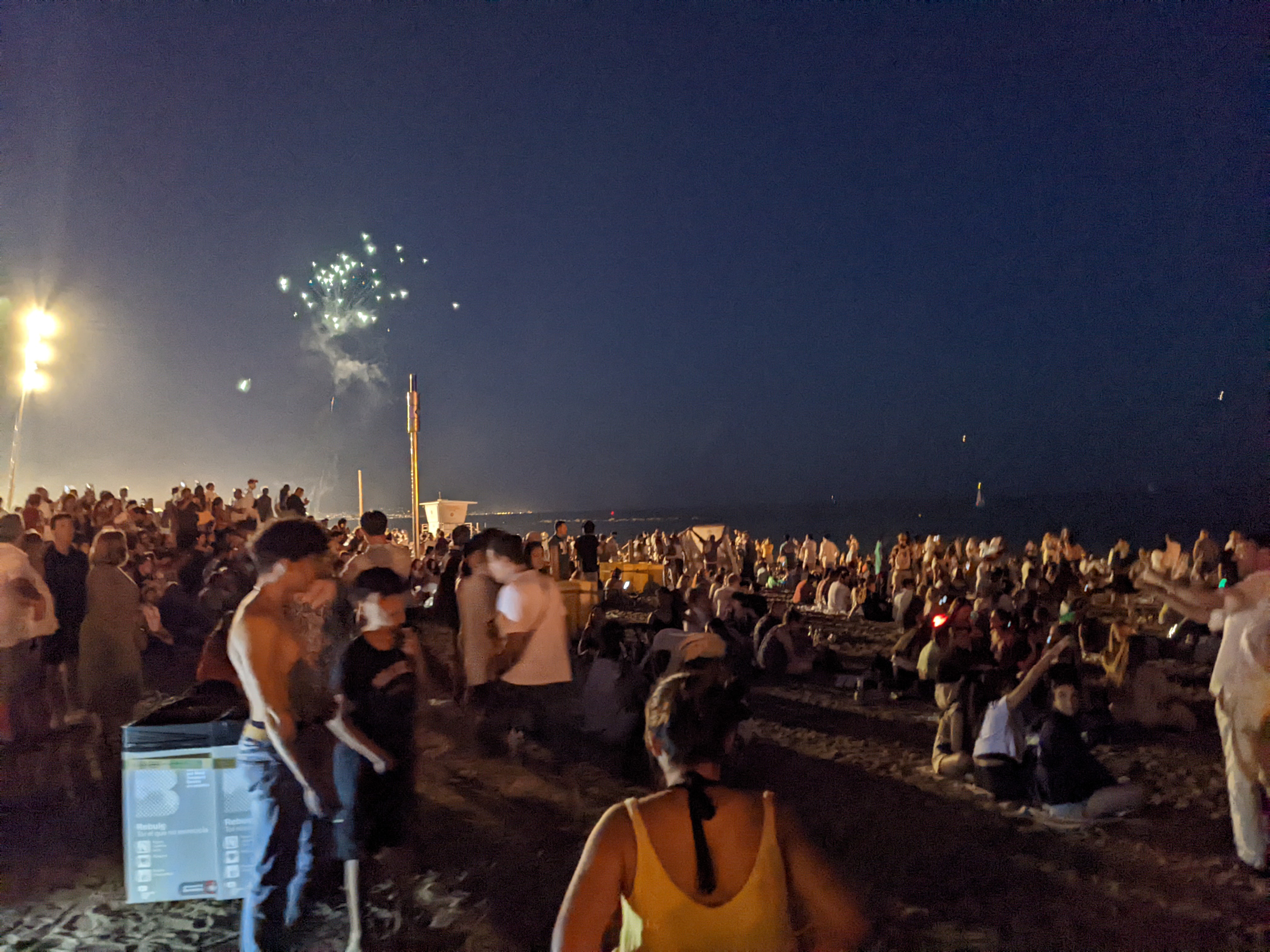
They led me to the beach where it seemed to be a sort of unorganized yet still orderly beach party with people talking, responsibly drinking, and setting off small fireworks.
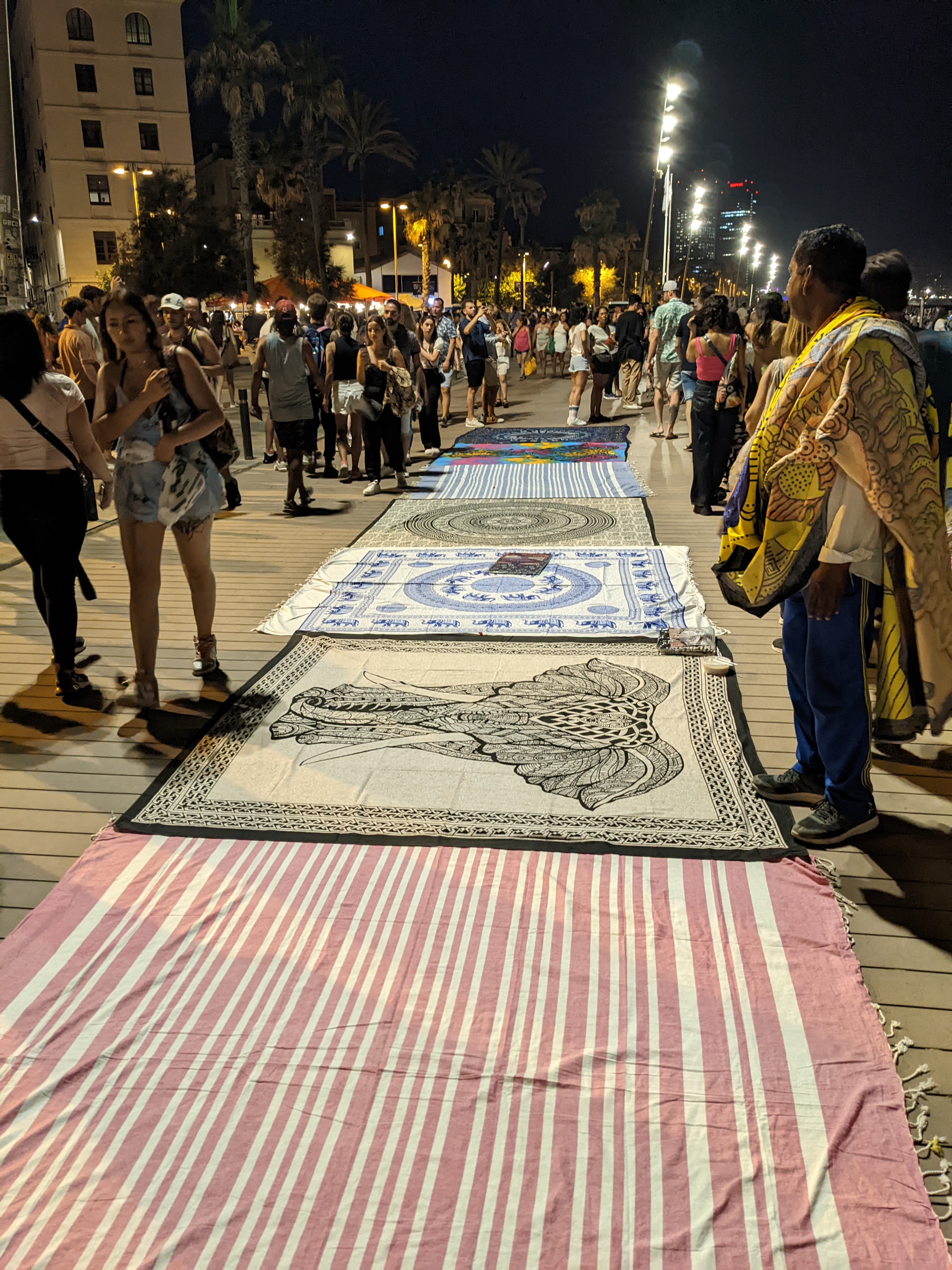
Having just flown in from India, I found it funny that they were selling these Indian themed sheets to sit on while at the beach.
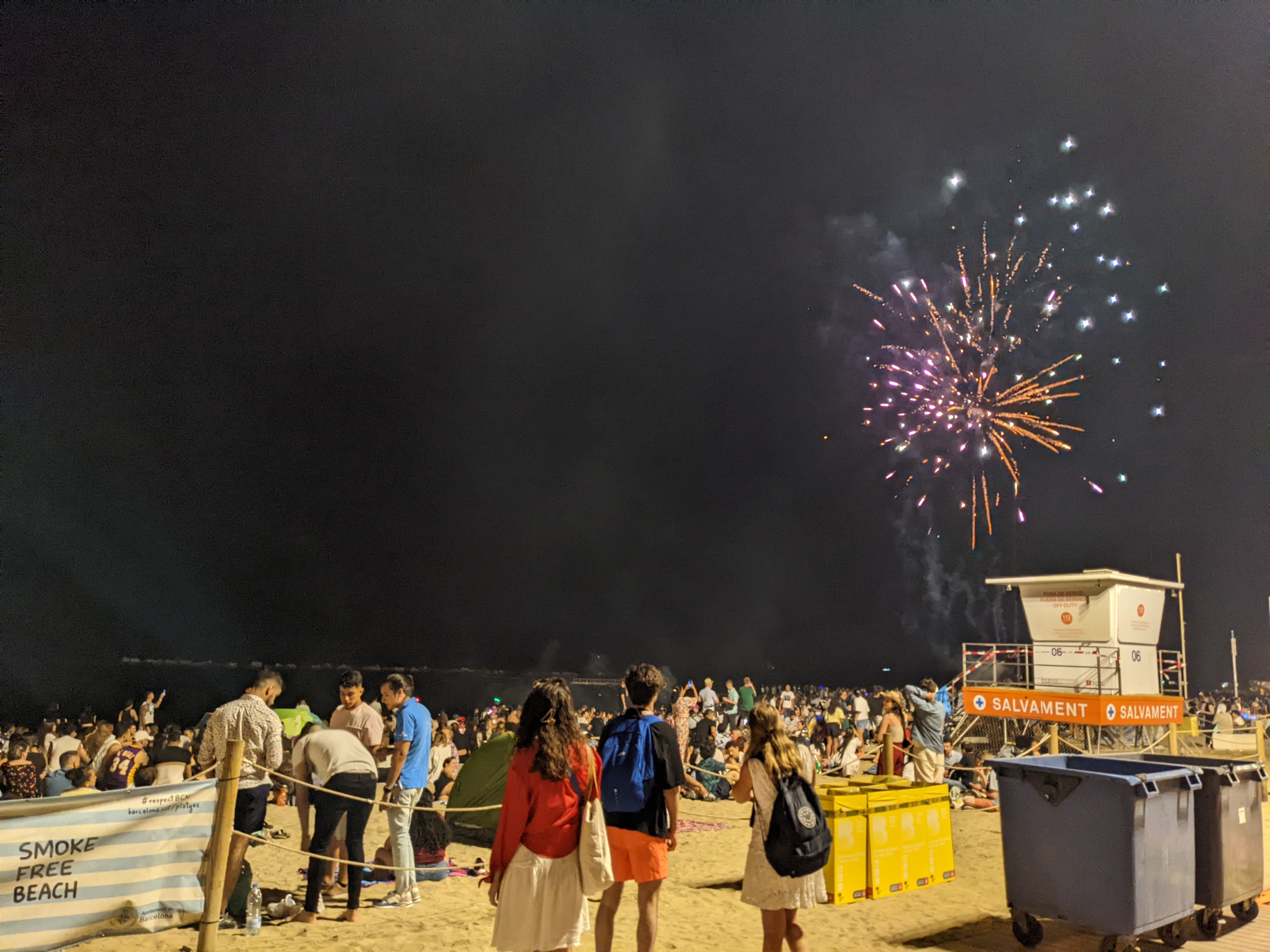
Some of the personal fireworks were quite large, but many were just small and rather annoying large firecrackers.
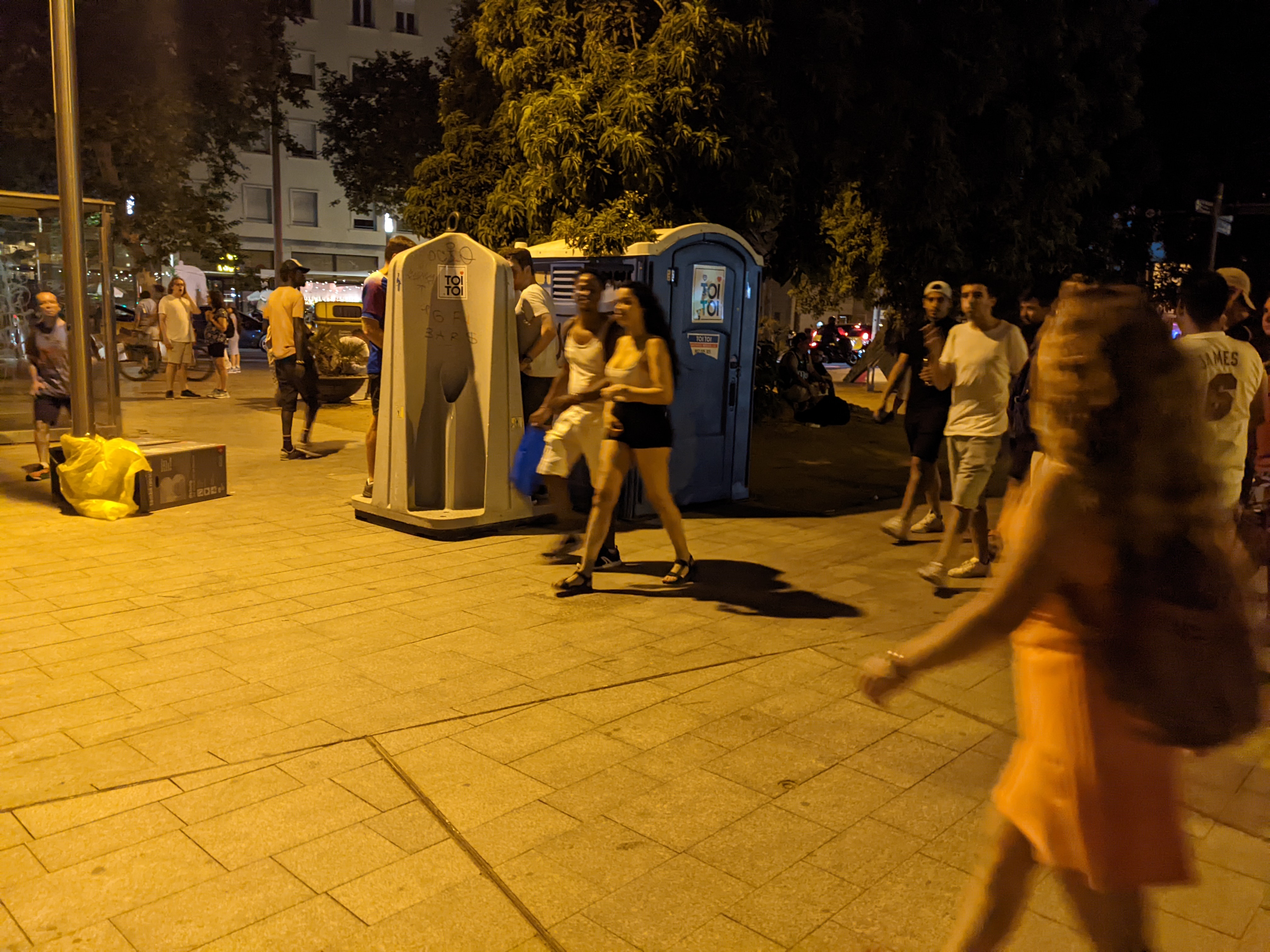
There were plenty of public toilets, including these open air urinals which can be seen to the left of the center of the picture.
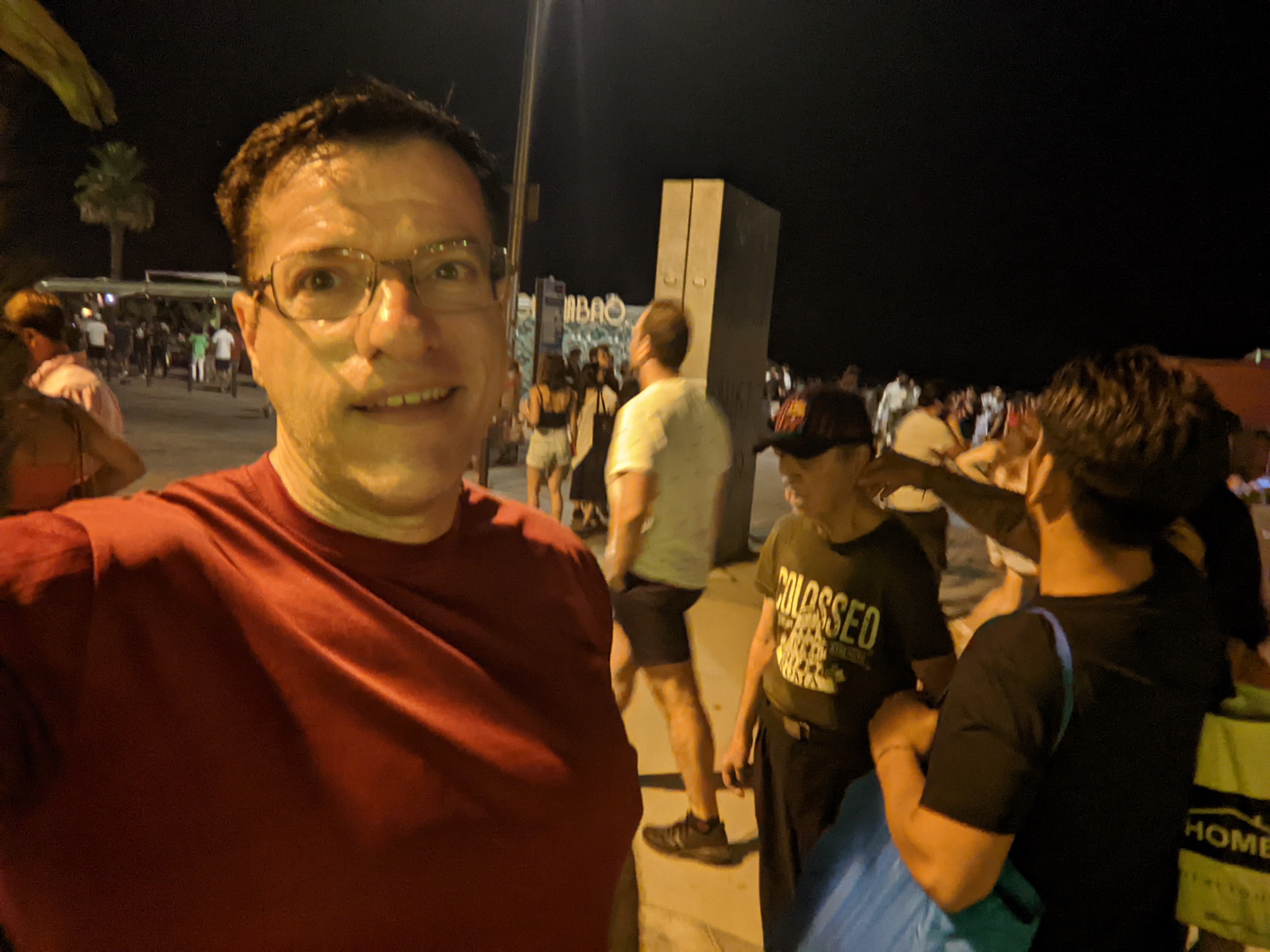
Even though I was on my own and couldn’t stay out late, I was very happy for the opportunity to participate in this local festival.

At around 11:40 PM, I went ahead and headed back to the apartment where I was staying. Since this was a festival day, public transport was running all night. By 12:15 AM, I was in bed. Tomorrow will be my big “tourist day” in Barcelona, so I’m expecting to see all sorts of fascinating places. Of course, as has happened in the past, things might not turn out as planned, but I’m sure I’ll have a great time. Until then, thanks for reading and don’t hesitate to reach out in the comments section if you have any questions.

Below the fireworks you can see the outline of what I assume to be some sort of local iconic oceanside construction.
Ladakh trip: The end (20-21 June)

Hey everyone. While I didn’t actually leave from Ladakh until the morning of the 21st, the trip itself was basically over as of June 20th.

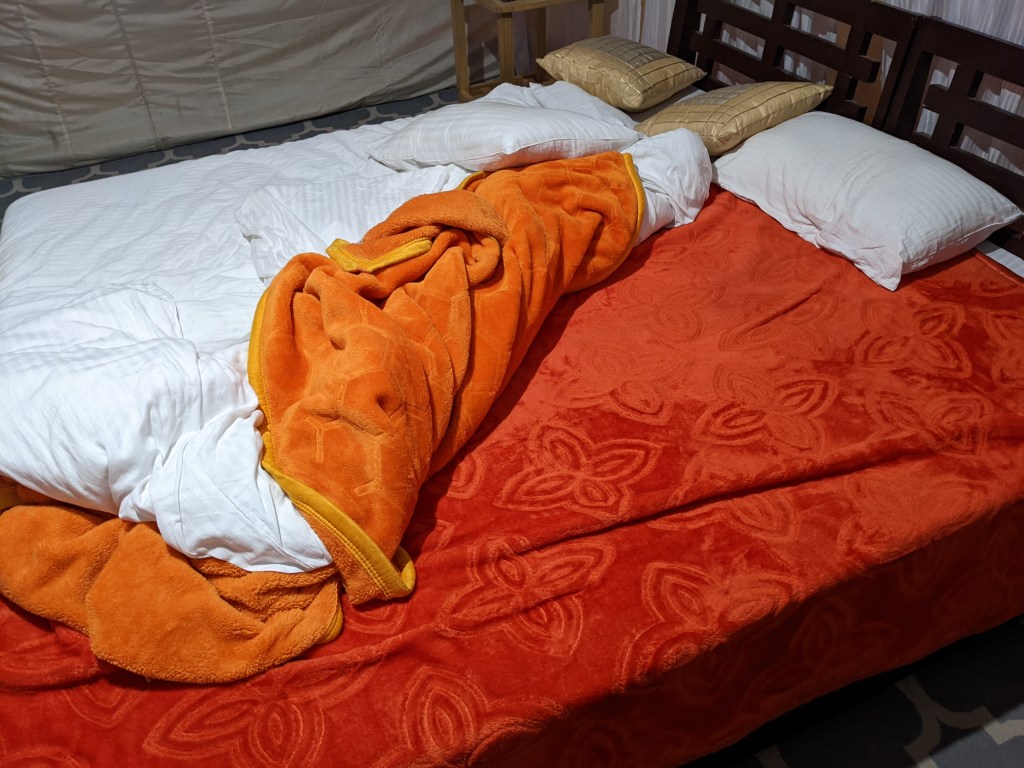
For the most part I slept quite well, no doubt partially because I was very tired. However, many would have been unhappy as the mattress was made of extremely firm foam. If you’ve ever laid down on a wrestling mat, that’s pretty much what it was like. Although it was 2 degrees Celsius (36 F) outside, it was much warmer inside than with my luxury tent experience last night.

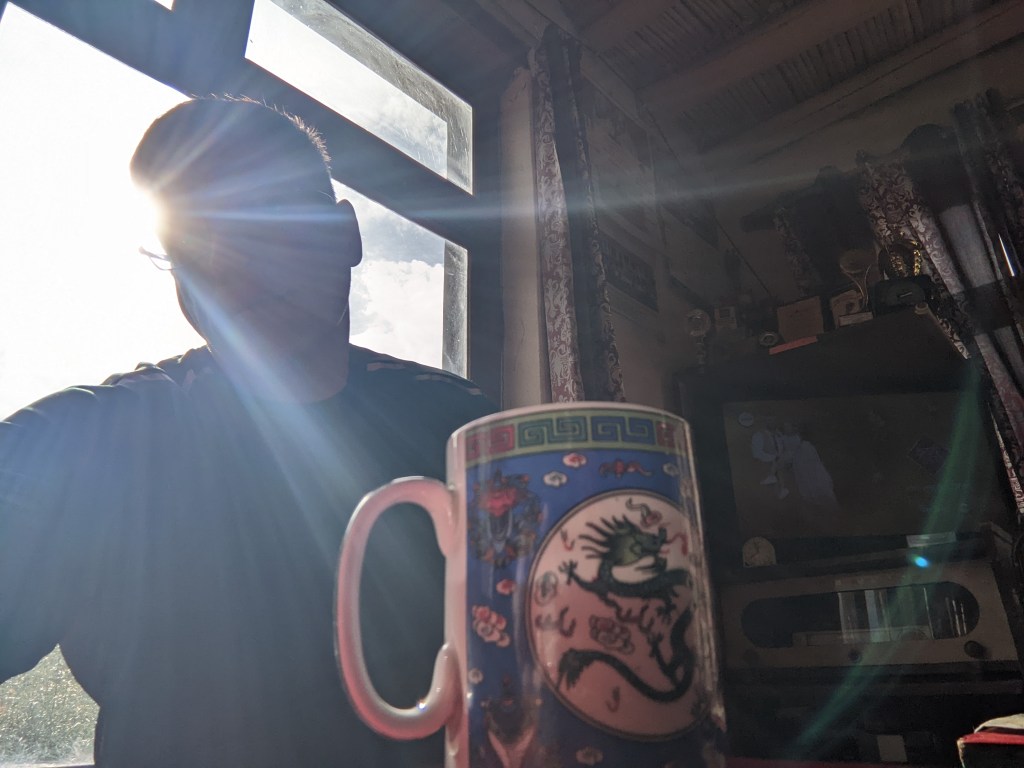
Yes there was of course more tea. Not pictured here was a matching porcelain lid which served to keep the drink warm before it was actually consumed.

Breakfast was a thin “omelet” served on plain sliced white bread. I thought Dawa’s mom must have snuck in some cream or maybe a bit of cheese, as it was much tastier than plain egg, but then when I asked, she insisted that it was just high quality local eggs. When I expressed disbelief, she made me another one as I watched, and sure enough, she cooked with just a tiny dab of butter, and then directly beat the egg with no seasoning before adding it to the pan. Who knew that plain egg could taste so good?
The most delicious plain egg omelet

As it had snowed again the previous night, Dawa indicated that we shouldn’t leave until 9:00 AM so that the sun would have melted most of the ice. The original plan had just been for us to hang around the house before then, but I mentioned to Dawa that I had been surprised to have not found the school the previous evening. He said he would be happy to show me, and that I probably had just not recognised it from the street. Sure enough, he was correct.
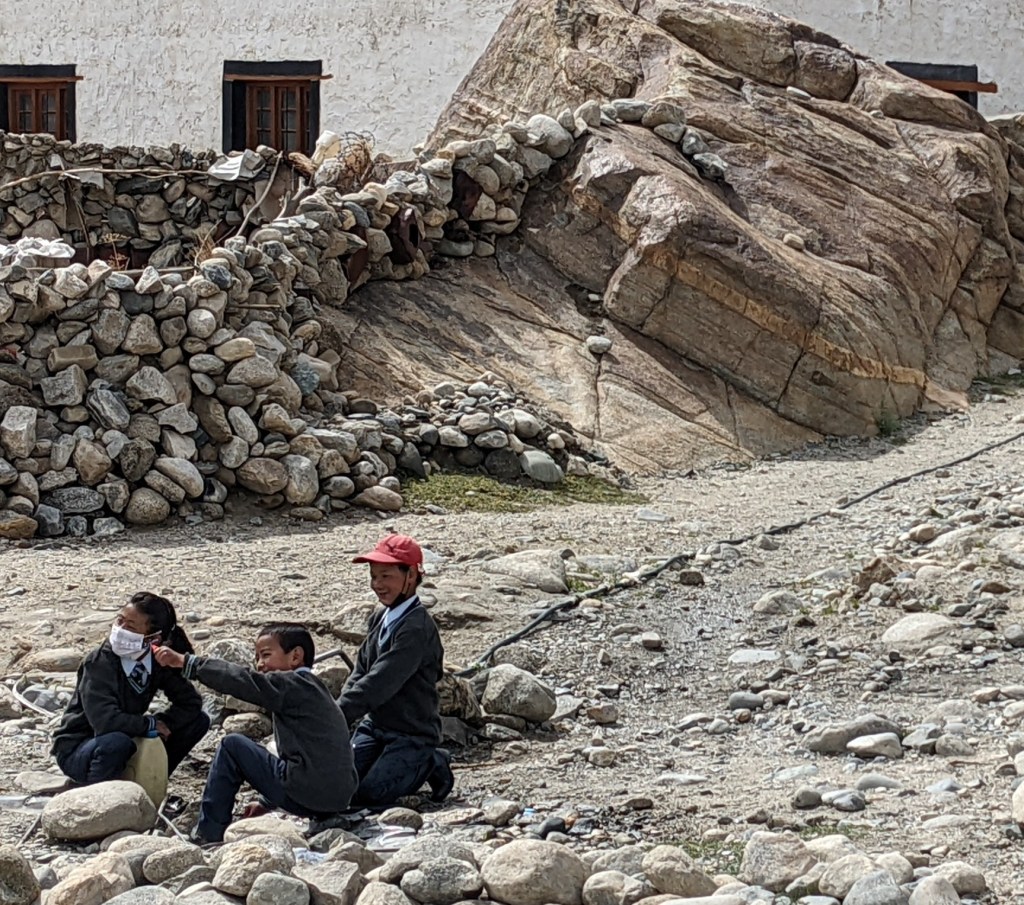
Kids were outside gathering drinking water to take into the school. Unfortunately you can’t see the water source here, but they were clearly enjoying being the early ones who were making sure to gather water for the day.

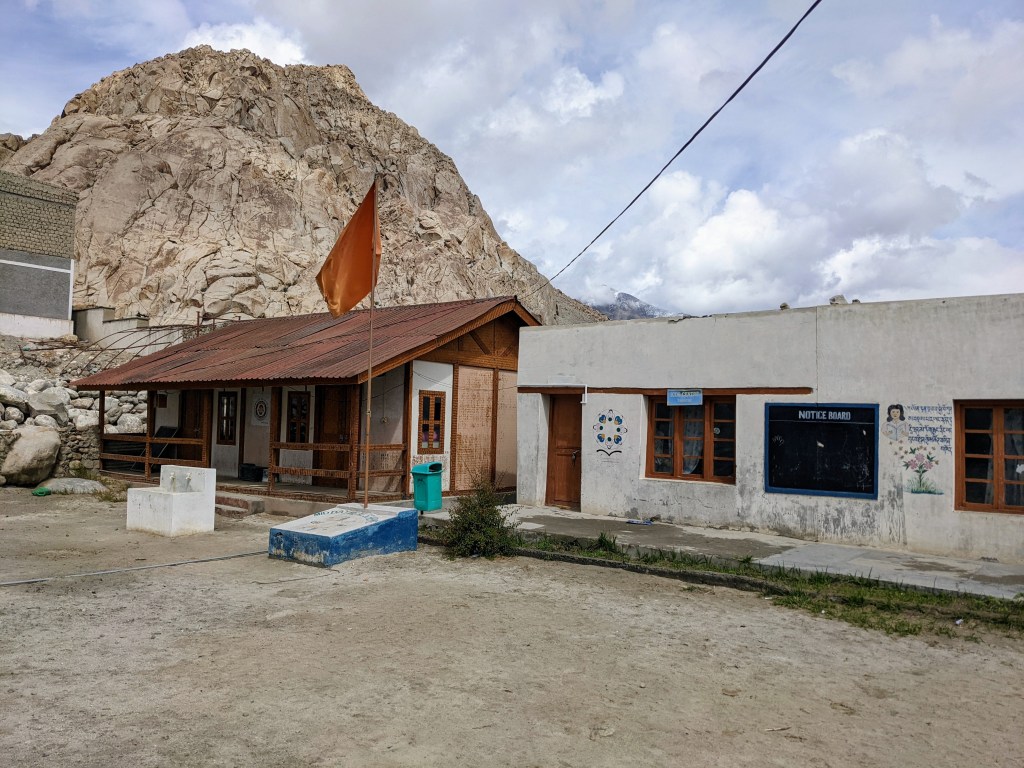
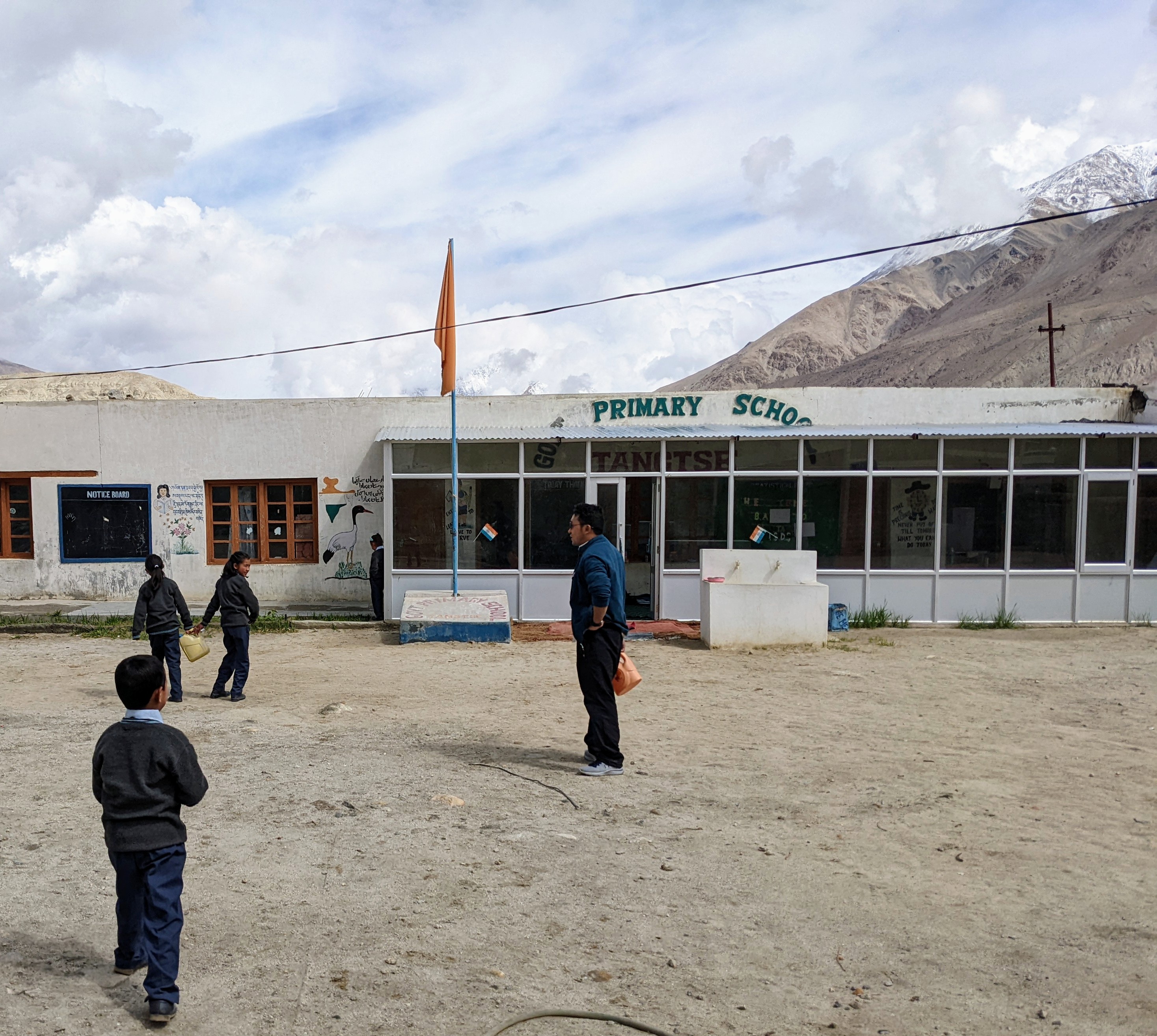
This was actually the same school where Dawa had studied as a child. I had indeed passed it the day before, but due to the plain wall which went around it, I hadn’t recognised it.

The building to the left was the preschool building and that to the right, the actual primary school.
They let me look inside, but I didn’t take any pictures since the rooms were rather simple, and I was worried that it might be seen as too intrusive.

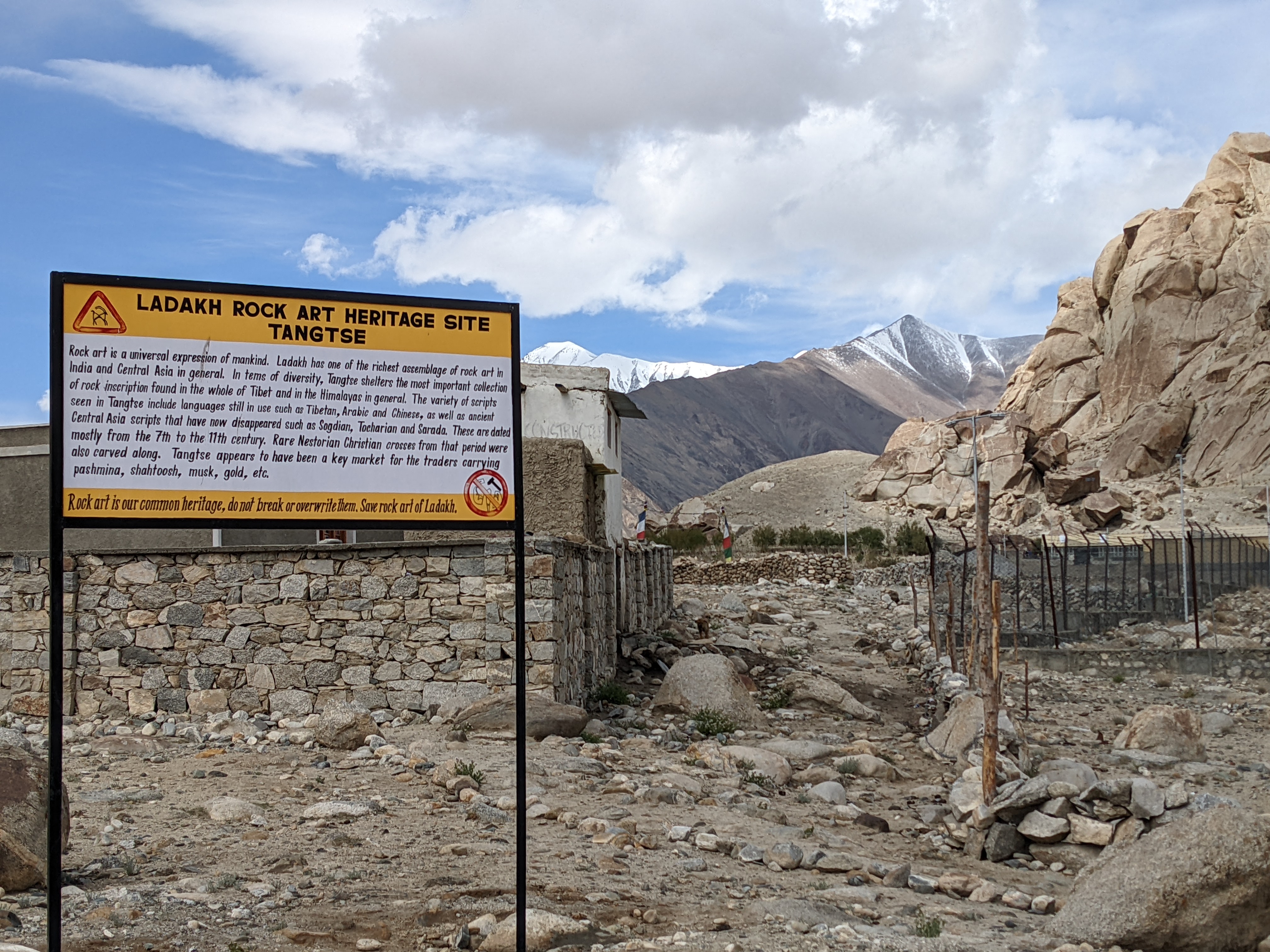
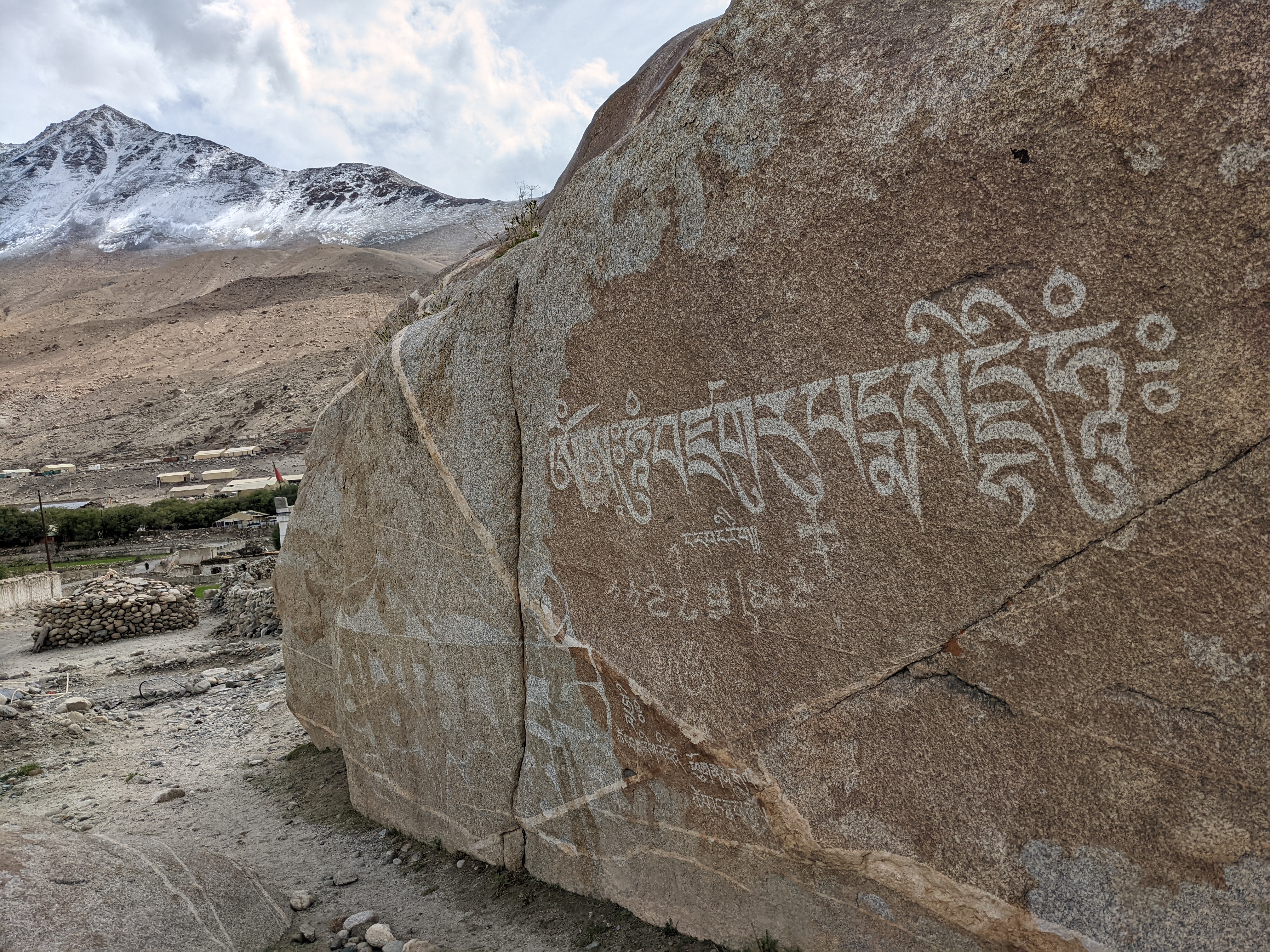
The kids were very funny and some tried out a bit of their English on me. Just outside the school, Dawa also pointed out some of the detailed carving on a couple of large boulders right next door. I had seen these previously but didn’t really take the time to look closely. Dawa explained that this area has lots of ancient carving on the boulders and had been rather extensively studied by different historians. I had assumed that any carvings were modern, but he pointed out different languages and petroglyphs which indicated that the rocks had served as sort of historical markers over the centuries. Near the top of one of the boulders appeared to be pre-historic petroglyphs, but there was also a large variety of different scripts, including ancient Mongolian.

The modern central engraving near the base had evidently been a source of controversy since in the process of doing it, a good deal of ancient engravings had been destroyed. However, as the rocks were not formally protected archeological objects, the new carving had still been allowed despite protests by many of the locals.
While there is a sign, there is no formal protection of the carvings.
The casual observer wouldn’t really recognise much unless there was someone along to point out the different scripts etc.

Looking at the boulders, I started thinking about how many archeological sites all across India are sort of just like this. With so many pressing daily needs, there just aren’t enough resources to fund proper investigation, much less preservation of so many sites. So much historical information is constantly being lost. I imagine it’s much the same in other parts of the world.

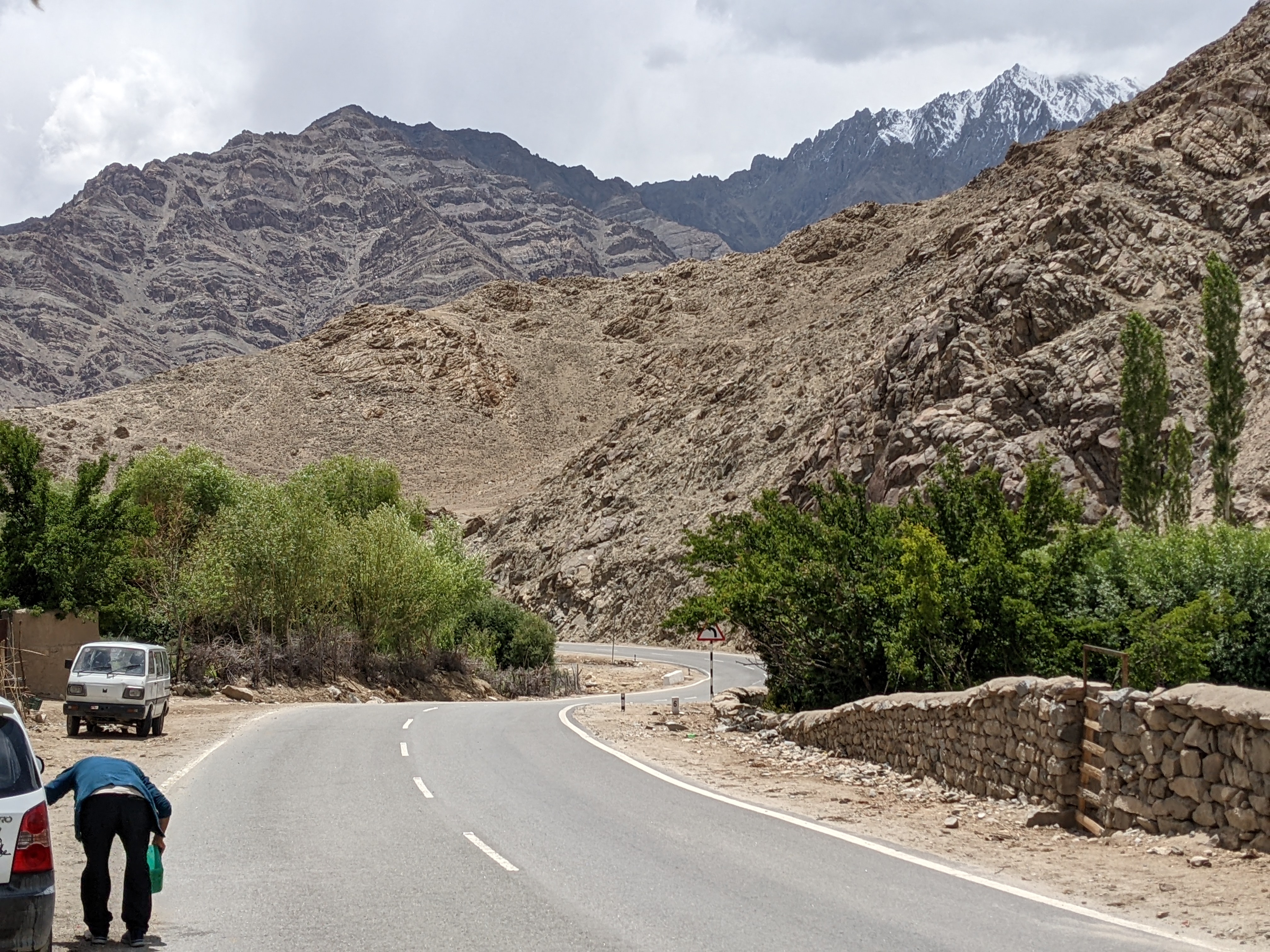
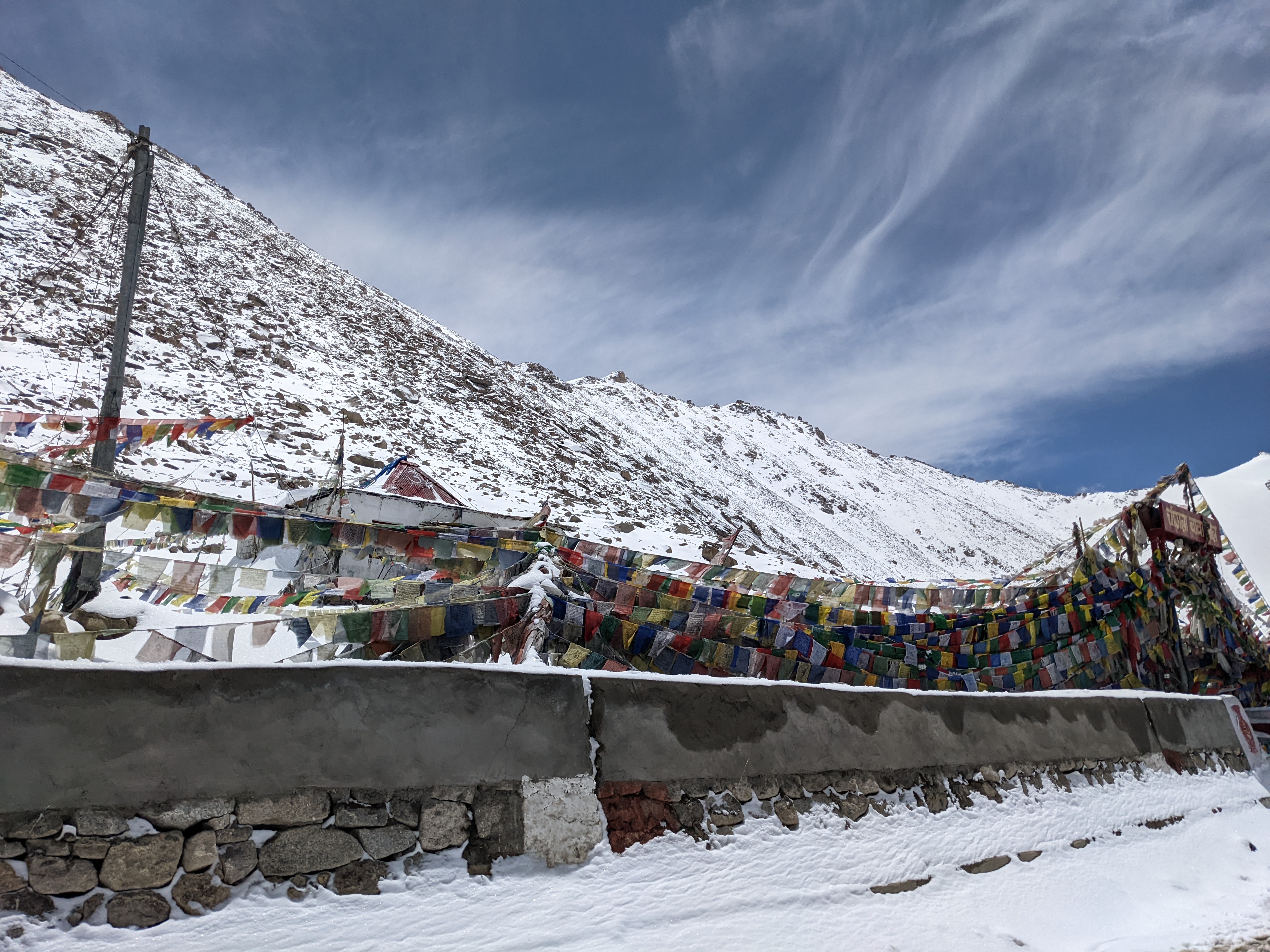
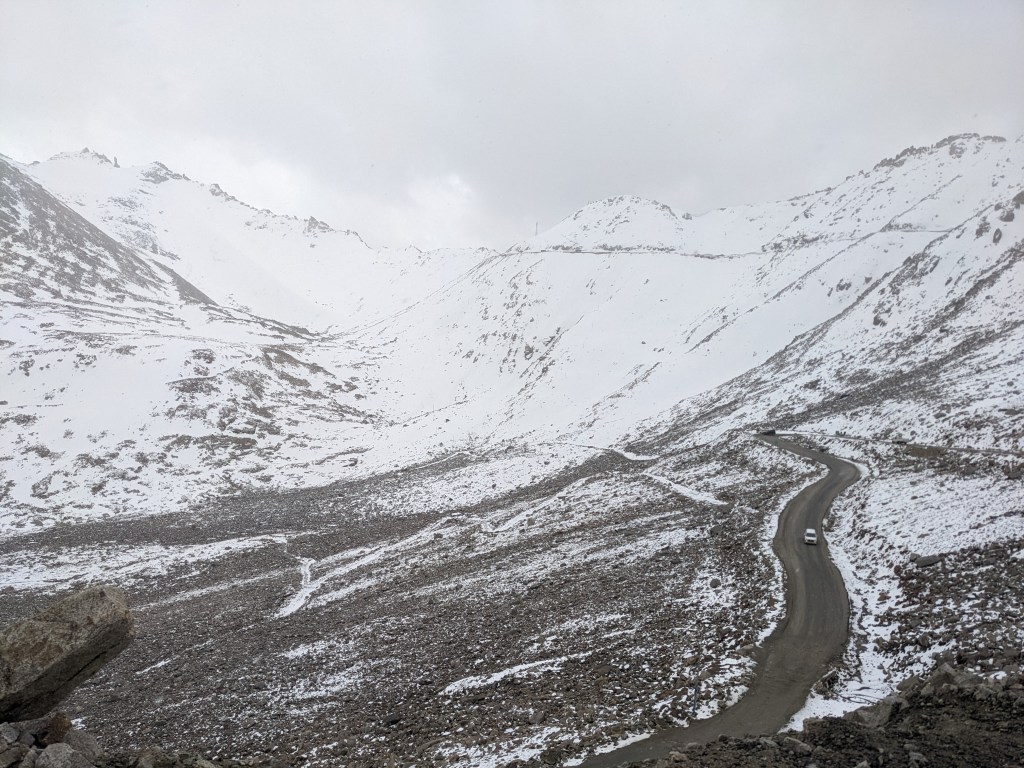
Then at about 9:50 AM Dawa indicated that we really needed to get going. At first the road was very smooth, but things rapidly started to get quite bumpy once again.

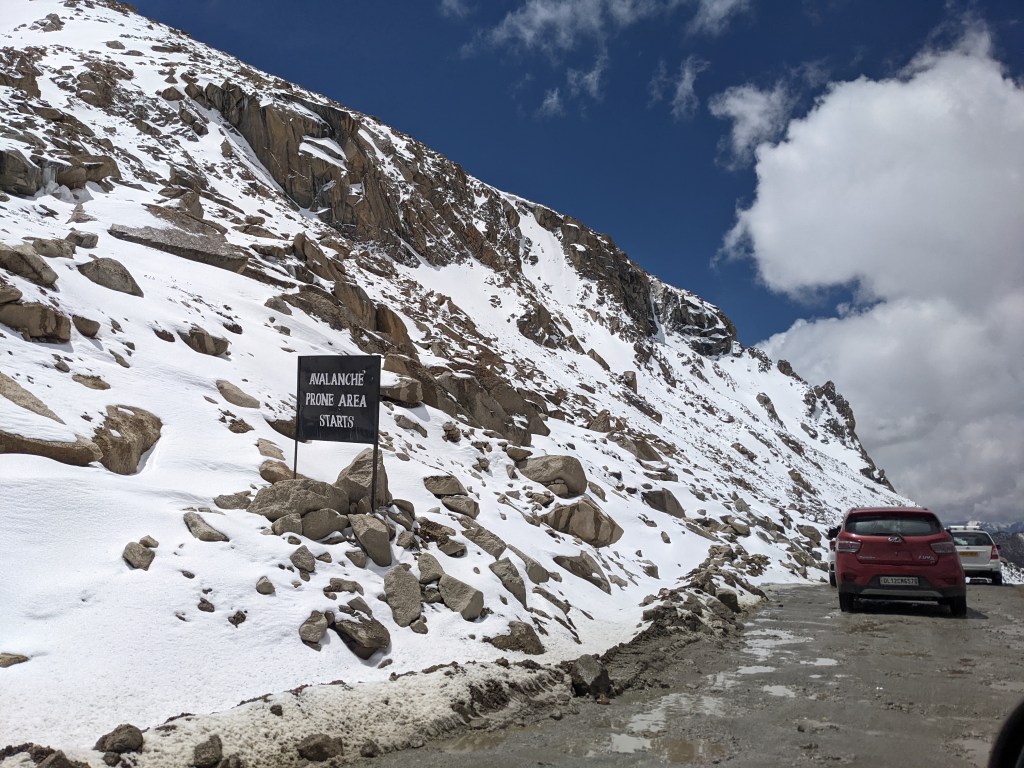
I was quite pleased but also retroactively alarmed when I saw a sign that said, “avalanche prone area has ended” but then 20 meters later there was a new sign “caution, avalanche prone area begins”. So I guess it was nice to know we had the twenty meters of relative safety?

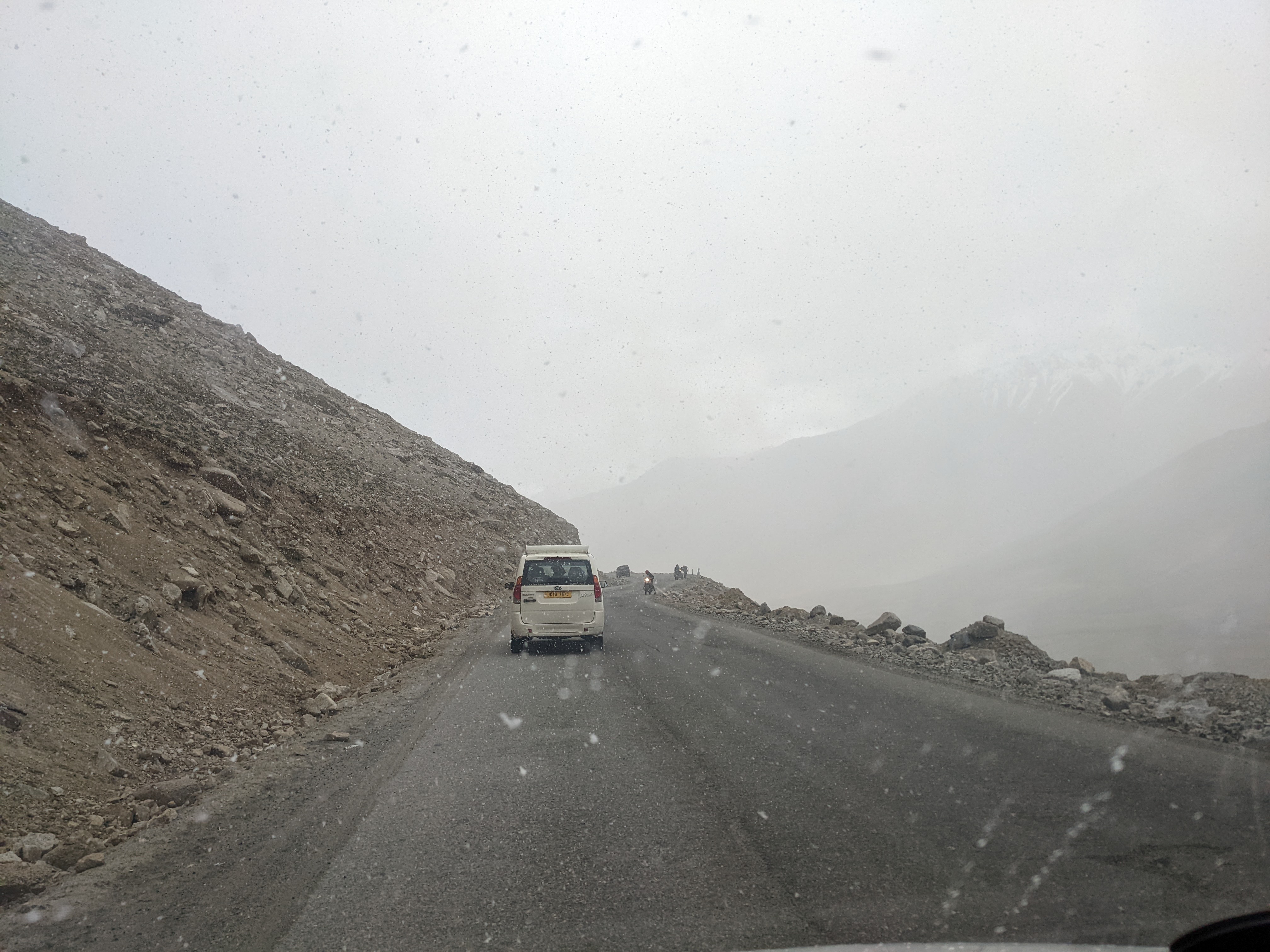
From about 10:50 to 11:25 AM we were once more stuck in stand still traffic as we were going over the pass. This whole stretch out road “was adequate” but all dirt and potholes. The worst part though was when we were behind a truck or bus, as pollution/exhaust controls for larger vehicles seemed to be all but non-existent, and we would have to constantly roll up the windows, sometimes even stopping the air intake from the vents.

I got quite bored with this and ended up falling asleep for about 45 minutes but then woke up again just as we once more reached smooth paved roads. At about 12:50 PM. From there on out.

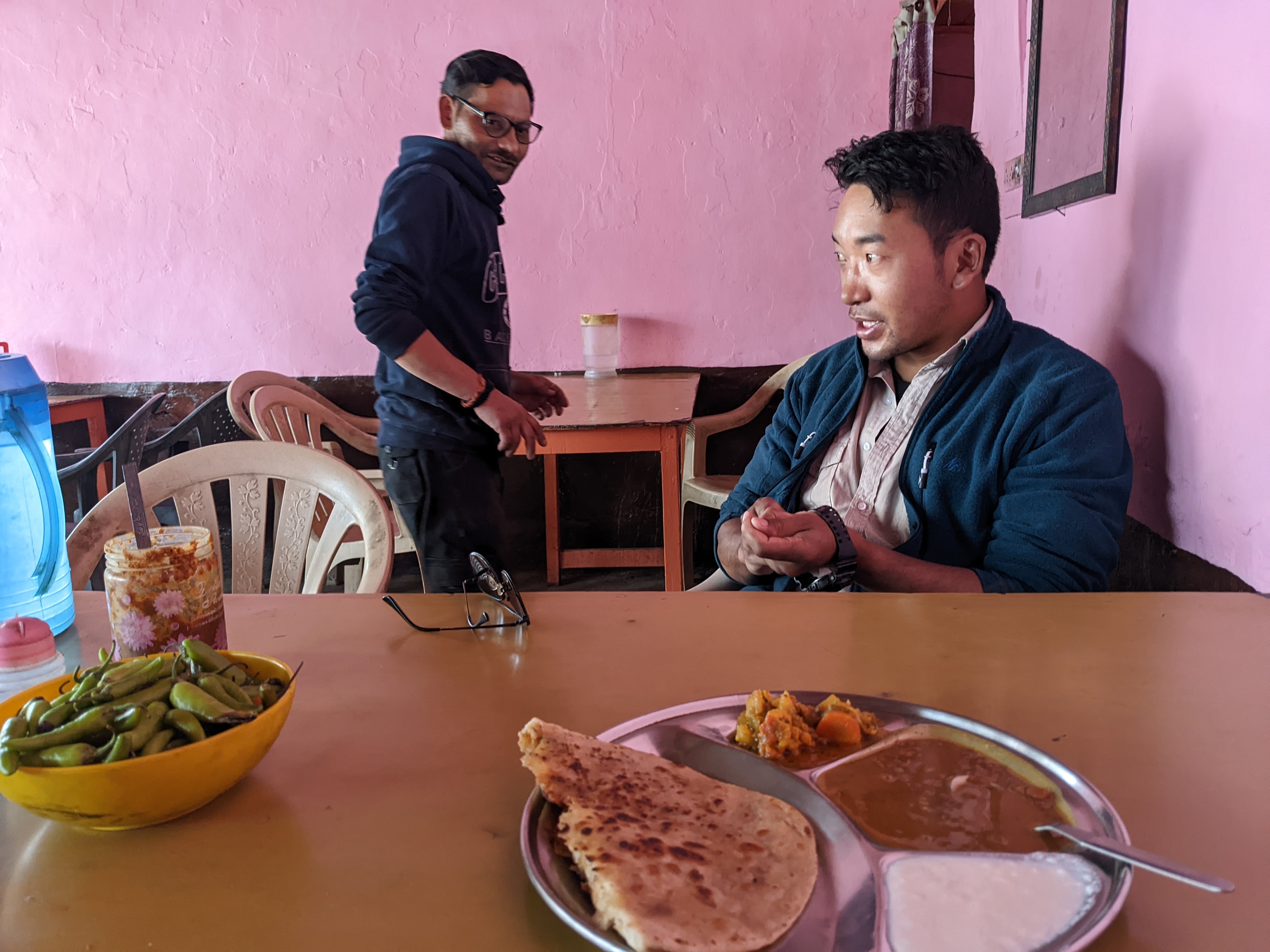
At 1:45 PM we stopped at Kharu for a quick Paratha. Dawa had asked if I would be interested in eating at a local place where he usually stopped. He was a bit nervous that I might find it too simple, but I told him I was happy to try. For the two of us, it was only 160 INR (2.05 USD) and also very tasty!

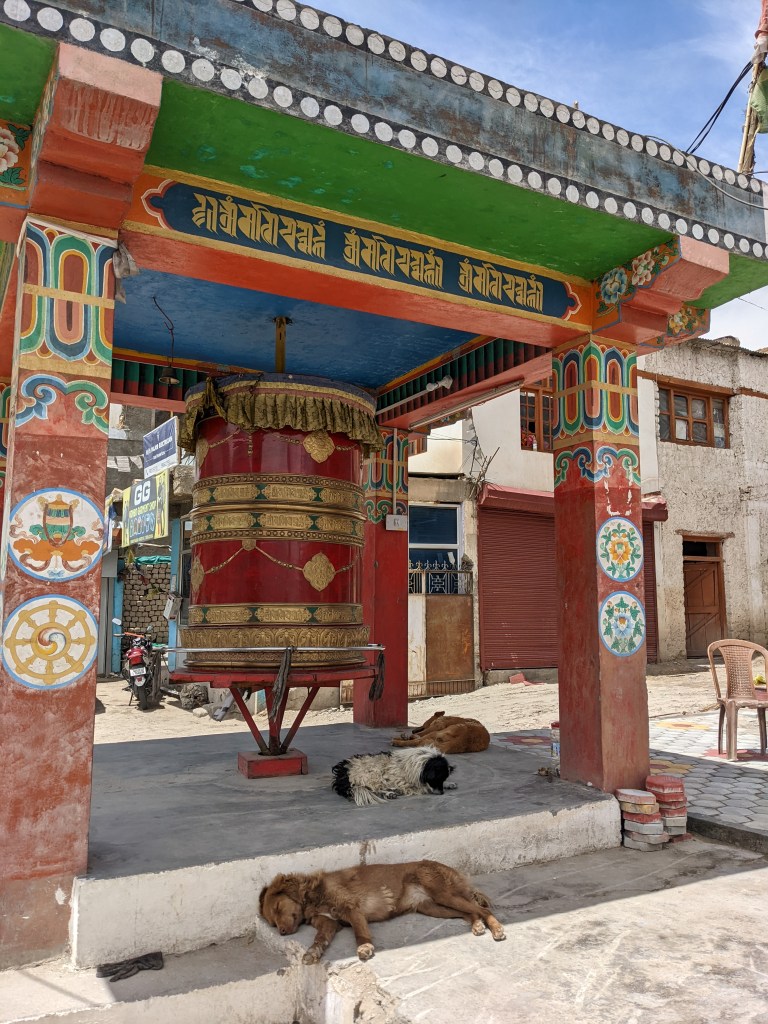
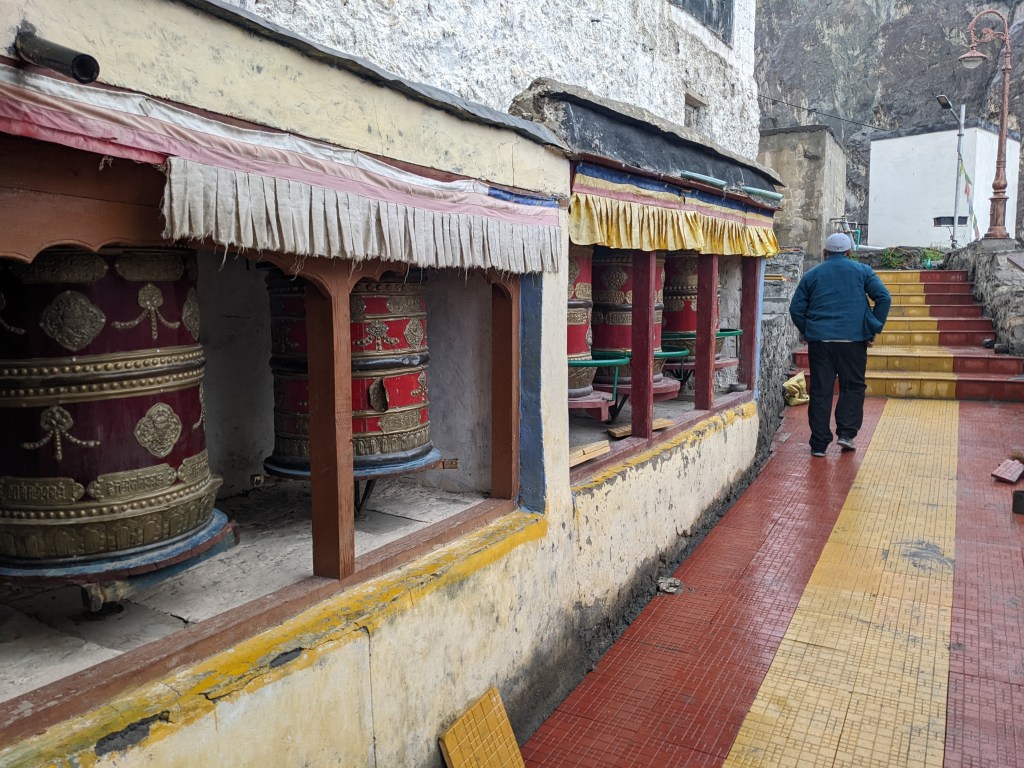
A prayer wheel and sleeping dogs outside where we are in Kharu
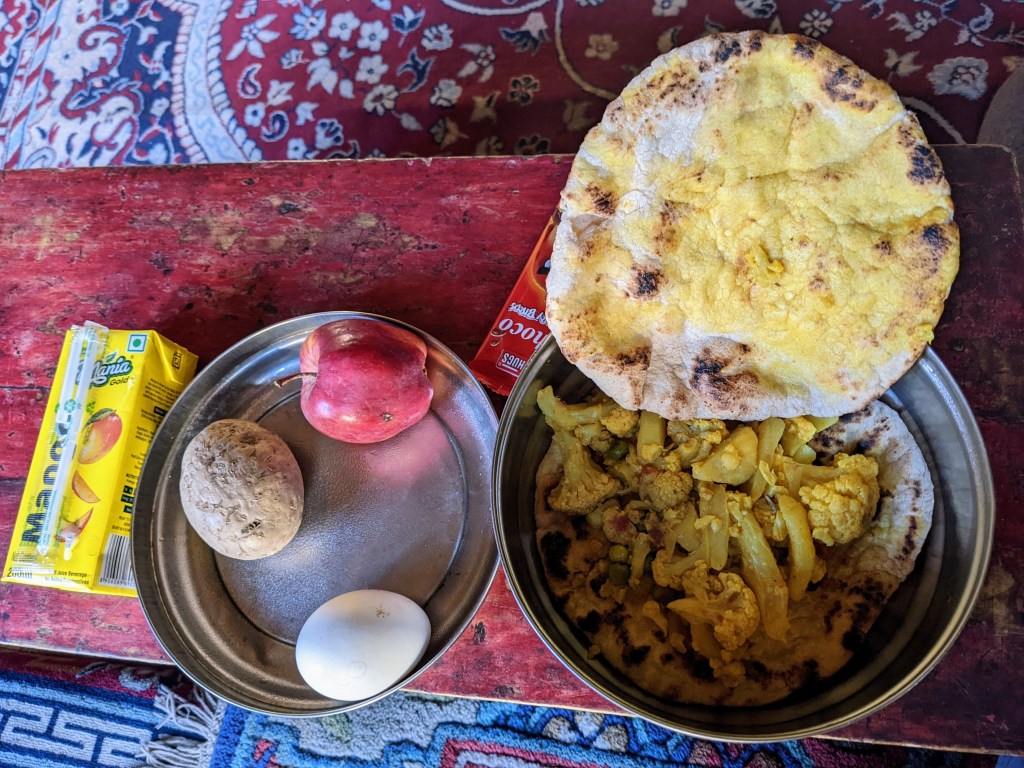
We both had a plate like the one pictured.

Finally by 2:40 PM we were back to Gangba homestay in Leh, and for the most part, my Ladakh adventure was over.

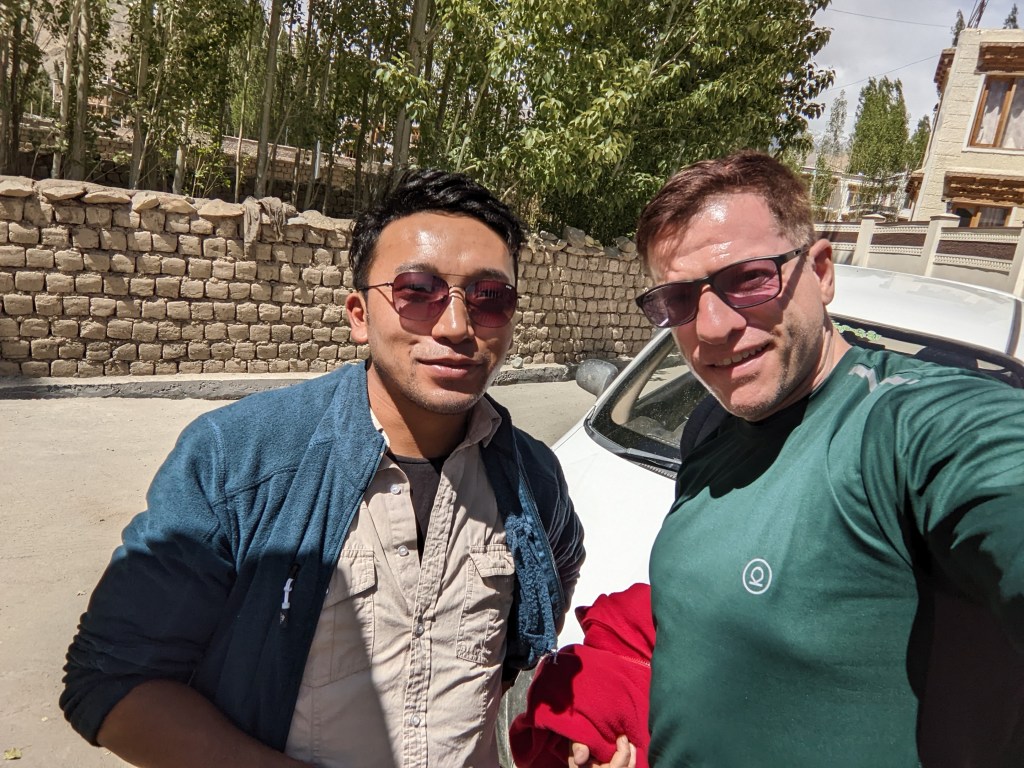
Dawa and I as we parted ways.

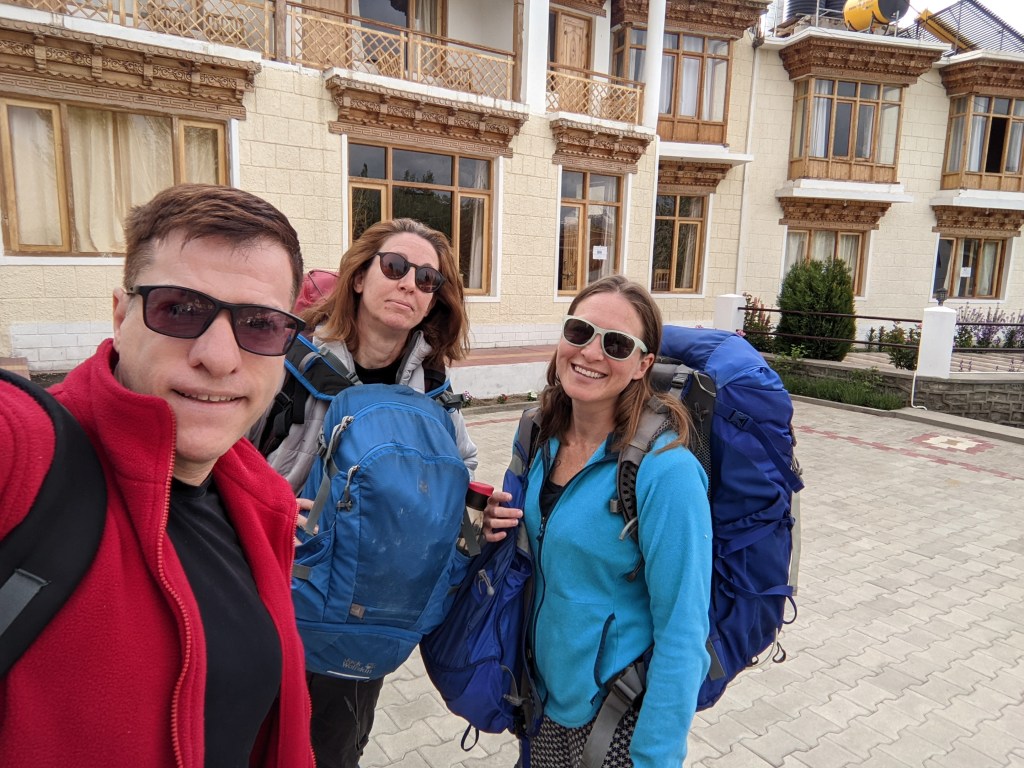
It was nice to catch up with Dorothée and Betsy over the next few hours and then early in the morning the next day we were off to the airport which was only about 15 minutes away by car.

I’m not sure if I’ll ever make it back to Ladakh, but I’m certainly grateful for the great experiences I had and the outstanding people I was able to share with as I explored different areas. A special thanks of course to Betsy, as it was she who first suggested the trip. Things went quite differently from what I had originally planned, but I can happily report that overall, the trip was a great success. Until my next travelling adventure, thanks for reading!

Ladakh trip: Day 10 (19-Jun)

While the bed was admittedly comfortable, getting up required quite a bit of courage, since the whole massive tent sleeping experience just doesn’t make that much sense when it’s this cold. Staying only one night, I still appreciated the novelty, but I wouldn’t recommend it for a longer stay.

After a quick breakfast, we were off to Diskit monastery (yellow hat sect) complex, arriving at around 8:30 AM. It was drizzling for most of the visit, but it was still possible to get around alright. Most visitors to the complex just go to see this one large statue, but Dawa took me up to the actual temple area. It was good that I had him with me, since otherwise I would have thought that the space was closed.

When visiting the earlier monastery, I had not fully understood a lot of the basic information, so I appreciated Dawa being there to explain more. This monastery was actually founded in the 14th century, but much of the current complex is either restoration or even fairly modern buildings. However, the actual temple area is the oldest section of the complex.

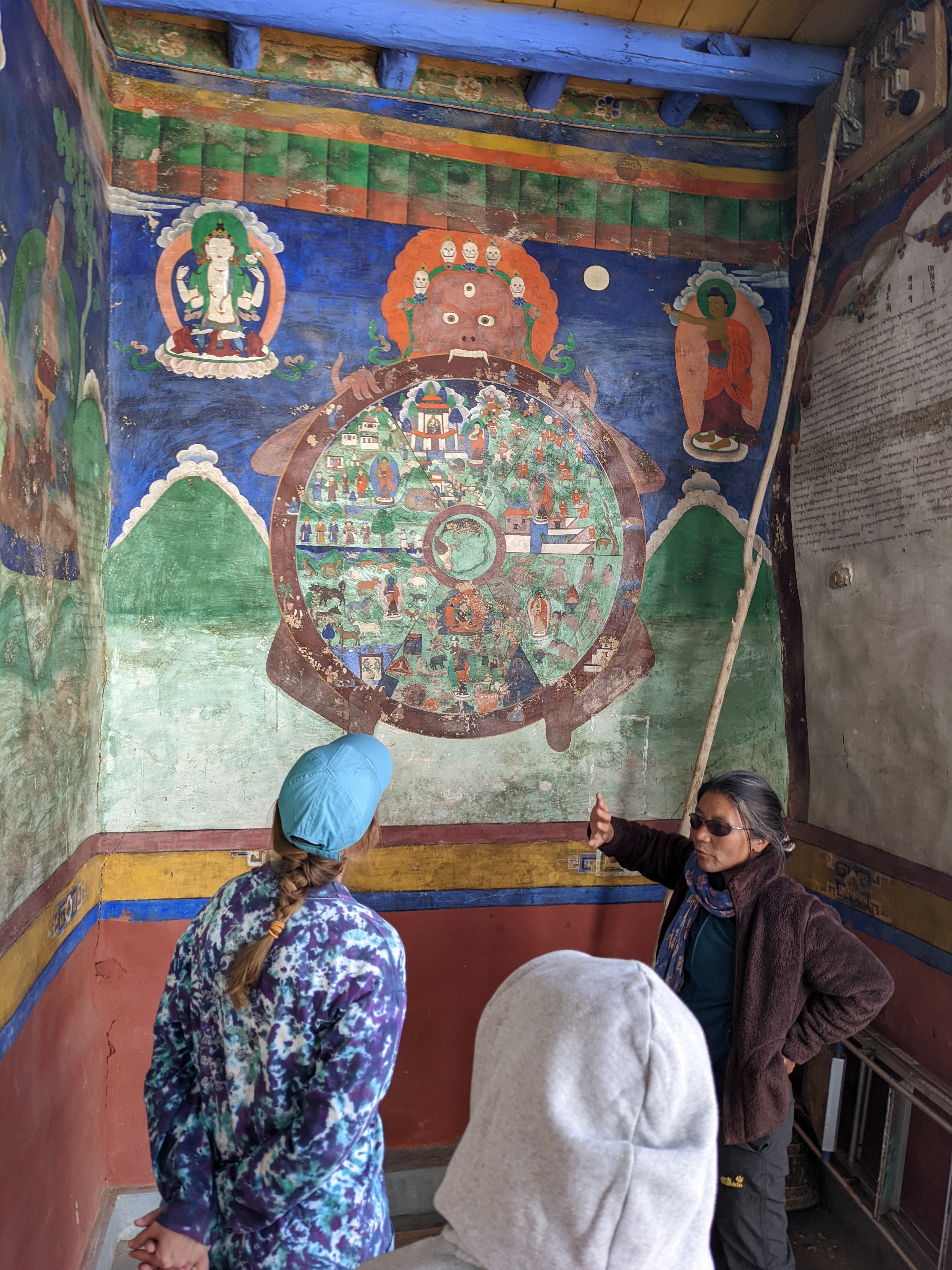
This depiction which is found near the entrance to most older Buddhist temples is NOT as I had earlier thought a representation of different sections of hell, but rather a representation of the six different realms in which humans can live. Interestingly enough, in the most advanced realm, humans essentially live as “deities” but they still are not “enlightened”. It is only after one is enlightened that one can leave the cycle of death and rebirth.
Also found at the entrance to most temples are the four guardians, deities who originally opposed Buddha, but with time came to be defenders. They correspond to the four cardinal directions.

I didn’t actually take any pictures in the main temple building, because there was a big sign saying all photos were prohibited. Normally, since I’m not using a flash, I would have taken pictures anyways as long as nobody was worshipping, but Dawa was with me and he is obviously a devout Buddhist, and I didn’t want to cause offense. Still, if you do get a chance to see the temple room, it really is quite different from others which I’ve visited, and in particular if you have a decent guide, it’s definitely worth visiting.

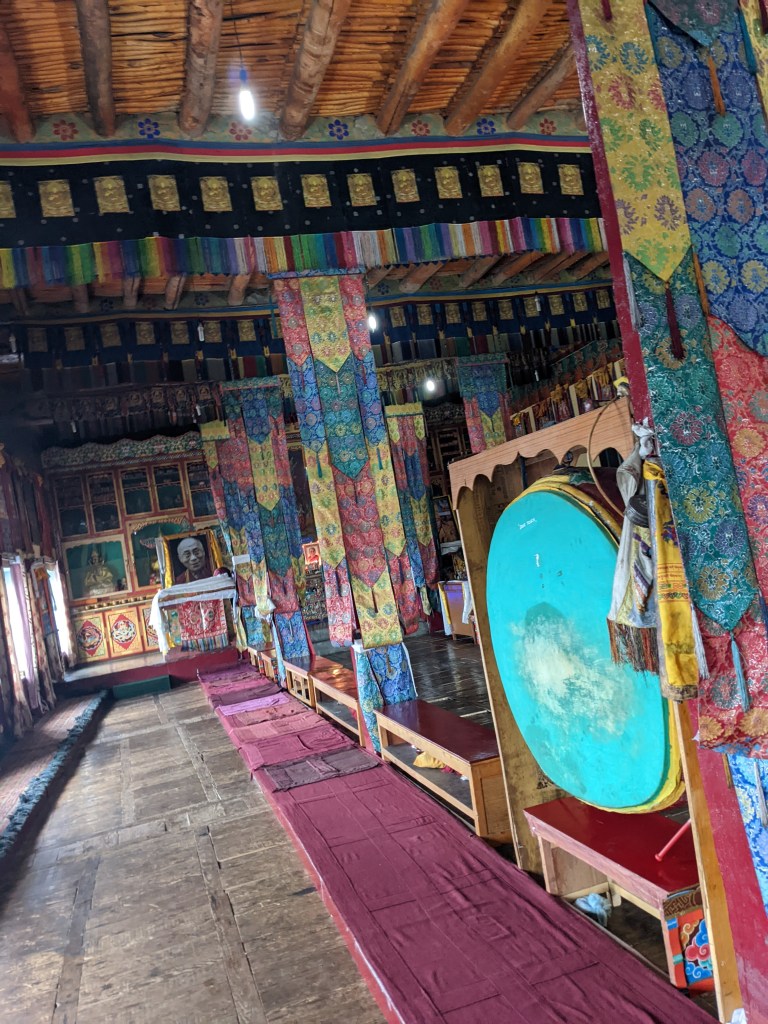
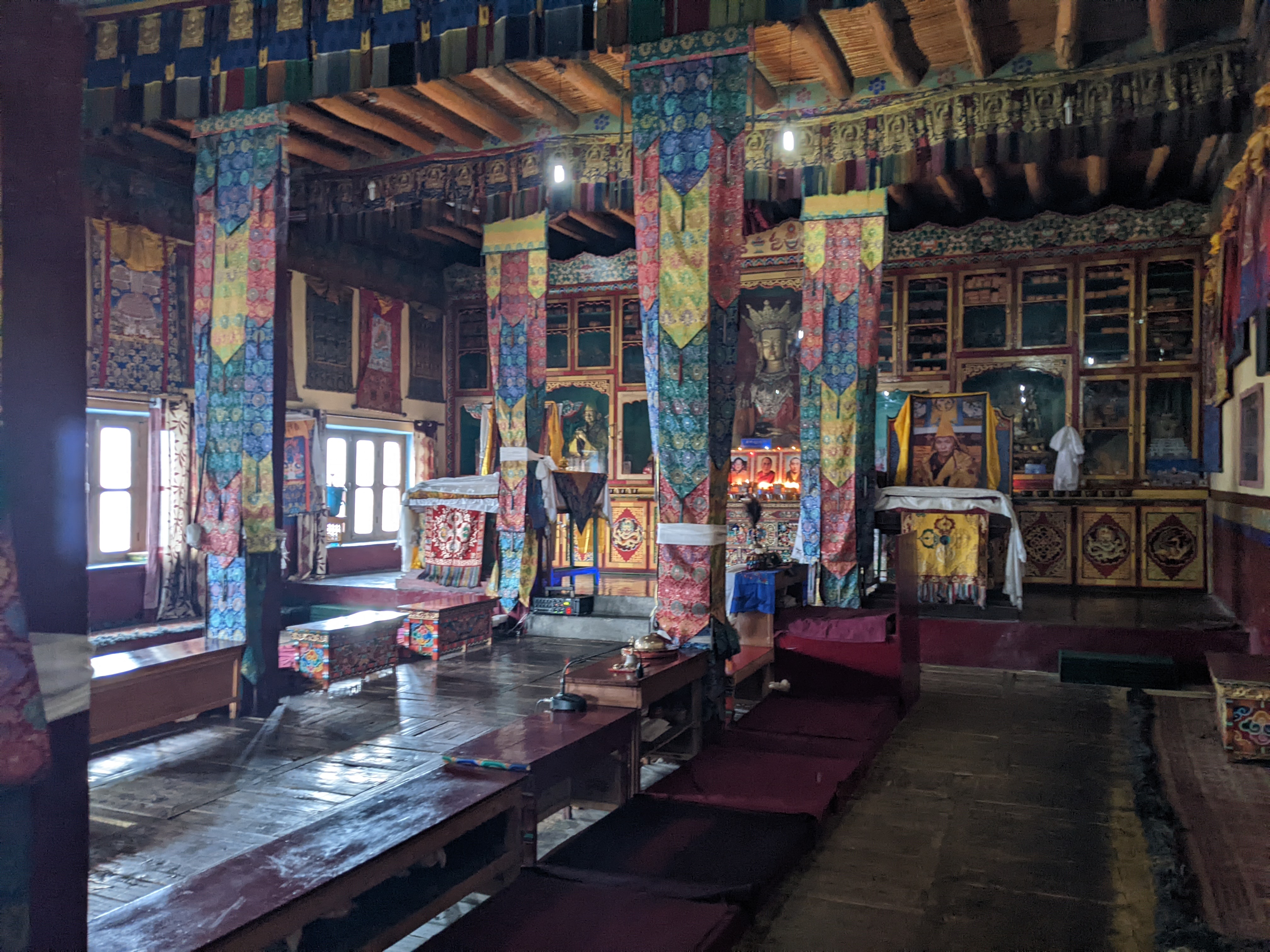
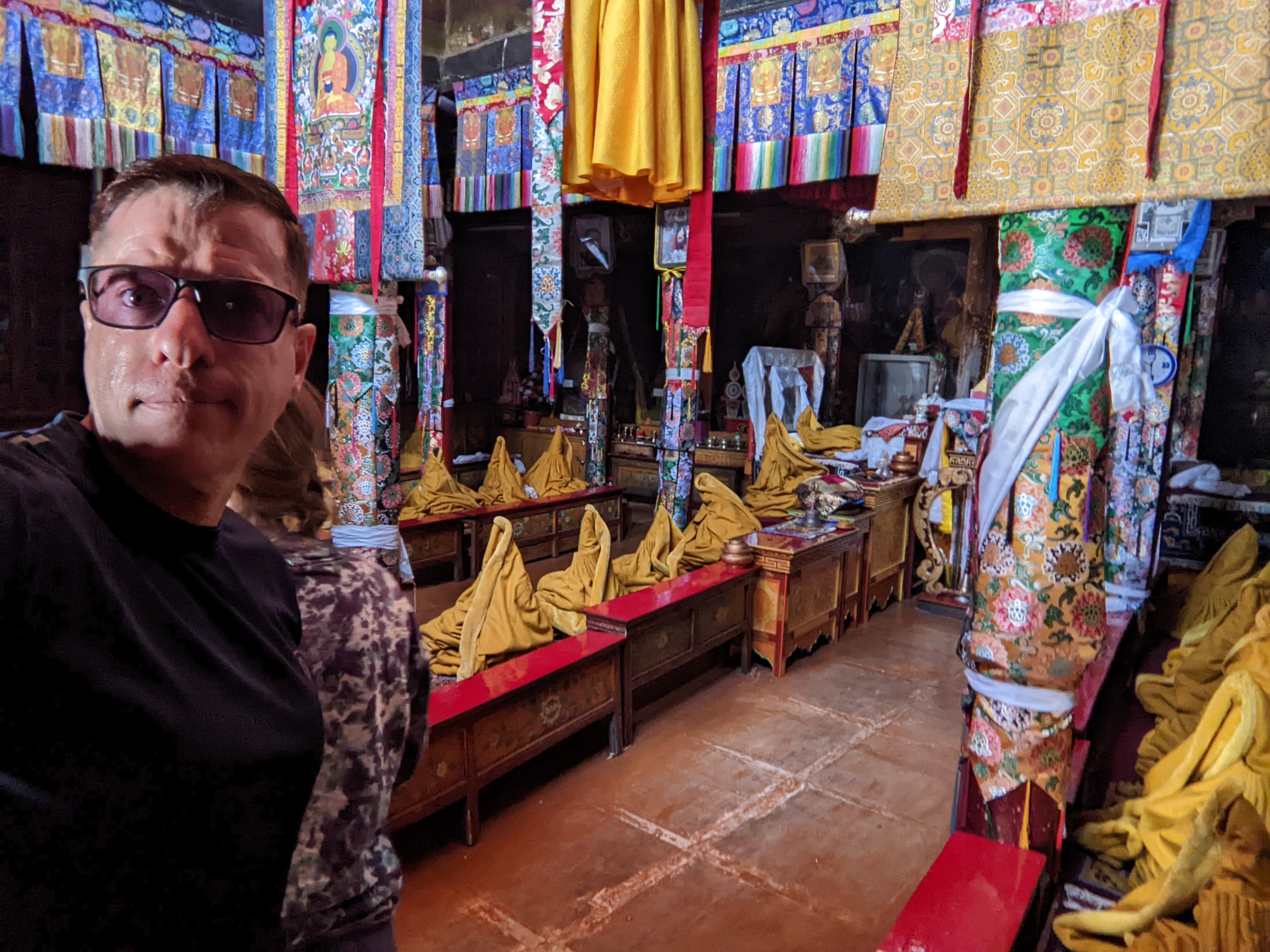
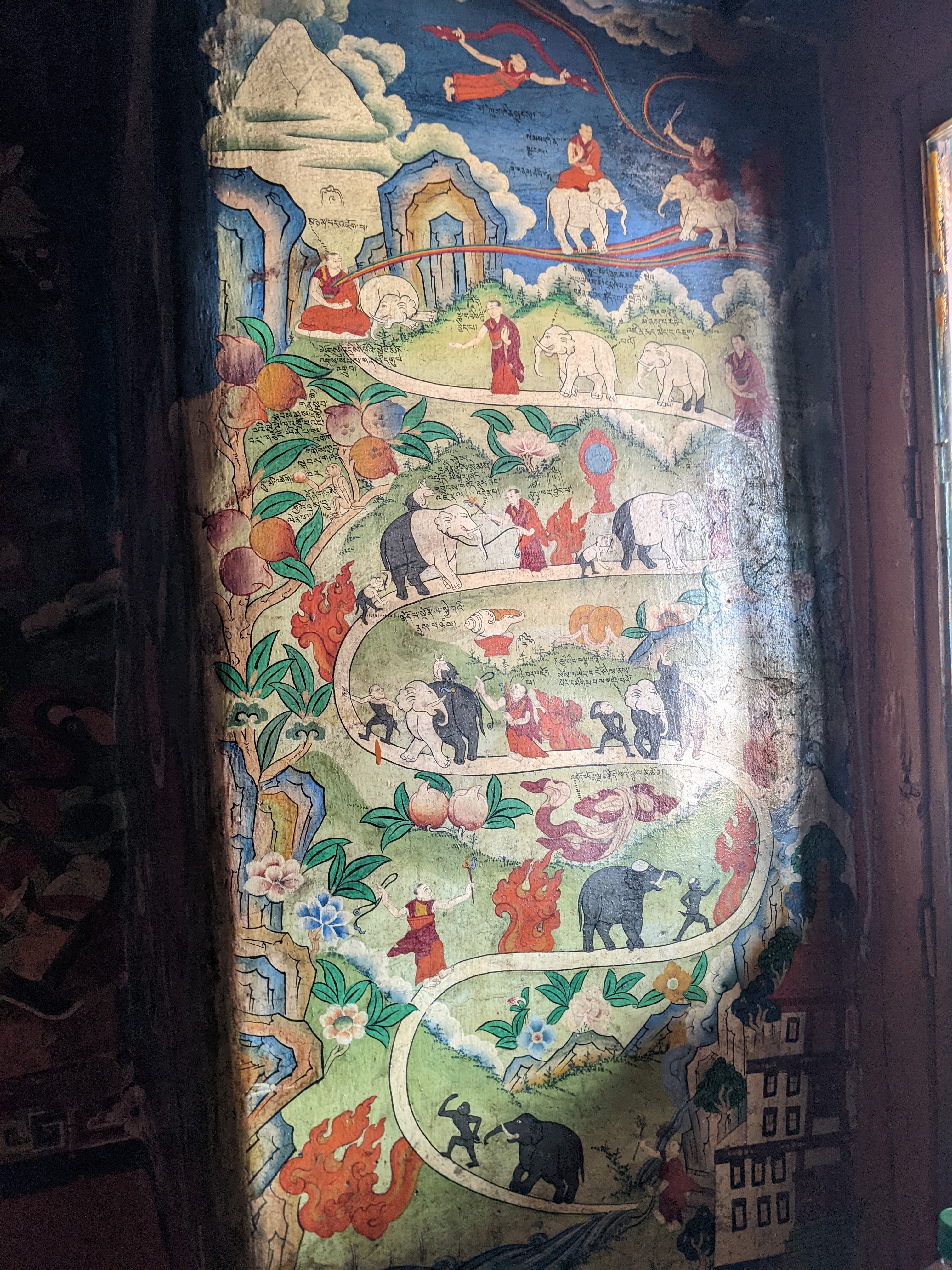
Very near to the temple is the prayer room. While it’s not near as packed as the temple, it’s very beautiful. Again, ideally you would visit this with a guide. Dawa, was more than willing to go into great detail about everything, but I was already a bit overwhelmed, so I don’t remember most of the details.

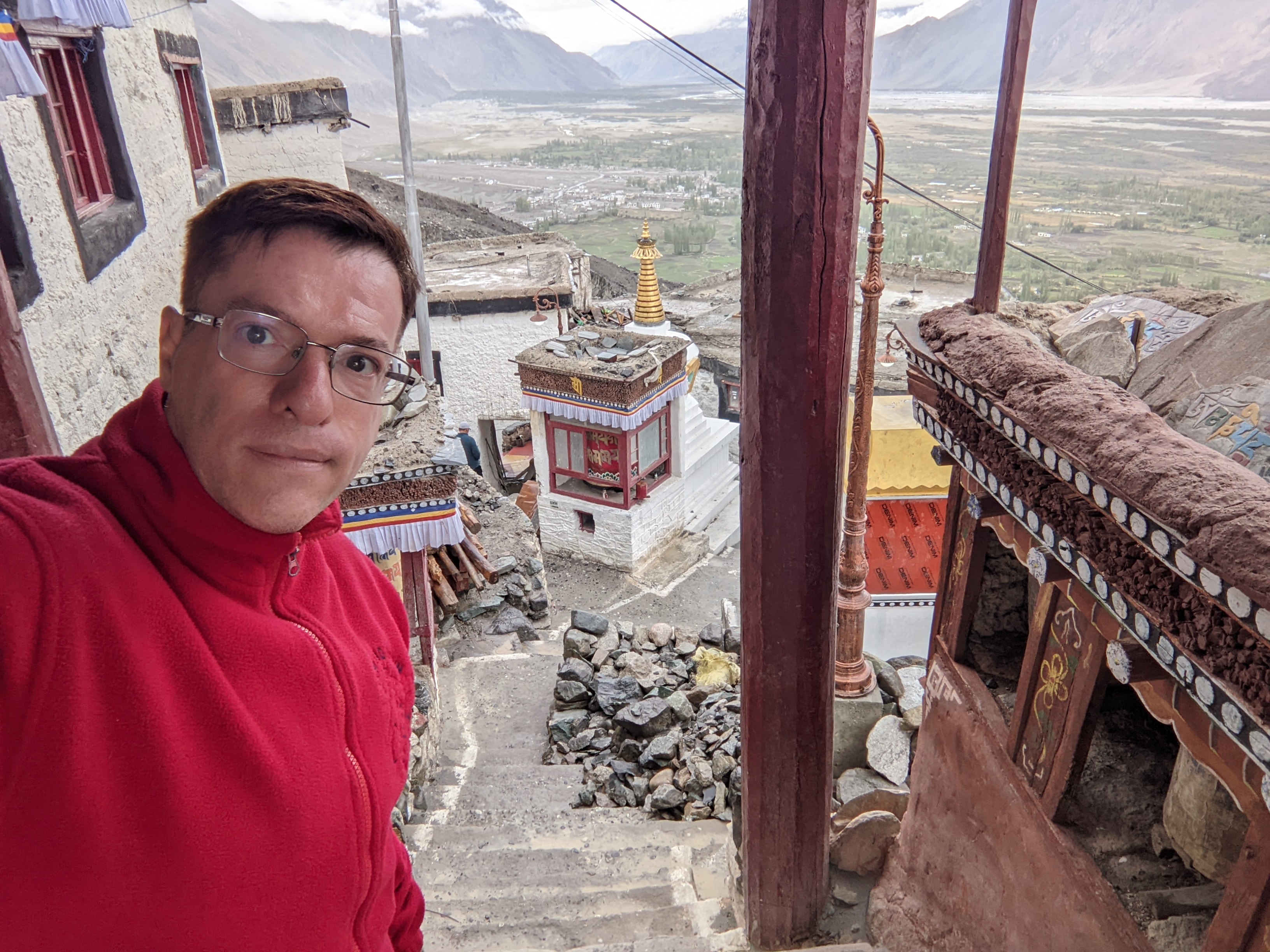
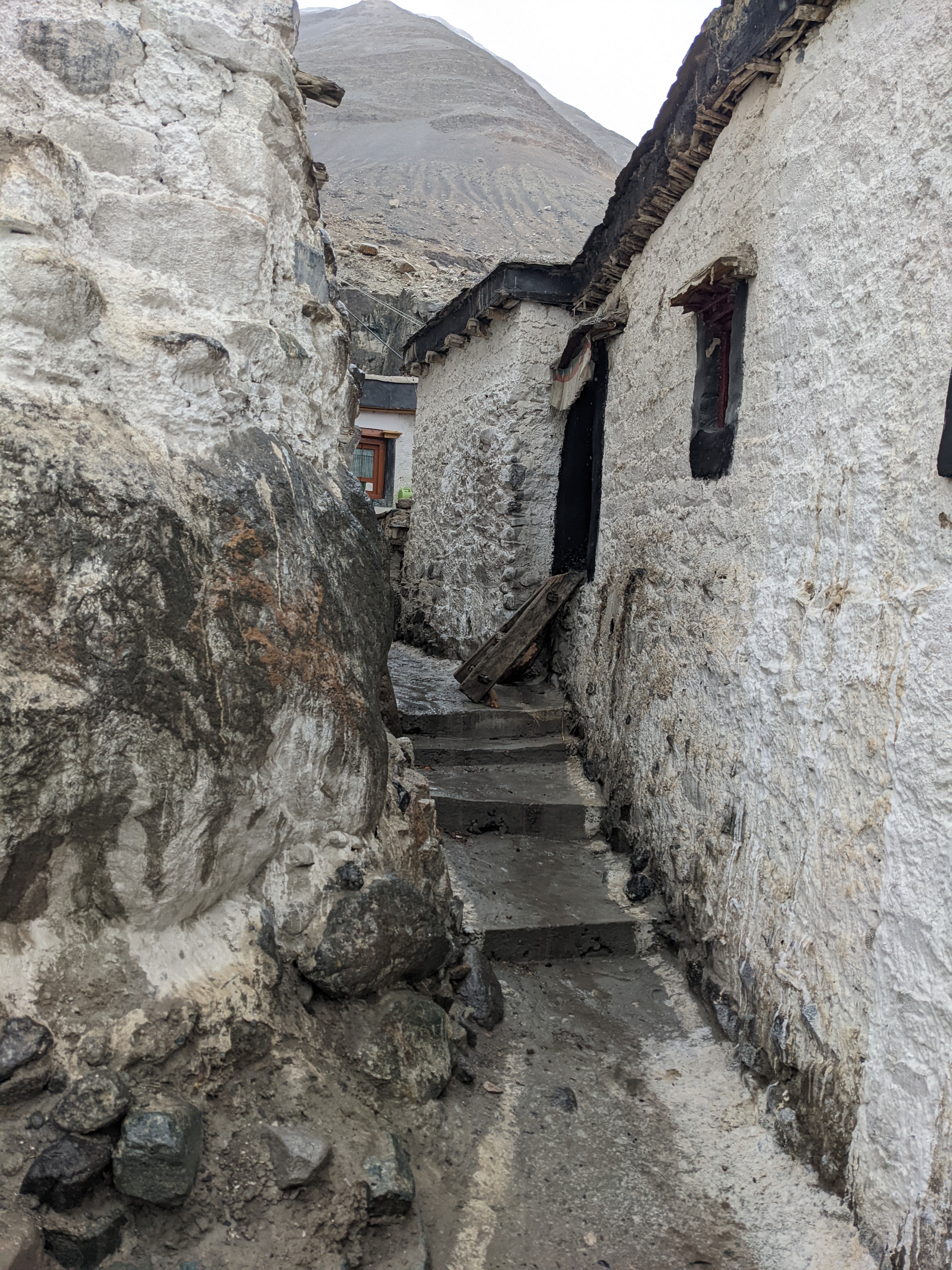
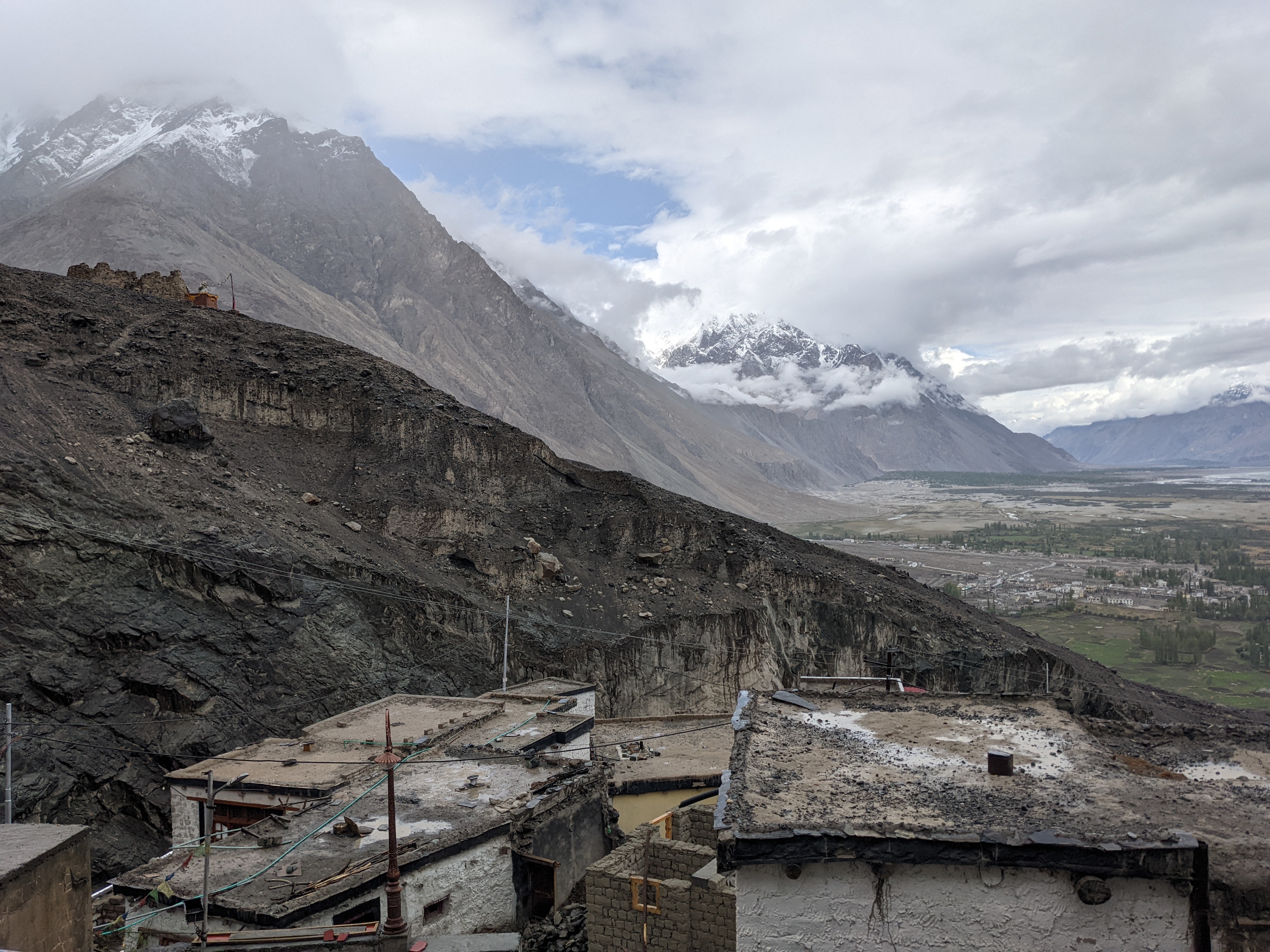
After spending some time in the prayer room, we walked back down to the car. Clearly much of this area was currently in the process of being restored; whereas, other sections were similarly in need of the same. As we were very high up, there were excellent views of the surrounding area.

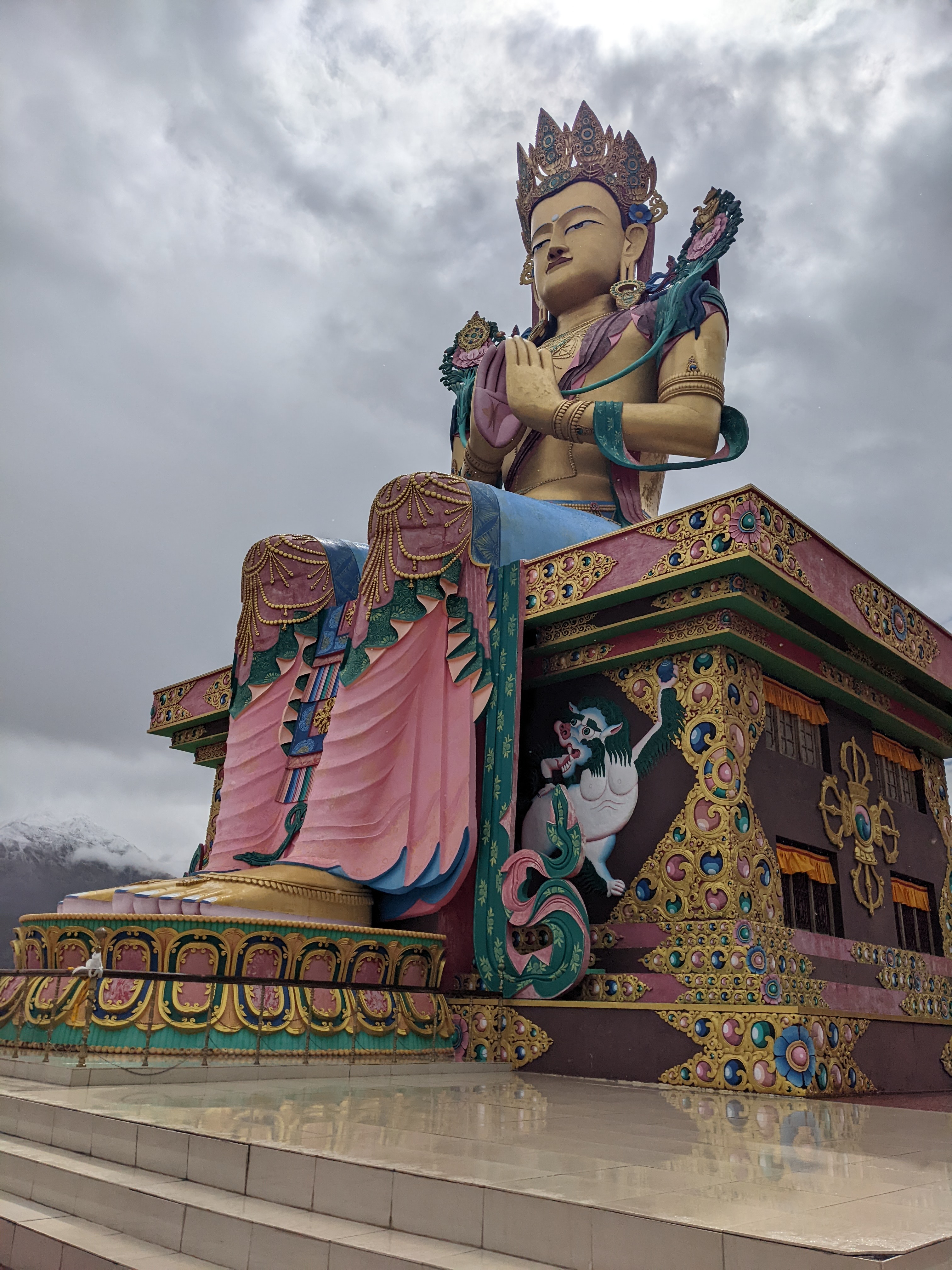
I wasn’t especially keen to head over to see the massive statue of a crowned Buddha, but we were already here, so I figured may as well have the whole experience.

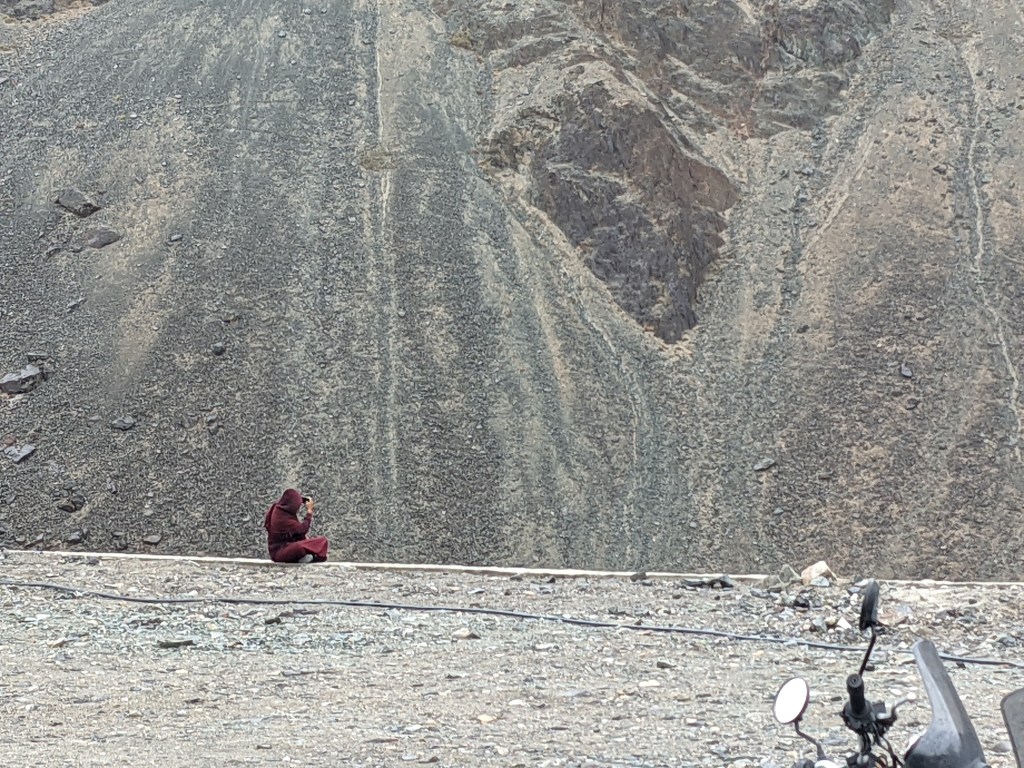
It’s hard to appreciate in the picture, but this was clearly a monk off in the distance taking selfies.

This statue, which faces Pakistan was supposedly built to promote peace between India and Pakistan. I couldn’t help thinking that it might actually be counter productive to a peace process. Does a Muslim majority (overwhelming) country really see a huge statue of what for them is an idol, facing them, to be a gesture of peace?

By 10:10 AM we were headed towards Pangong Lake area. Thankfully the road, at least starting out, was not at all crowded and the weather was clear despite the rain from earlier in the day.

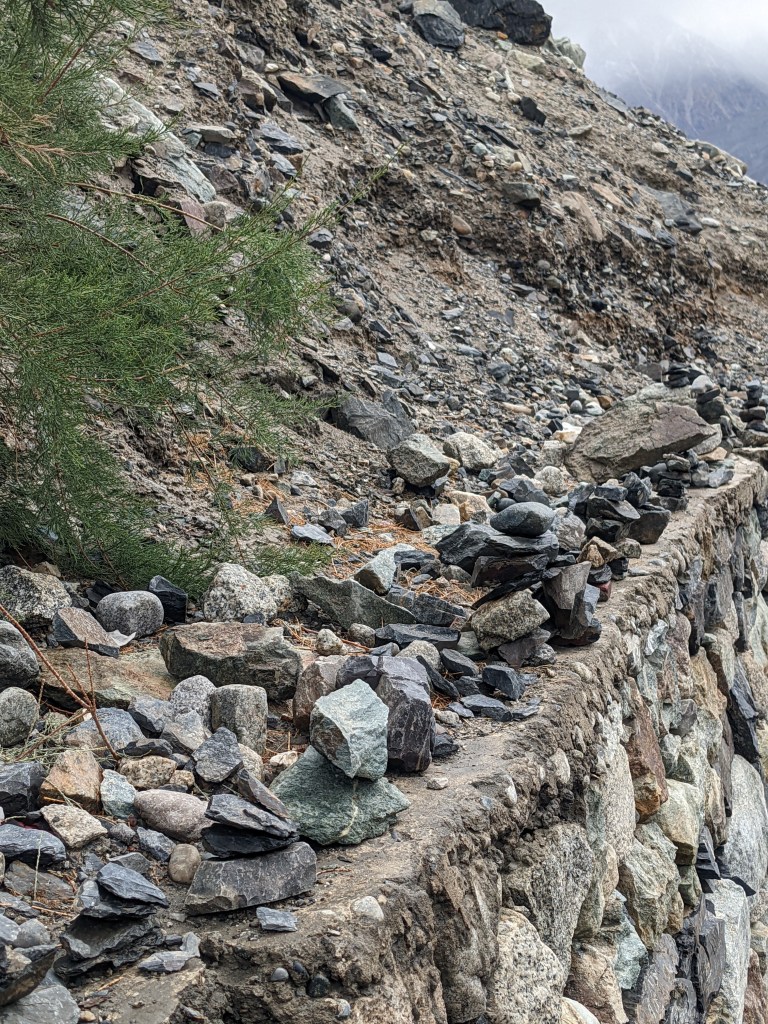
It’s hard to appreciate here, but the wall on the walkway headed up to the statue was full of various stacks of rocks which had been left by visitors.
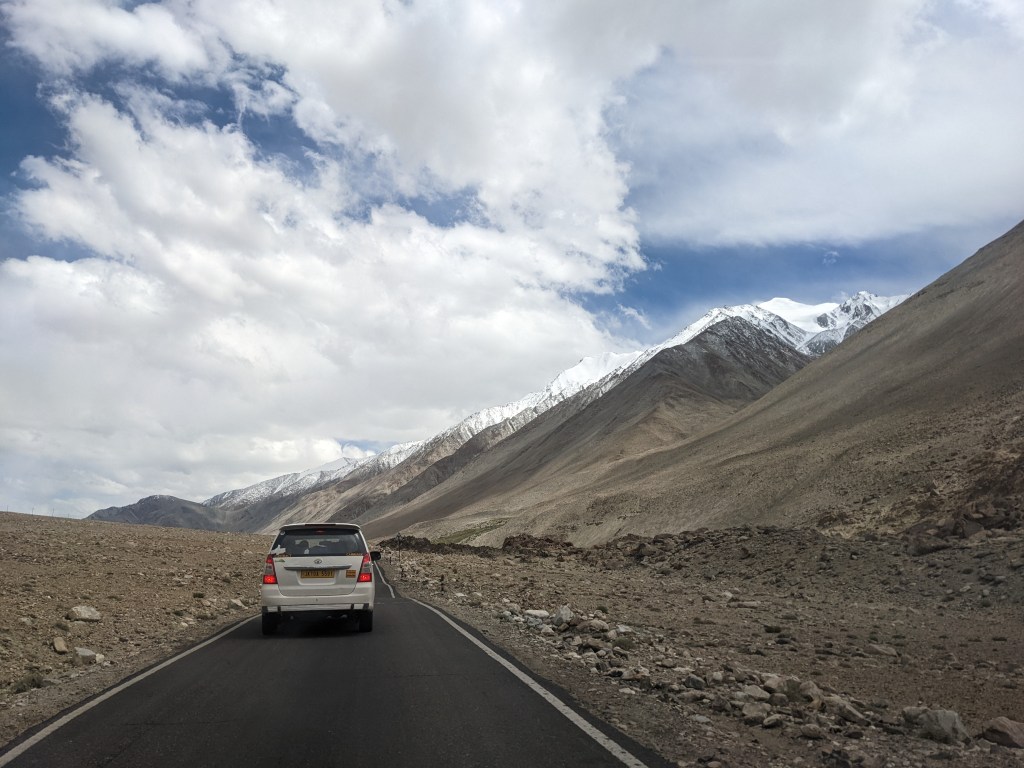
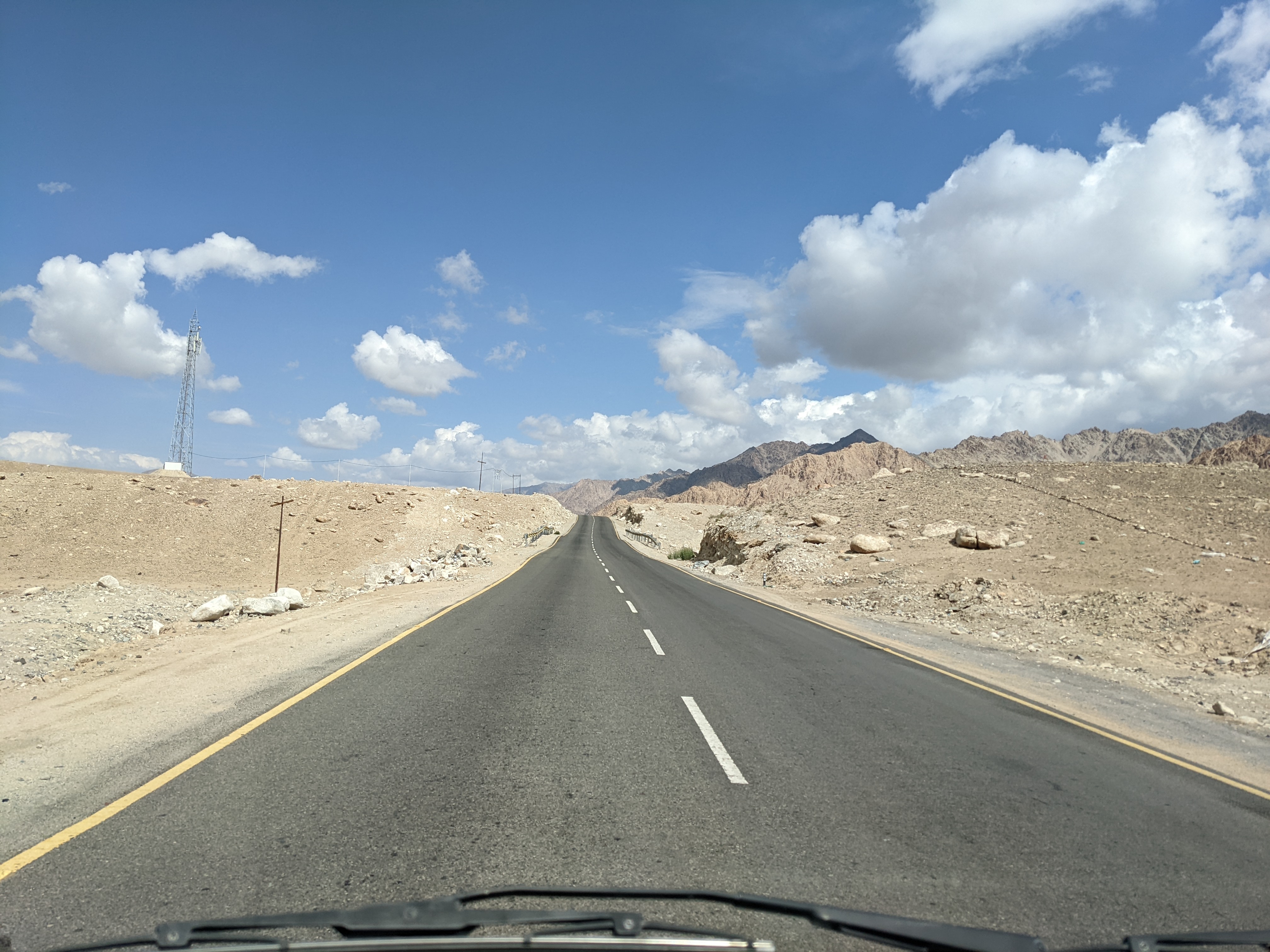
I had hopes that the road would be like this all the way to Pangong.

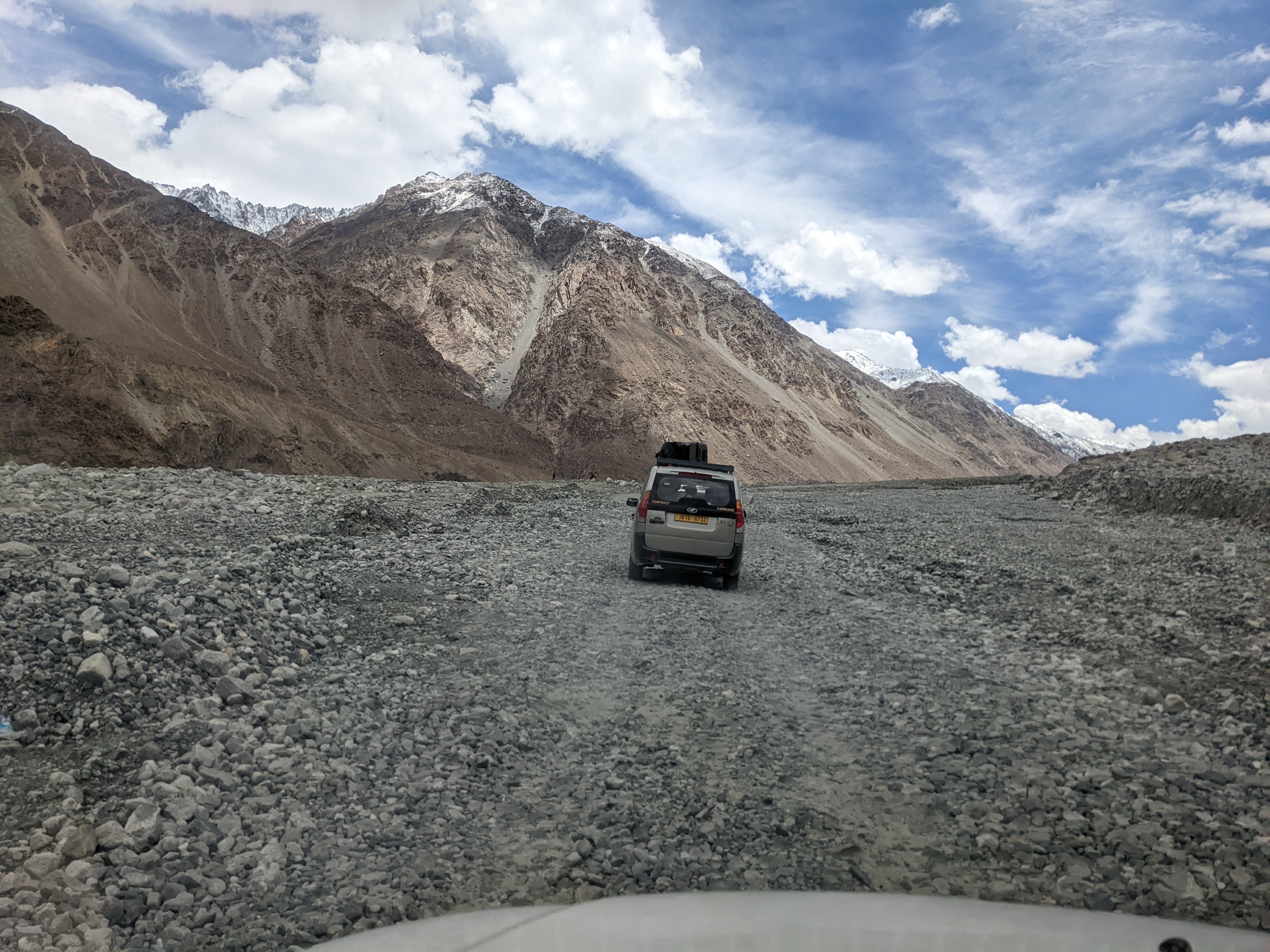
At 11:20 AM, we hit backed up traffic again. Thankfully this was cleared up by 11:45, and we once again continued on through winding roads, which frequently were in rather good condition, but at seemingly random spots, the pavement would suddenly disappear and it would be all rocks with no obvious sign where one was actually supposed to drive.

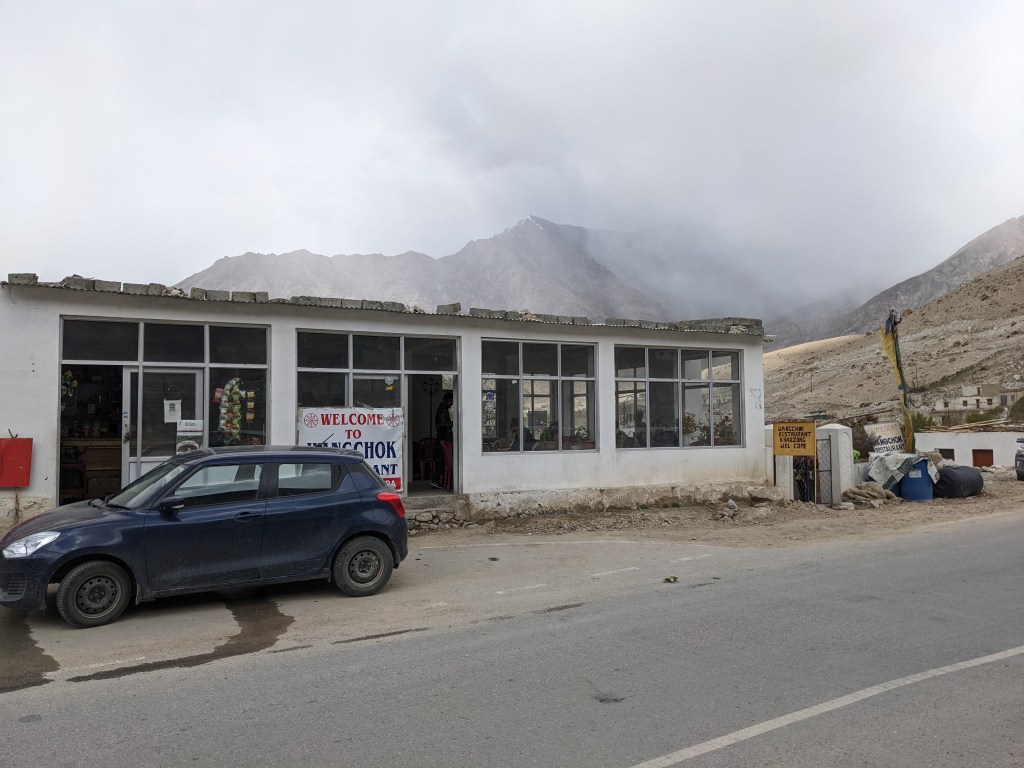
At 1:40 PM we ostensibly stopped for a simple lunch, but more importantly Dawa was a bit concerned about the tires, so he took the car for a quick checkup. Here there was also another security checkpoint; I know, it all seemed a bit excessive and bureaucratic, but fortunately Dawa handled everything. Lunch itself could have been worse, but certainly it was nothing to mention beyond that.

By 2:15, we were once again on the road. The mechanic had indicated that yes, some work needed to be done before heading back up a mountain, but we could wait until reaching our final destination. The road here seemed to be in excellent condition, and driving was easy. Of course, there were the ever present mountain peaks in the background.

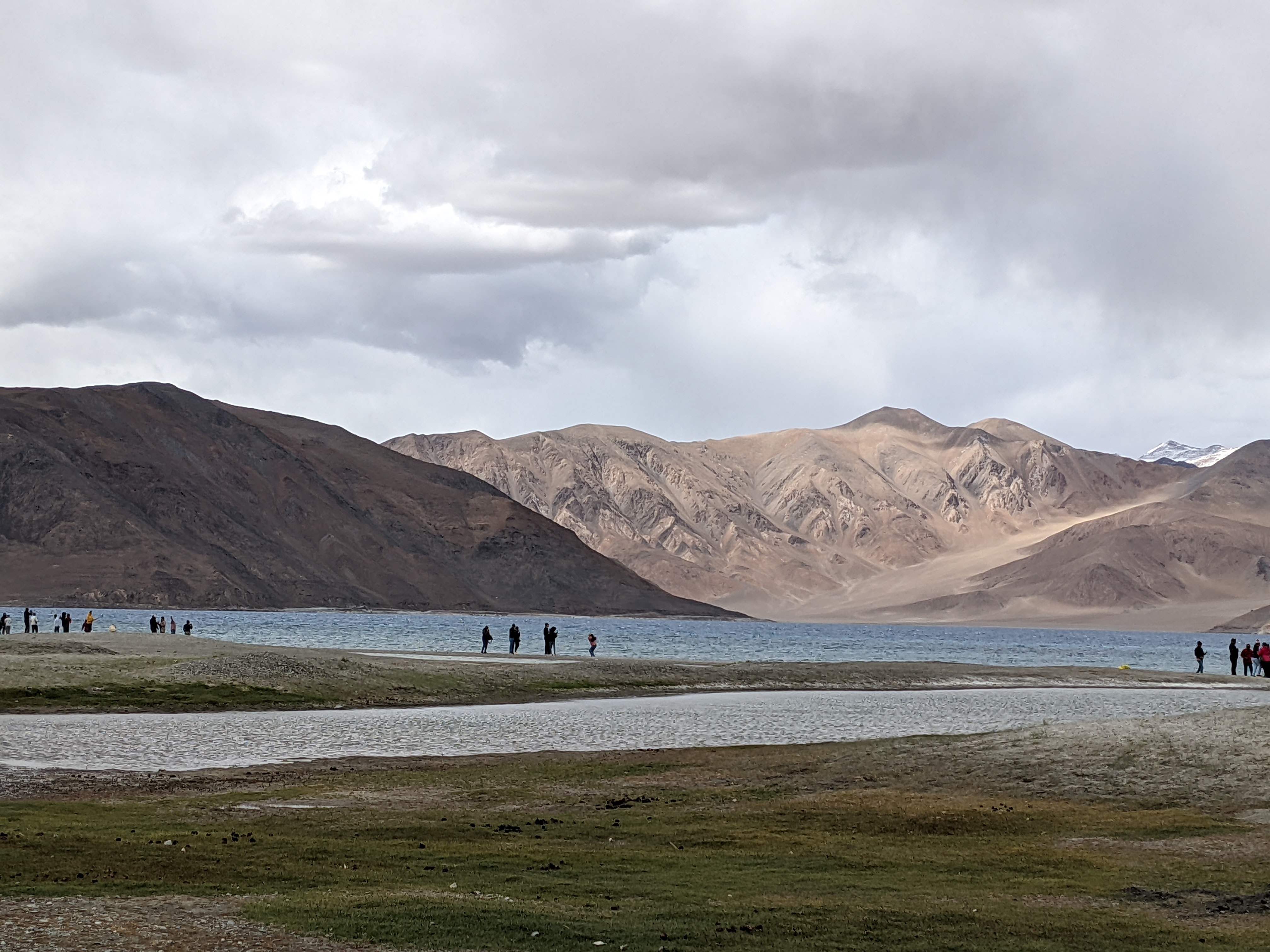
Finally at 3:25 PM we arrived to Pangong Lake. I had been warned that since the day was overcast, the lake would not look as spectacular as when it was sunny, so one should probably remember that as it relates to my comments. Yes, it was very pretty, and yes the water was crystal clear. However, I honestly thought it was a bit overrated, especially when considering just how hard it was to reach. Furthermore, civilians aren’t allowed to enter the lake, not even in a paddle boat or a row boat, so there just wasn’t much to do. So, should you go? I guess that depends on how much you like looking at lakes and how much time you are willing to spend to get there.

I did rather like these small bunches of flowers growing in the Sandy soil near the lake.
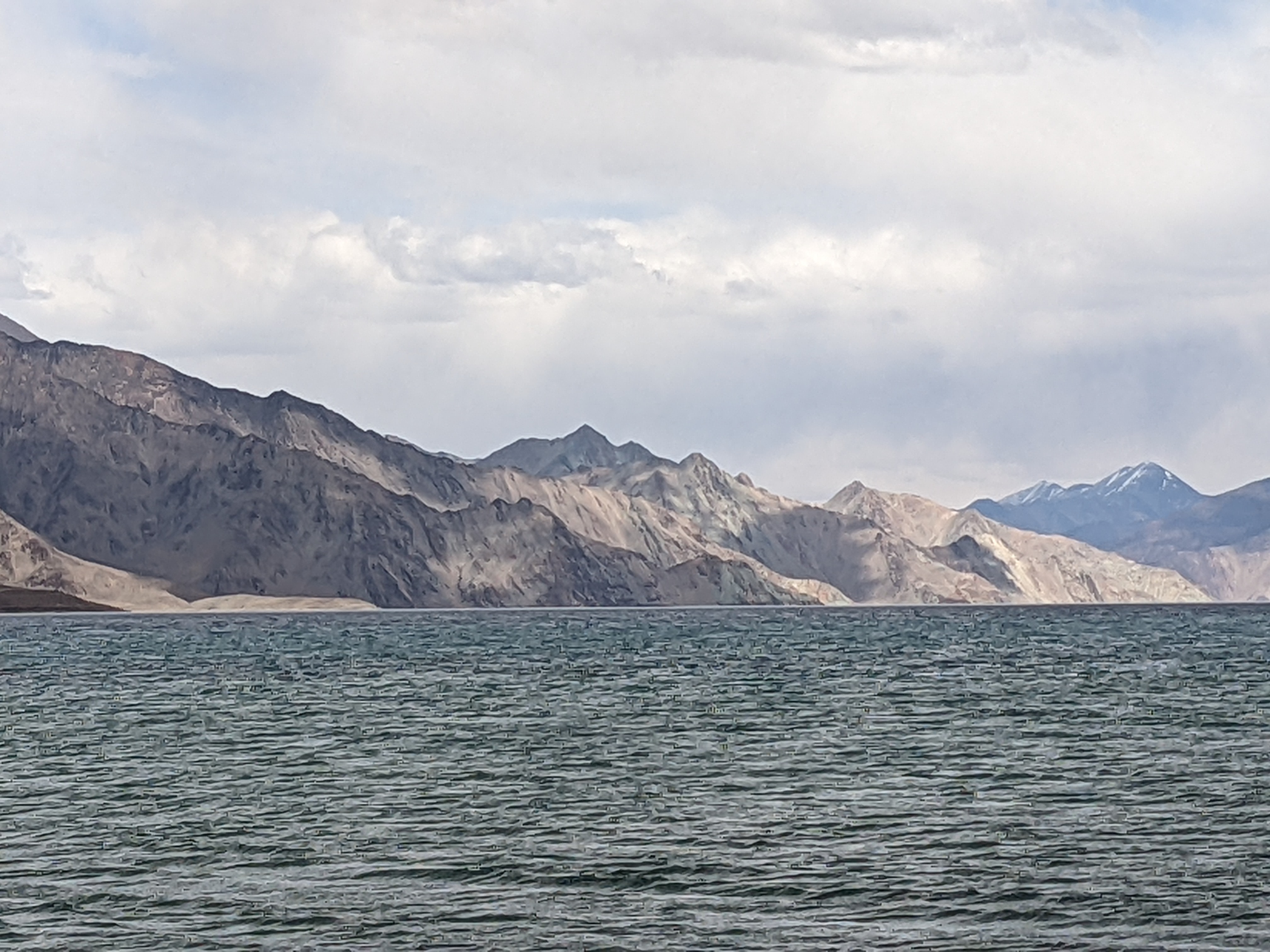
The view across a section of the lake.
It was rather windy with a temperature of about 3 degrees Celsius (37 F) and my face was so cold I couldn’t really feel it anymore, so that also contributed to my less than ultra enthusiastic appraisal of the lake
There were at least a couple hundred visitors to this particular section of the lake, but as it really is very large, it was easy to find an area far away from everyone else and walk peacefully along the shore.

Yes, I am still happy that I visited the lake area. It IS nice, but I was certainly ready to leave after about twenty-five minutes. Other people seem to really love it and about 500 meters away from the shore there are several tent camps which from the outside appeared to be similar to where I had stayed the night before.

At 5:00 PM we arrived to Tangtse village. This is where Dawa grew up, and his parents still live there and have a homestay.

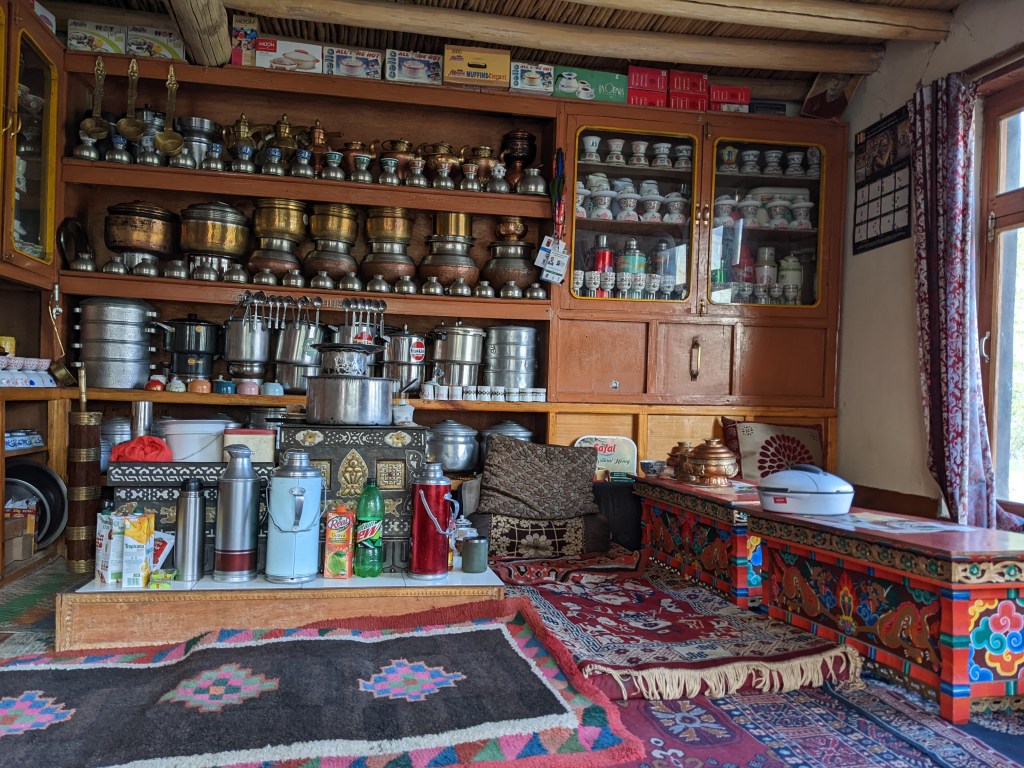
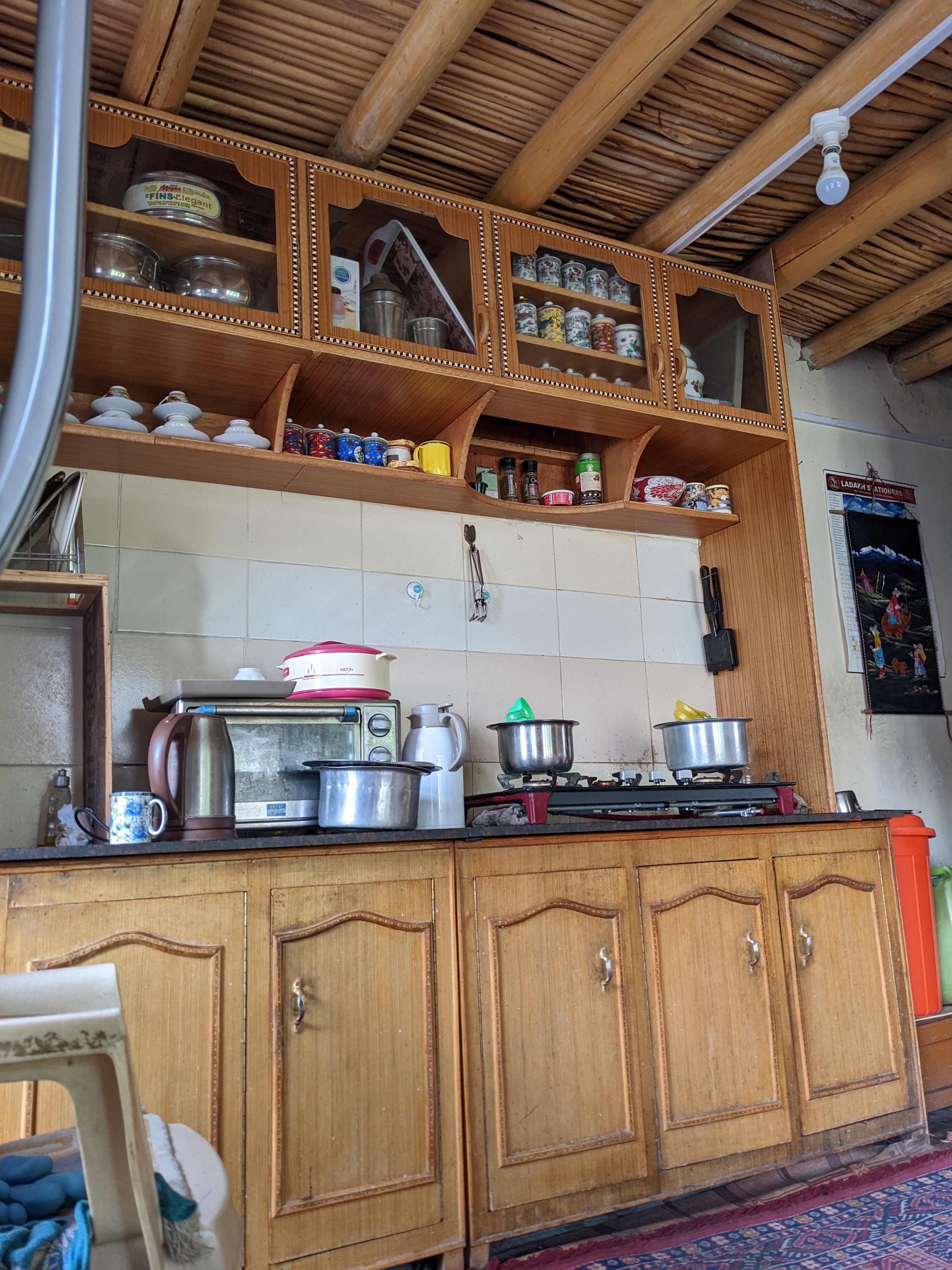
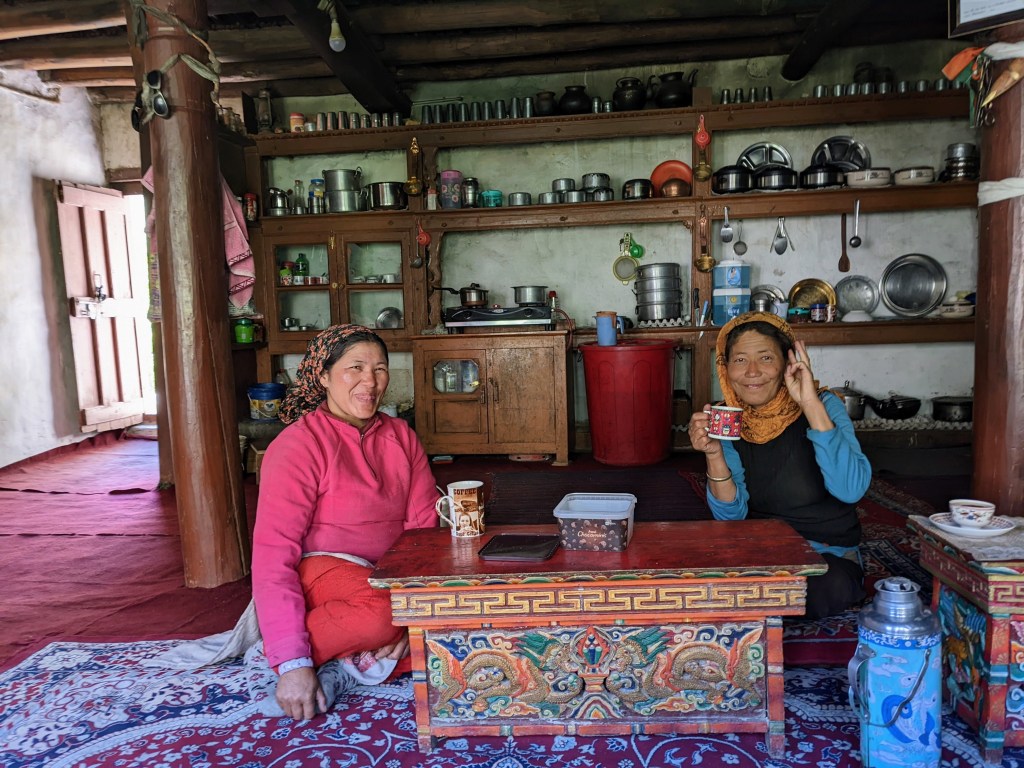
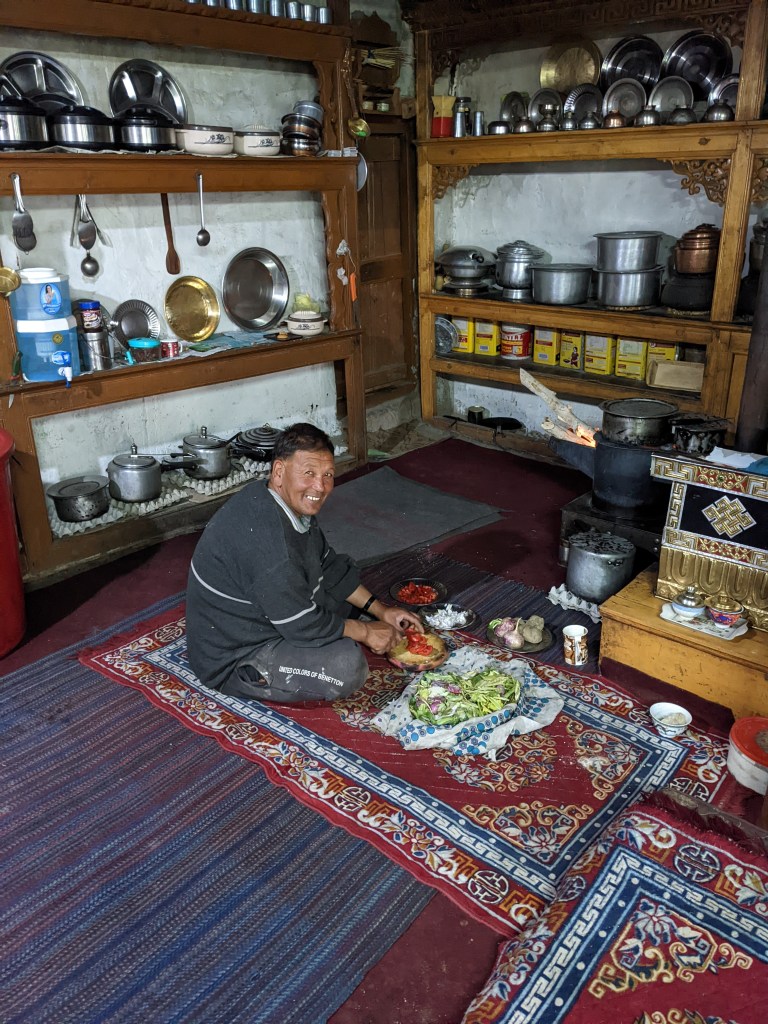
The kitchen seems to be the main social area of Ladakhi homes. There was a separate large sitting room, but I said I preferred to be with them where they would normally visit as a family. This made sense since I was the only outside visitor at this time.
They had a modern LPG stove top.
Dawa’s aunt was washing some clothes in the mini canal next to the house. Most of the water was currently being diverted to nearby crops.
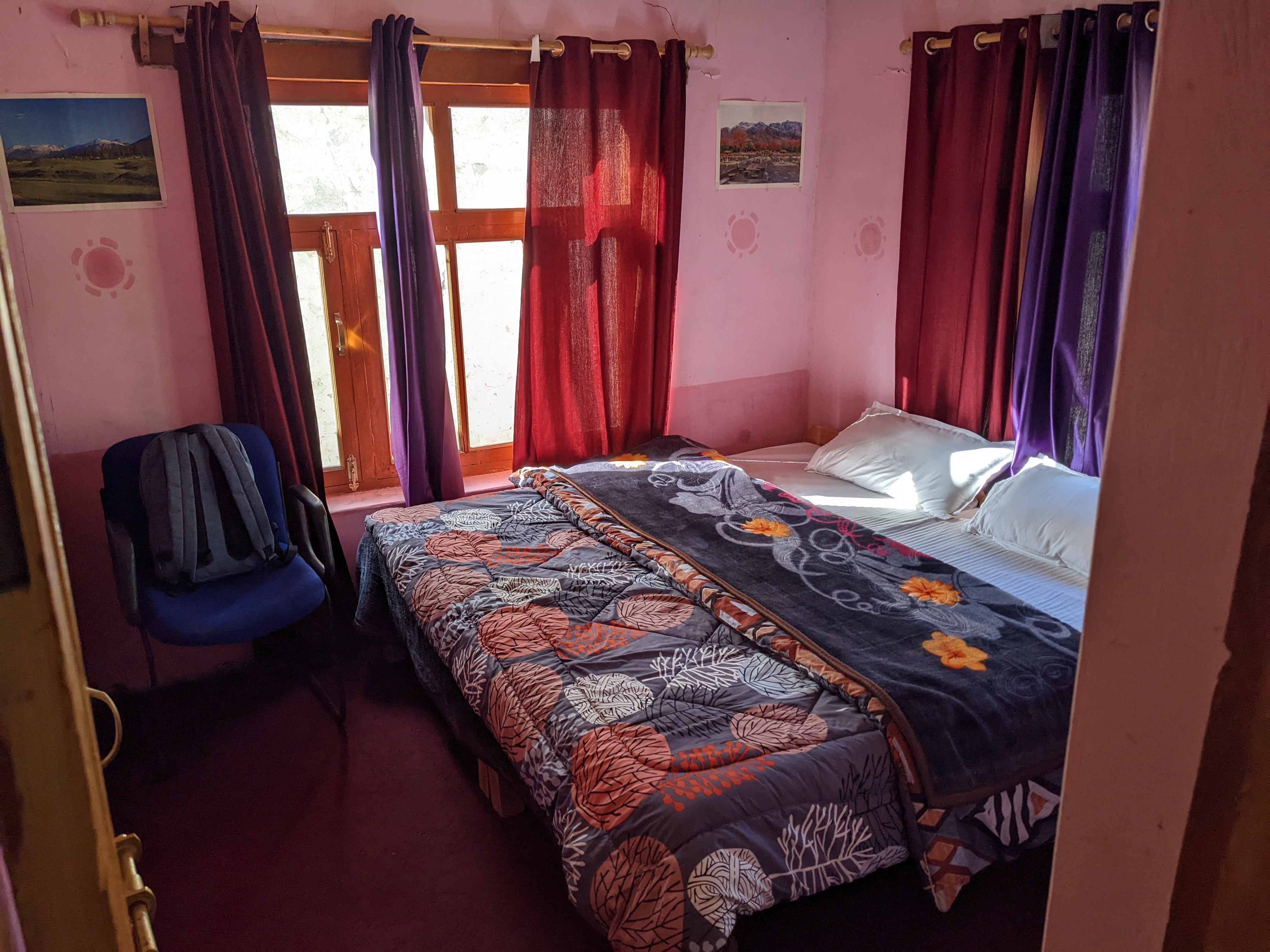
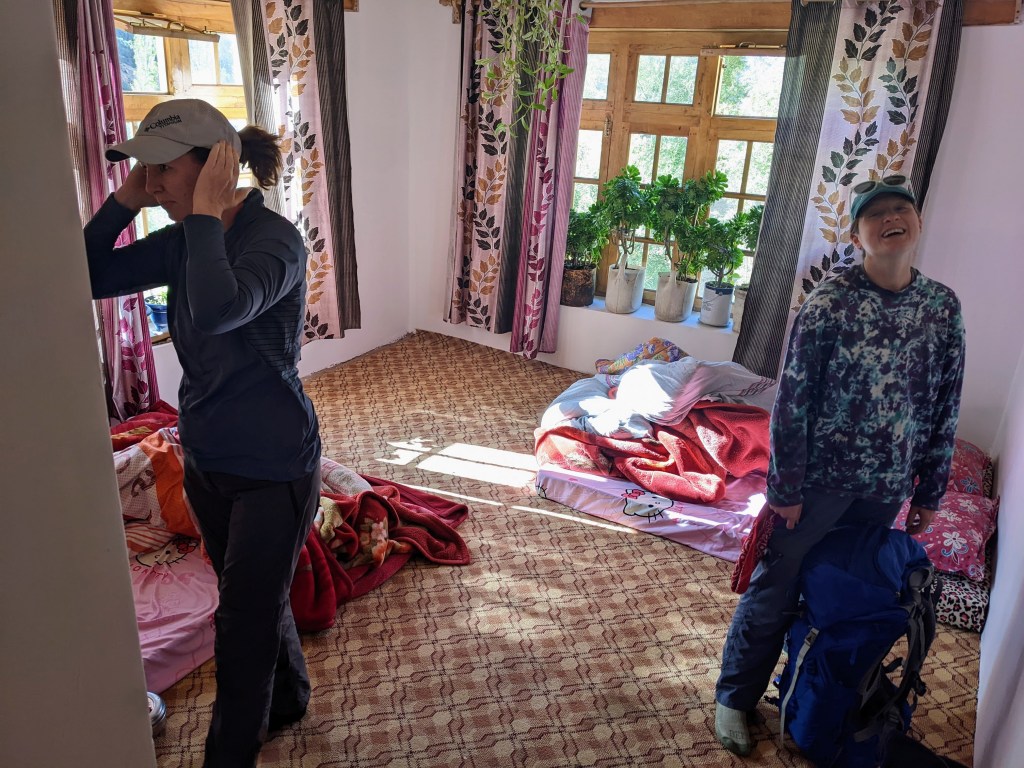
My bedroom was more than adequate with plenty of natural light.

Dawa needed to take the car to the mechanic, so after about twenty minutes, I decided to go out walking on my own to explore both the surrounding immediate countryside and then the village itself.

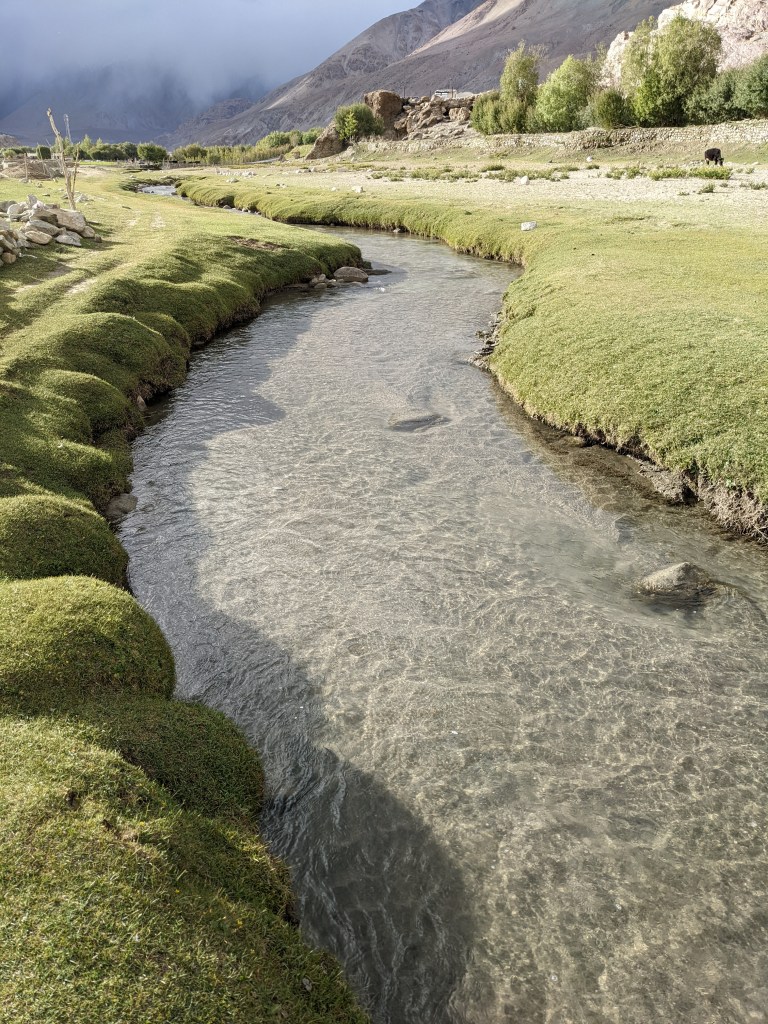
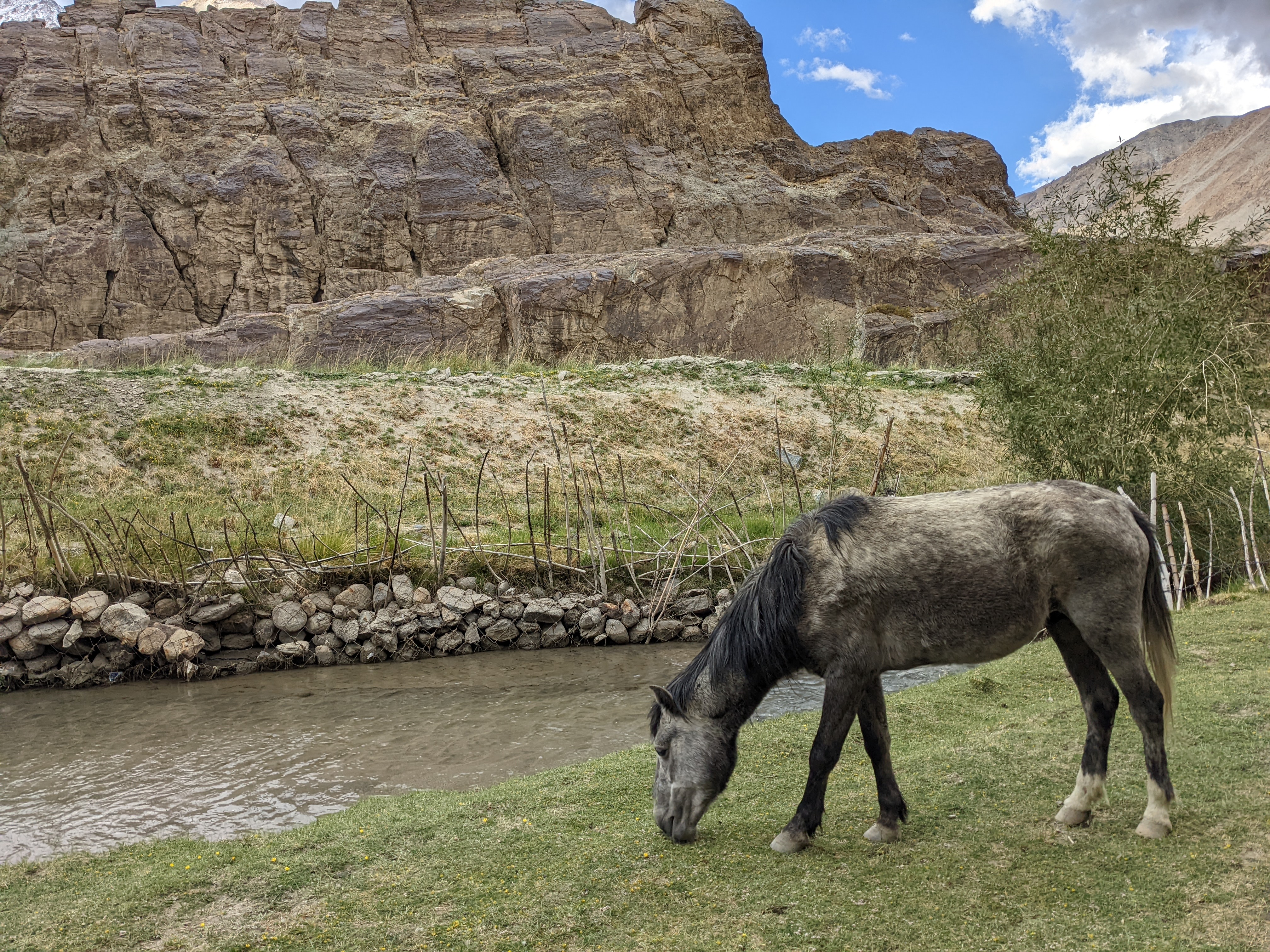
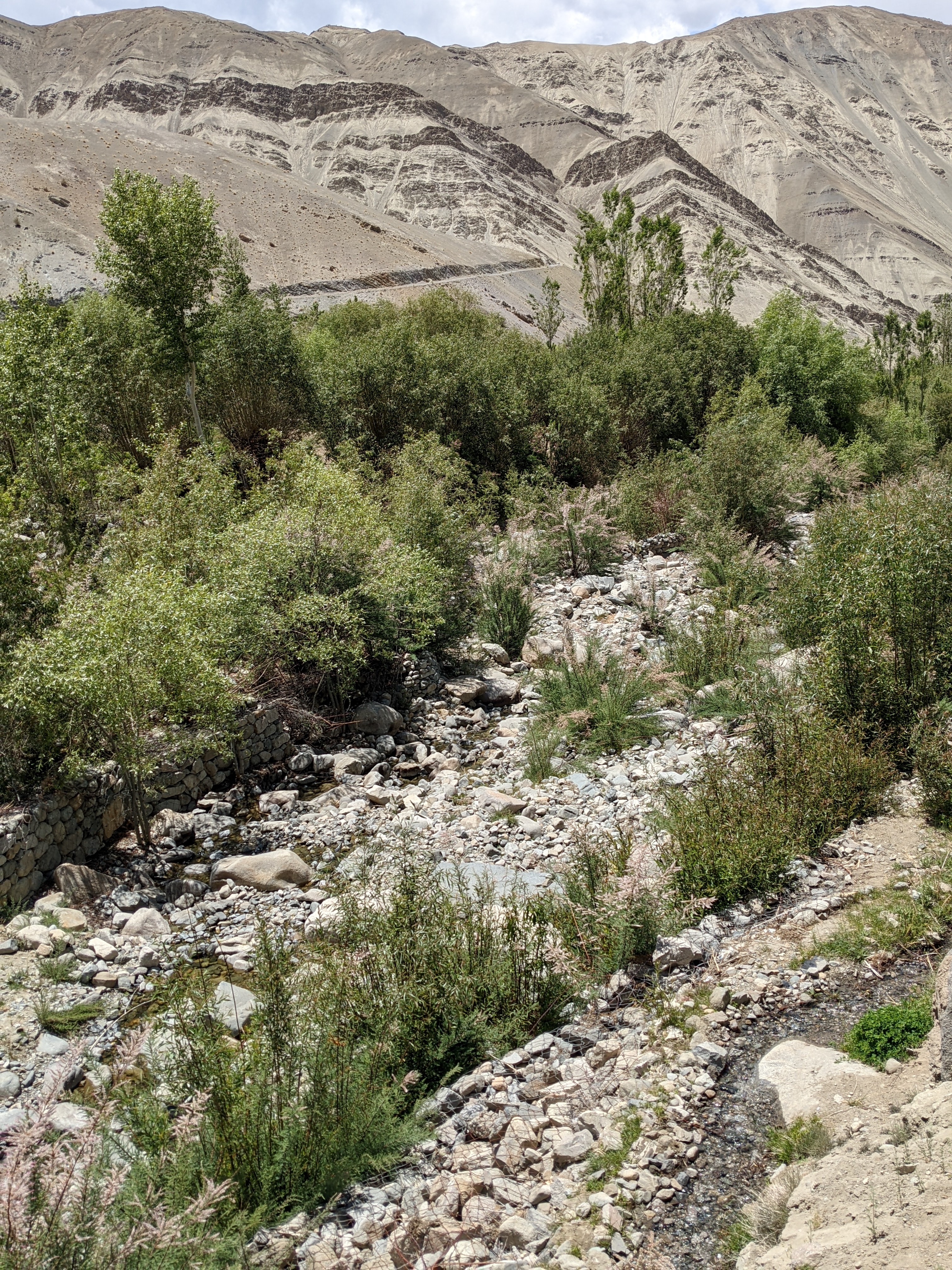
I absolutely adored the picturesque stream which flowed nearby, so I decided to just walk along it for some time to see what could be discovered.

The picture doesn’t do this pony justice.
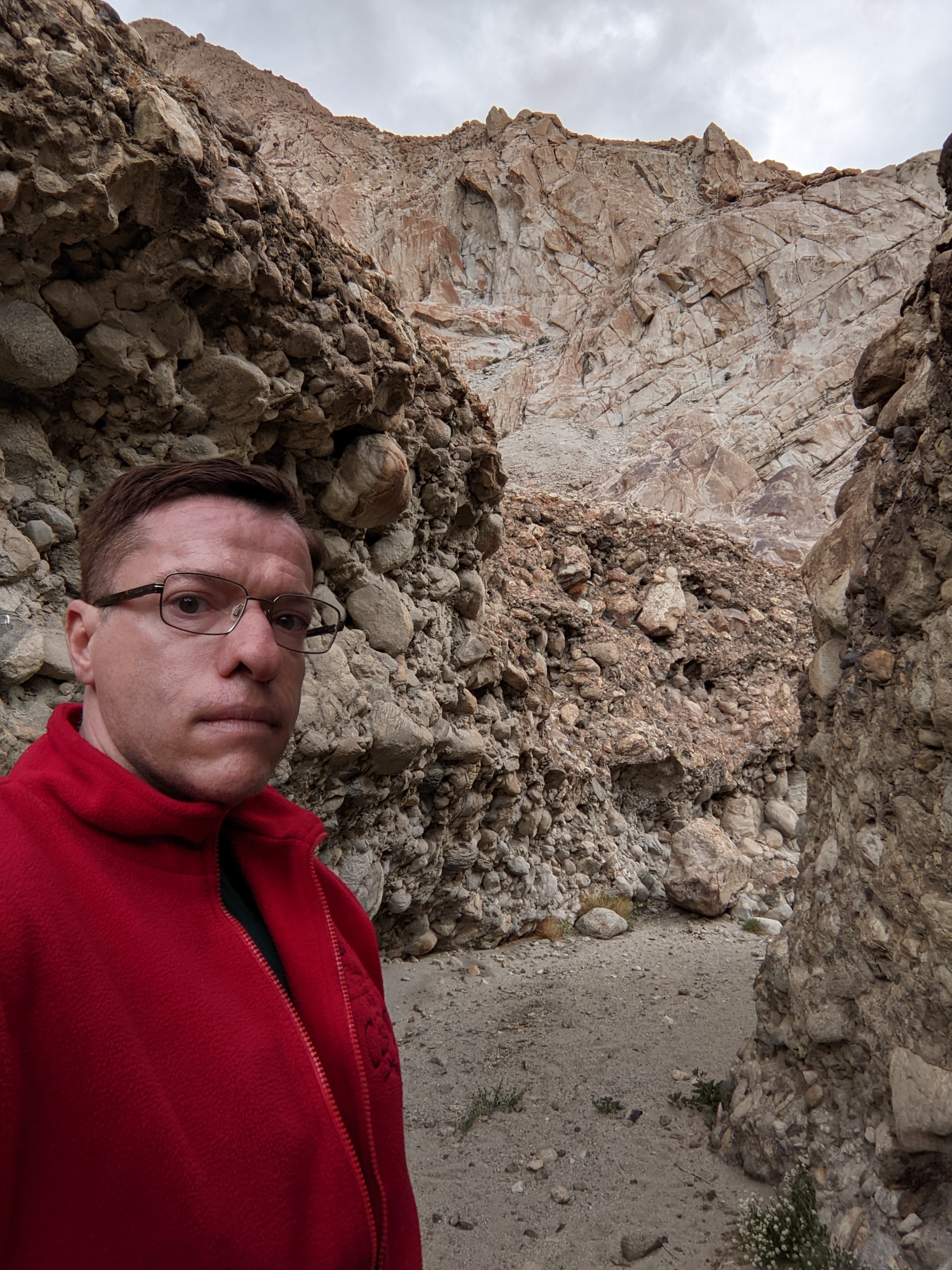
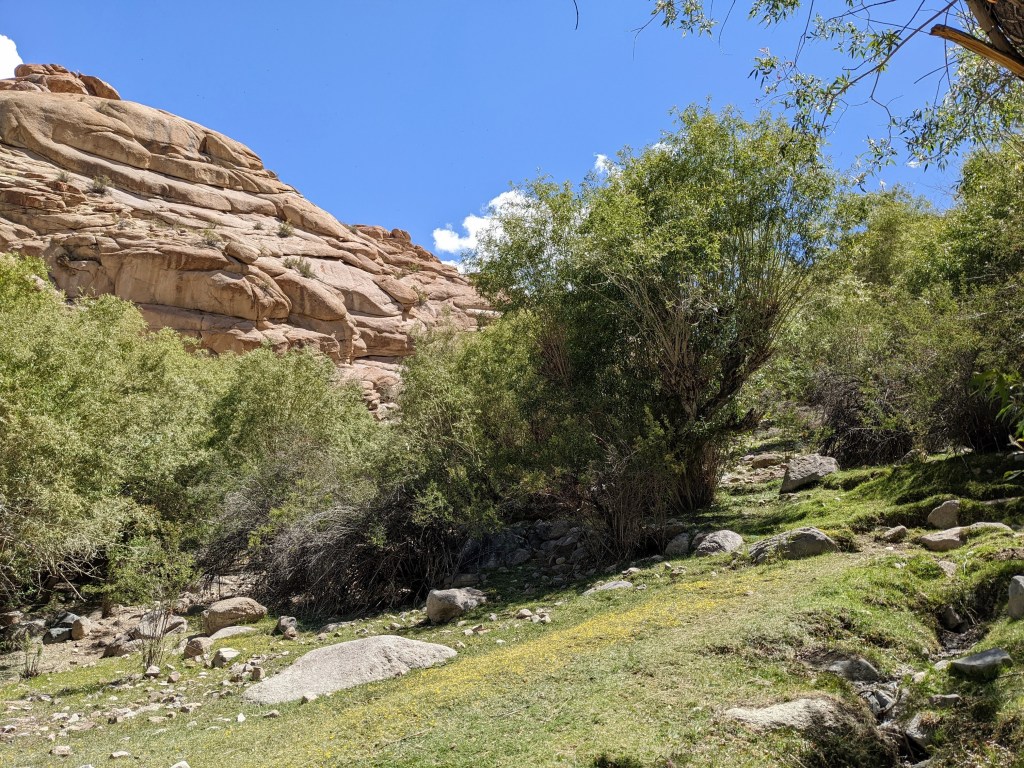
There was a large rock formation next to the stream, and it had sort of a natural path that went on for about twenty meters
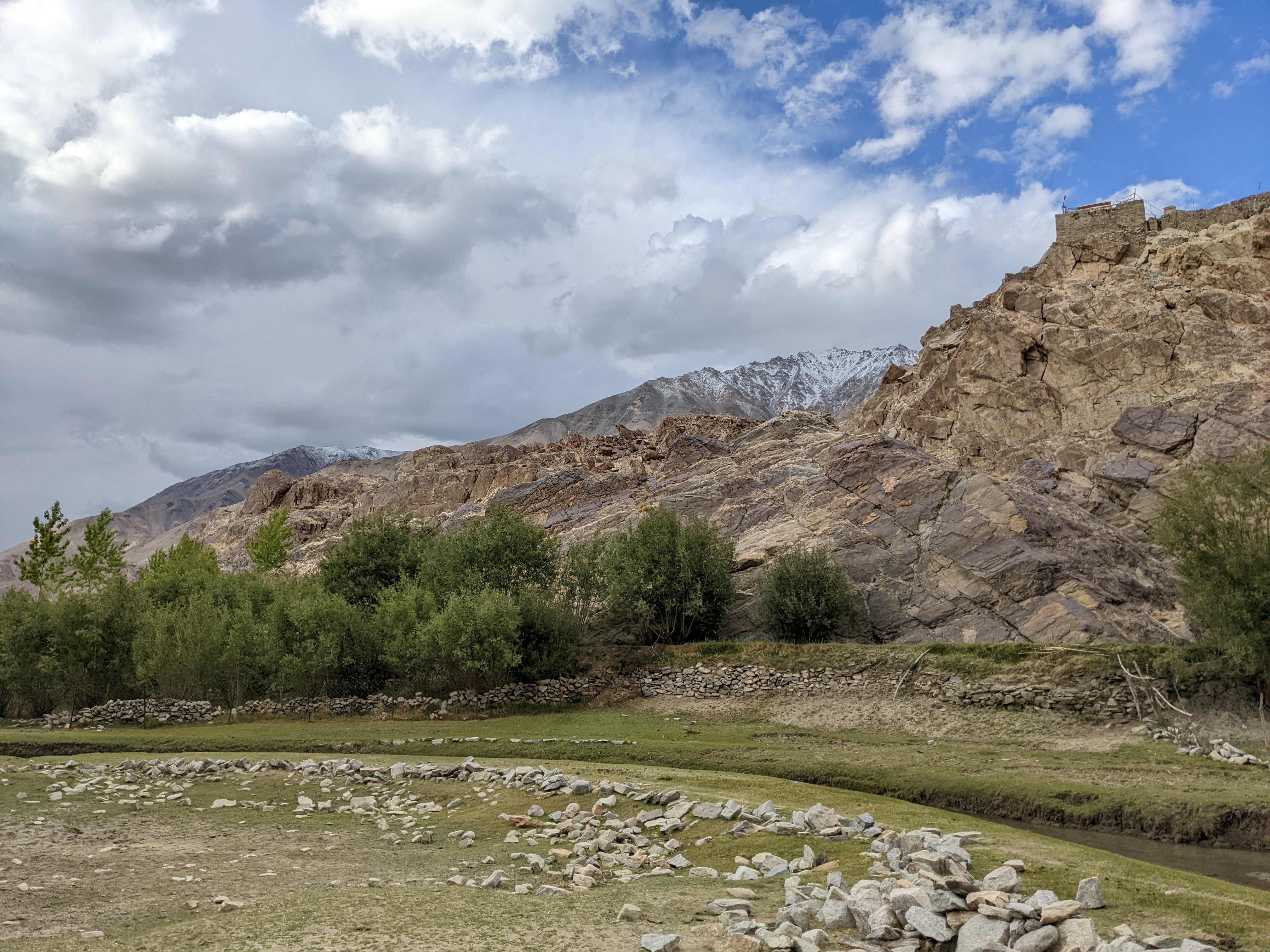
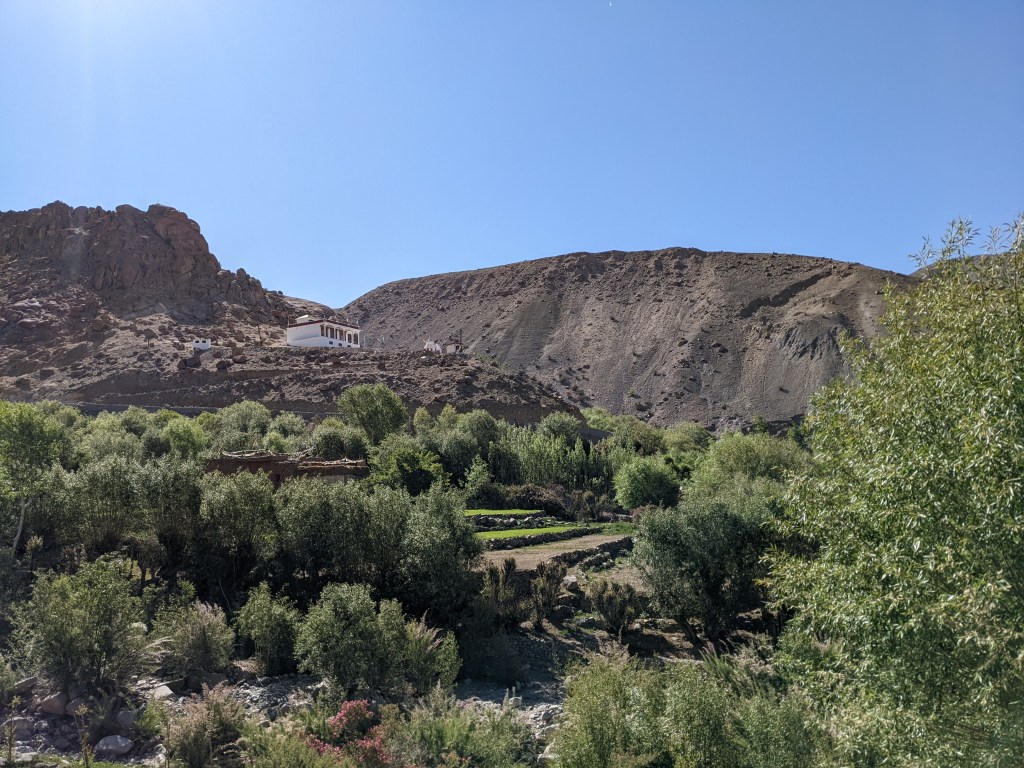
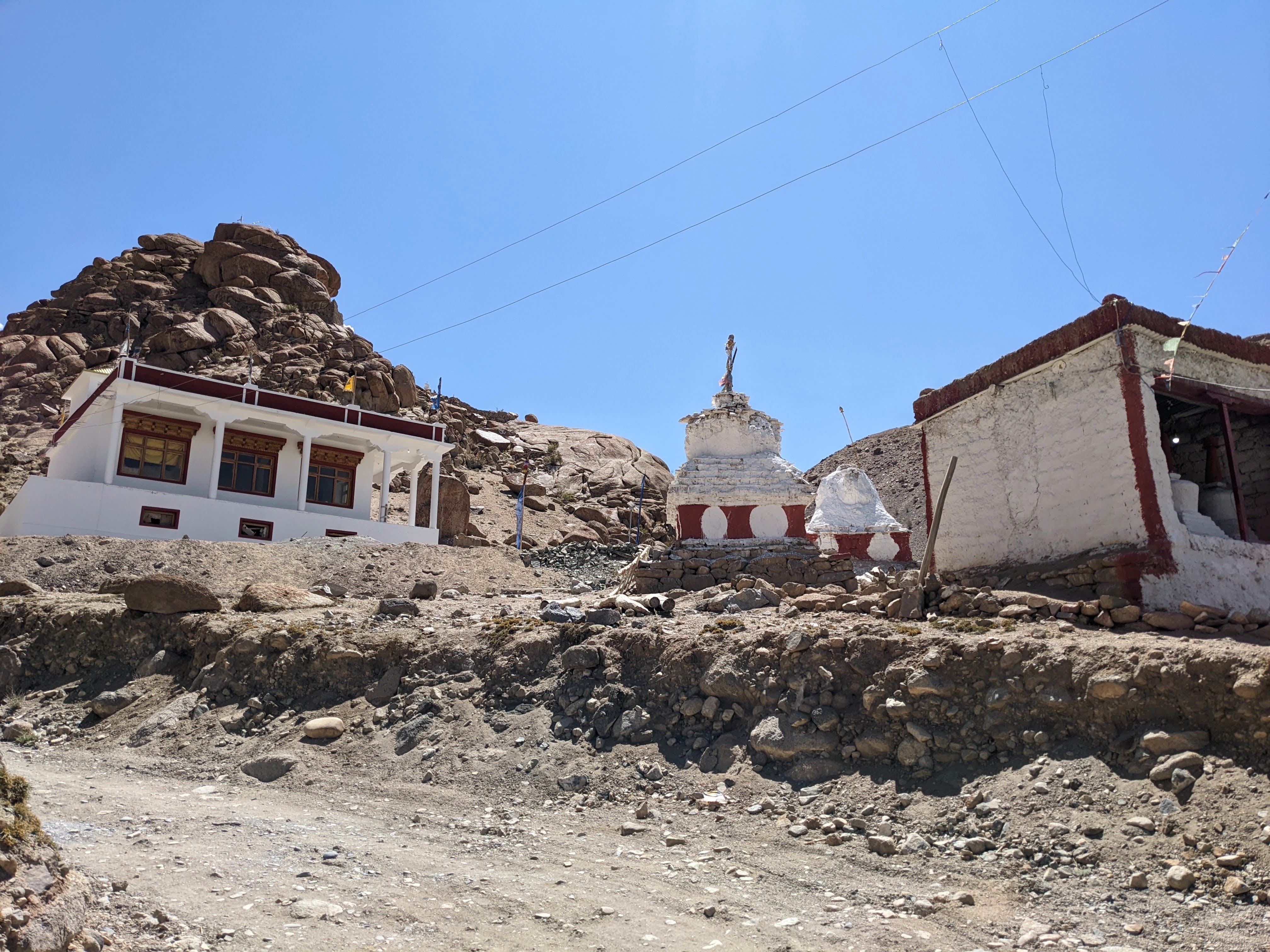
A view of the local monastery in the distance. Dawa said his mother would be happy to go with me, but I said I preferred to appreciate the town itself and the surrounding nature.

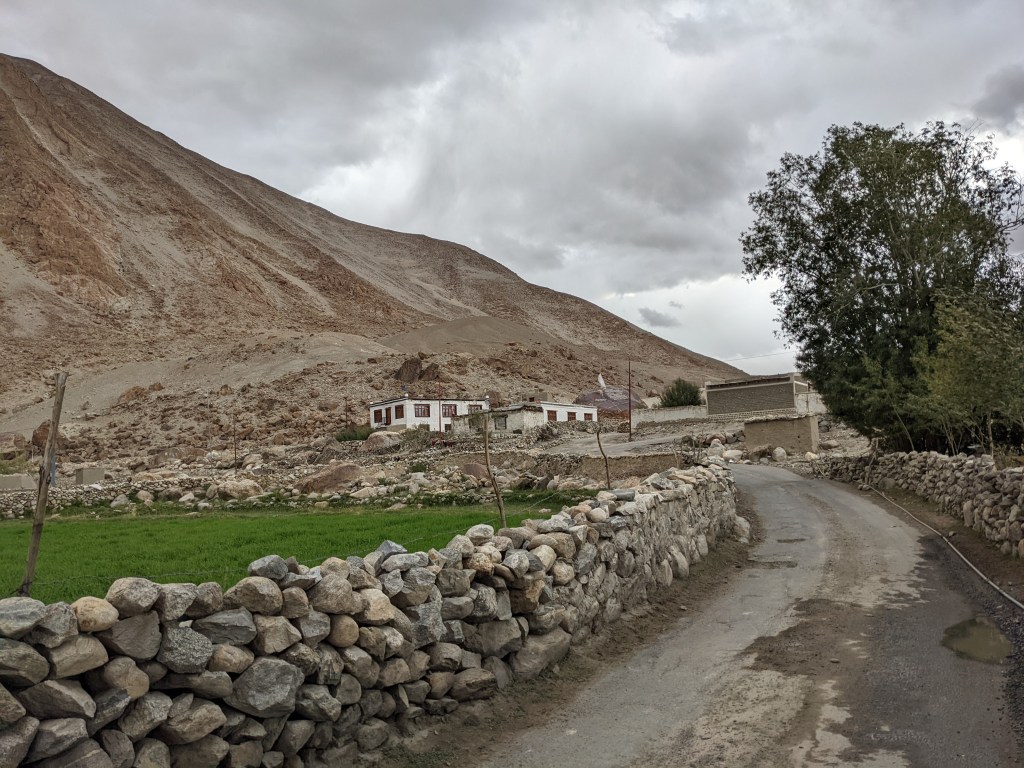
I then decided to turn around and head towards the actual village. I was really glad to be here. The earlier villages I had visited, while no doubt authentic, sort of seemed like romanticized attempts to hold onto the past. This village certainly still had its obvious historical influences, but I suspected that it was actually more representative of what most modern Ladakhi people hope to have. Of course this is my purely personal interpretation.

A coop grocery
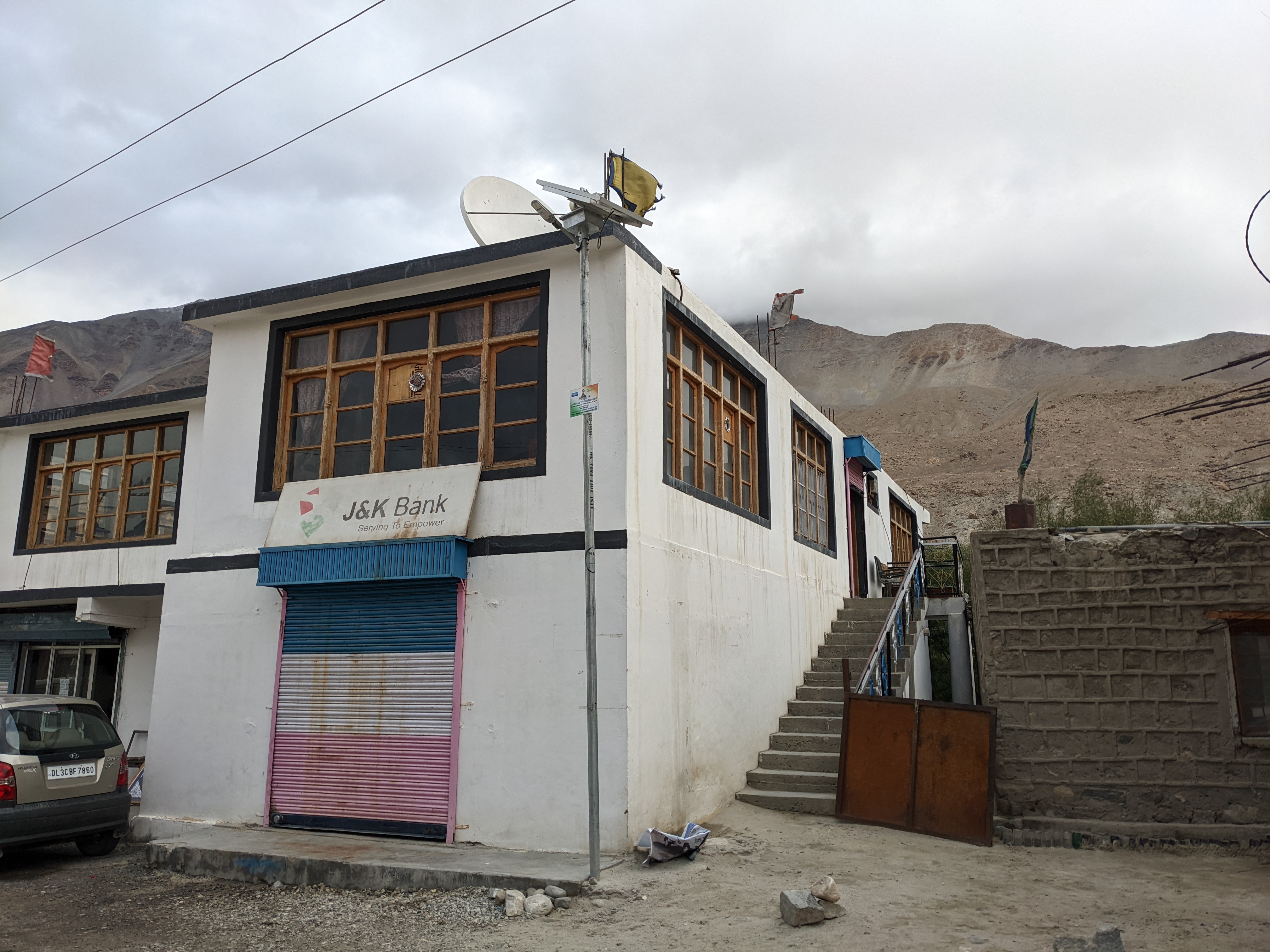
A local bank branch
The entrance to what appeared to be a very nice and modern local government clinic

At 6:50 PM I headed back to the house. I had been a bit surprised to not see a school, since the village seemed quite large, but maybe I just missed it. Also, I was only exploring along the main road, so there was a lot left unseen. I wanted to see more, but it was really too cold for me to still be out walking, especially with the wind, but then I thought to use my surgical mask along with my ear cover and hat. This actually helped a lot.

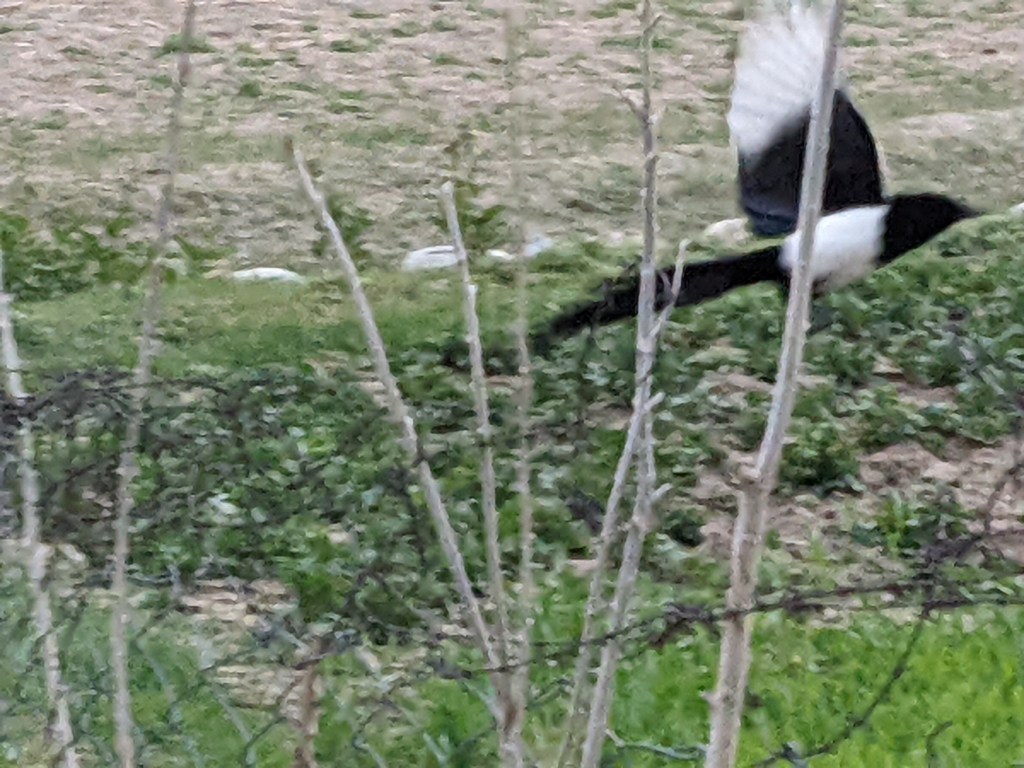
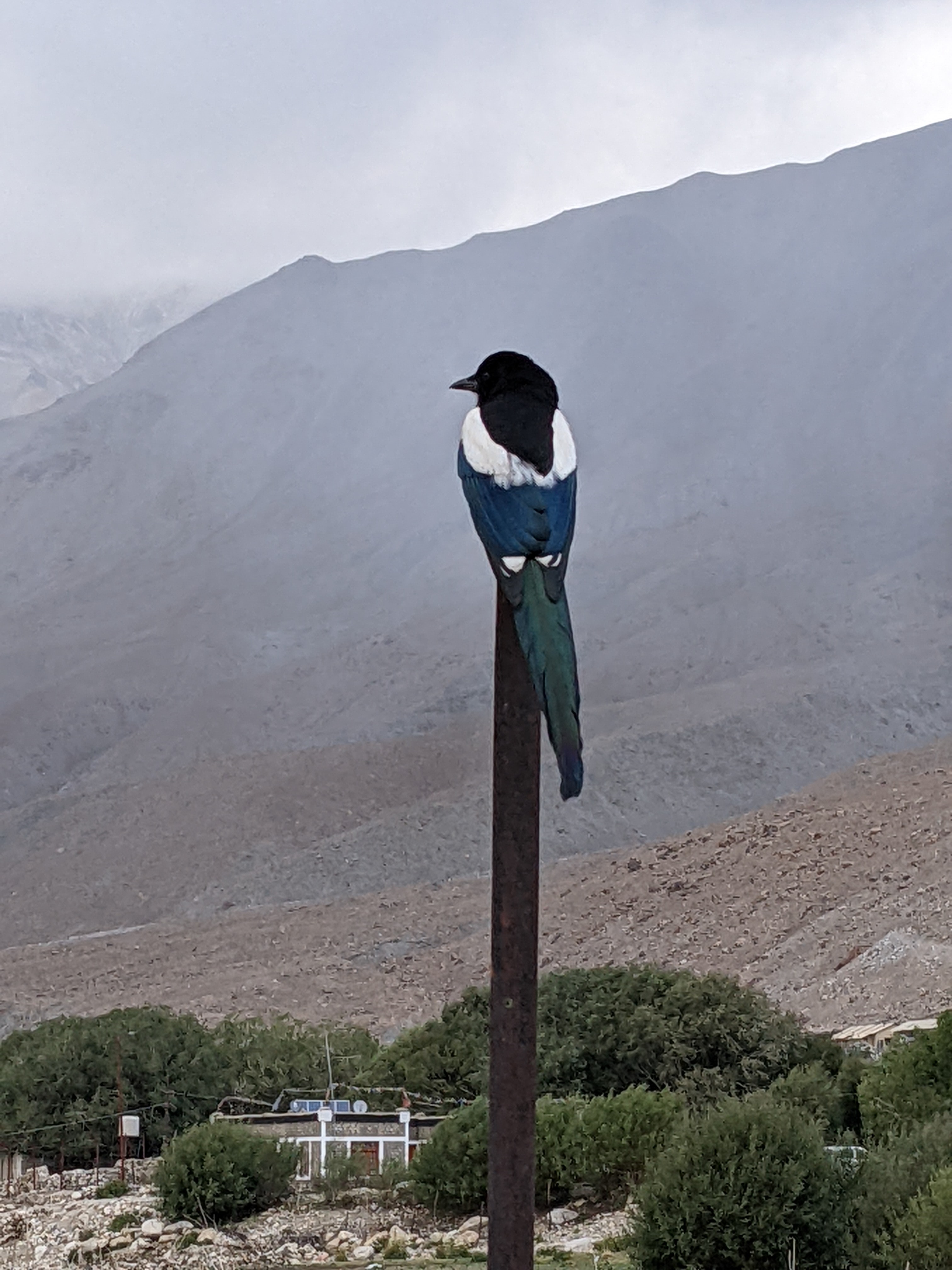
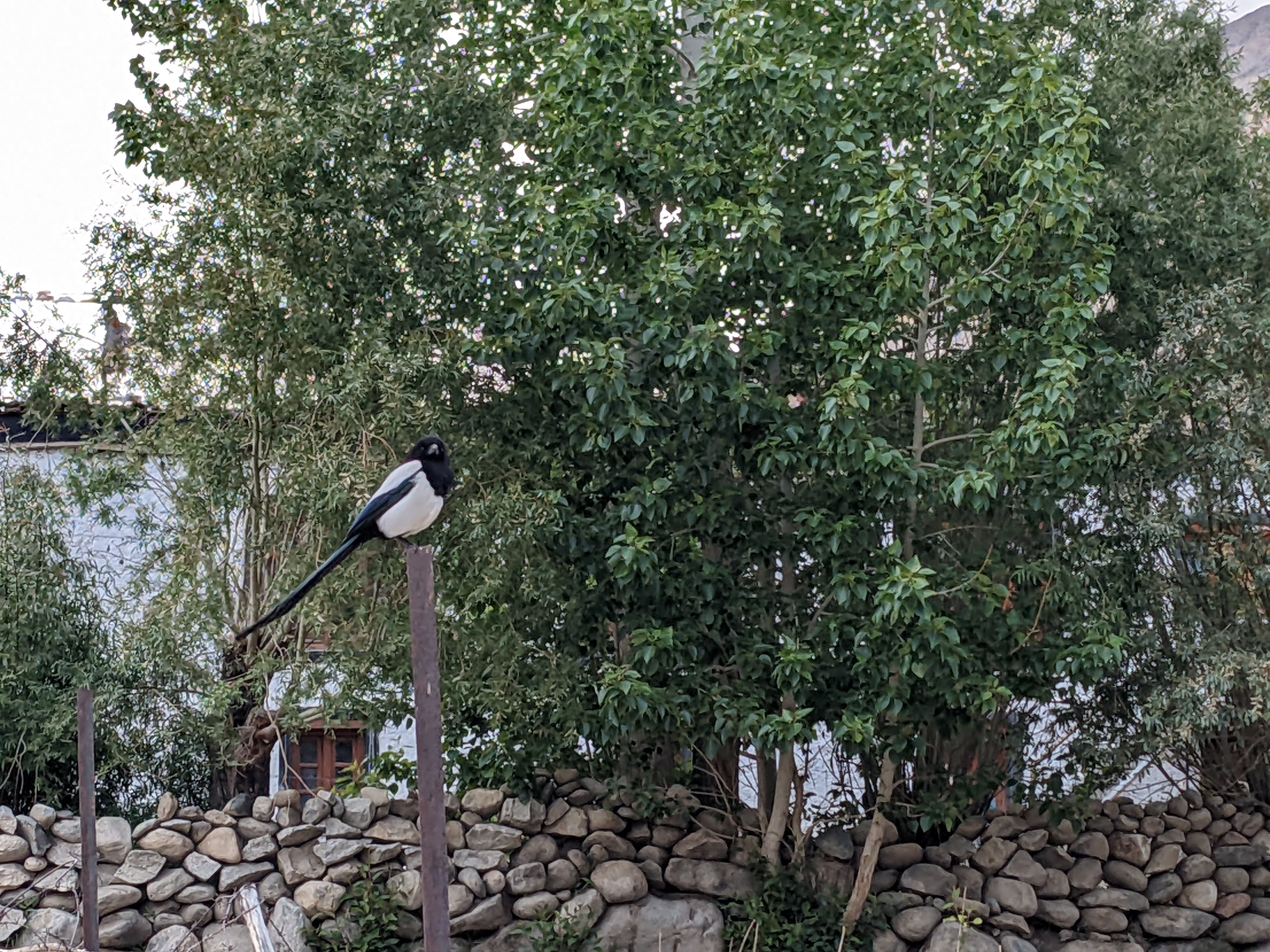
Almost as I reached the house, I was very excited to finally get a close look at a sort of large black and white bird which I had several times seen from a distance in Ladakh. According to Dawa, it’s a Magpie. I had previously heard the name, but this was the first time I had really ever seen one.

I was back inside by 7:30 PM and ended up watching two hours of  NHK World, which they had clearly chosen for my benefit rather than their own. I’m not sure why they thought that would be entertaining (Maybe because it was in English?), but I will admit that I learned quite a lot about  “fresh freezing” and bottled green tea. There was also a bit of world news, but the “best Japanese inventions” section was way more interesting.

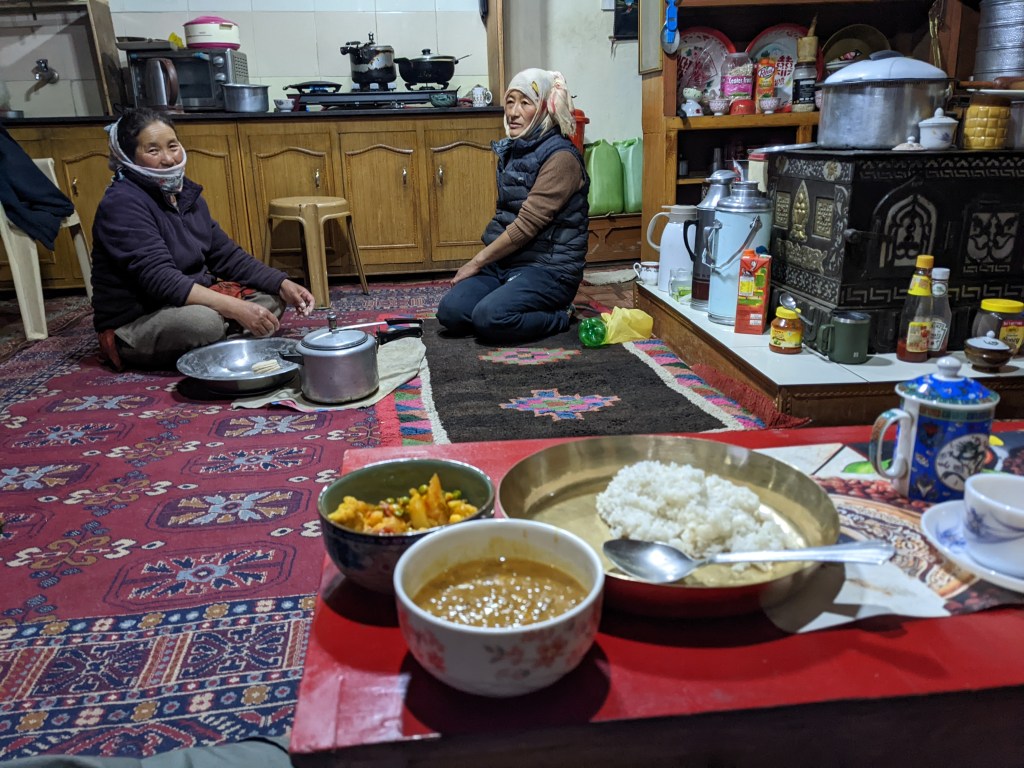
For a while I tried to keep being polite when Dawa’s mom kept refilling my cup with butter tea, but after refill #4, I just turned the cup upside down and placed it behind me. Anything less, and she just refused my polite protestations and hand gestures of “no thank you”. Since customs around offering and receiving drinks/food seem to differ so much from place to place, maybe we should all institute the practice of giving a short instructional card before someone enters a house. What do you think?

Dinner itself was simple but tasty. The company was wonderful.

As soon as I finished dinner, eating before everyone else because I was obviously very tired, I headed straight off to bed. It was 9:45 PM. I’m not really sure when everyone else ate, but dinner here, like in much of India seems to be eaten rather later than what is the norm for me.

As I stumbled towards the bedroom, Dawa warned me that the road back to Leh might be a bit tiresome since more rain and snow was expected that night, but he assured me that there would still be a way to get me back to Leh with plenty of time for me to get ready to leave the morning of the 21st. I wasn’t really sure how things would turn out, but I was completely certain that the next day would bring plenty more interesting experiences.

I saved the best picture of the lake for the end of the blog post. I hope you like it!

Ladakh trip: Day 9 (18-June)

I got up happily at 5:30 AM to quickly repack, decide what to take, what to leave behind, and ended up with only my small blue daypack for this three day trip. The plan was to leave at 8:00 AM.

While showering, I received several text alerts but assumed they were just messages from friends. I got out quickly, slathered on the moisturizer (without which my face and hands flake and crack in this cool dry desert clime) and discovered that the alternative route which we had planned on taking had now also been temporarily blocked due to some rain and snow on the mountain pass. Our preferred route had already been blocked by a big rock slide two days ago. As I left the room to head to the eating area, the shock of cold air and wet table and tiles confirmed the change in weather to which I had already been alerted.

According to Dawa (my driver and guide), the alternative mountain pass crossing should still be safe, but now our departure would be either 9:30 or 10:00 AM.  I still wanted to do this three day trip, but I made clear to him that safety was first, both his and mine.  Then stepping outside, I was hit with a shock of cold air, the sight of wet tile and stray raindrops. Assuming the weather is similar where Dorothée and Betsy are now located, I certainly hope they are okay. Even with my light gloves and fancy new rain poncho, I definitely wouldn’t want to be out on the mountain passes in this weather. Still, I trust Thinlas will keep them safe, but I can’t help remembering how slippery some of the paths were, even with ideal weather . . .

At about 10:30 AM, Dawa arrived and we headed off on the second highest motorable road in the world, Khardong mountain pass. Starting out, things seemed to be going well, with the first military checkpoint at 11:50 AM (have to make sure I’m not a terrorist). The travel was quite smooth as we headed further up the pass. Before that, traffic so backed up that we were frequently just parked. The road had two lanes and seemed in very good condition.

Then around 12:15 for some reason we were stuck again in a stalled line of cars. I guess it had to do with managing the mountain pass, perhaps only allowing a few cars at a time, probably only one direction at a time? Still, I suppose it was a good opportunity for some photos. At 1:43 PM, still mostly not moving, I asked Dawa what was the problem, and he said it was because mainland Indians (meaning those not from either the far north or northeast) all want to stop and take pictures at the highest point of the pass, especially when there is snow like now.

If that was really the case, then I don’t mind saying it was absolutely absurd. I am always very conscious that I’m a guest when visiting a country, but this sort of activity should be prohibited and if needed, there should be law enforcement officials stationed to make sure it doesn’t happen. This makes a massive problem for everyone and it’s also potentially a safety issue on a road such as this. But anyways, I certainly can’t change it;

Sure enough, it appeared that he was correct. As soon as we passed the top of the pass at 2:00 PM, cars were parked all over the place with people posing for their Instagram pics in the snow. After that, the road was wide open. Seriously, I know that for them it was important, but so many crazy people taking pictures and blocking the road at the top? There was noticeable but not heavy snow as we took the descending road. Happily, the road was clear and cars were now moving quickly.

At 2:33 PM we stopped because there was once again some sort of a checkpoint. How many of these are really needed on a mountain road with no other access points? Do they think someone is going to parachute in and then casually take the road? Enough complaining though. We were quickly on our way again and by 2:40 PM we had driven out of the snow, arriving to Khardung village a little after 3:00 PM.

There we stopped for a very simple lunch and then continued on, arriving to Diskit village in the Nubra Valley at 5:00 PM. Diskit is relatively large, so probably should be called a town. Around this area there are many “tent camps” and it was too one of these that we went to quickly leave bags etc… before continuing on the trip.

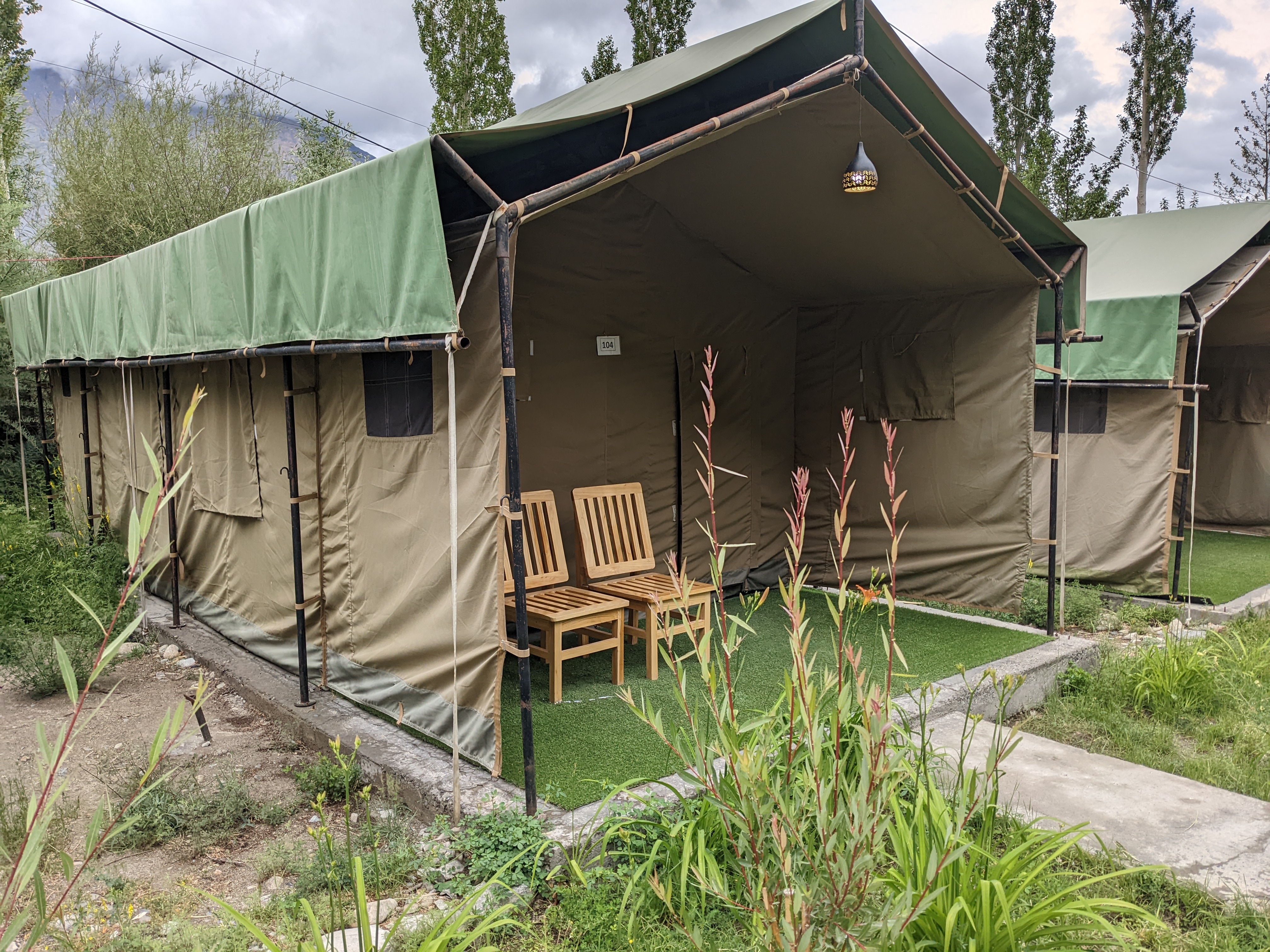
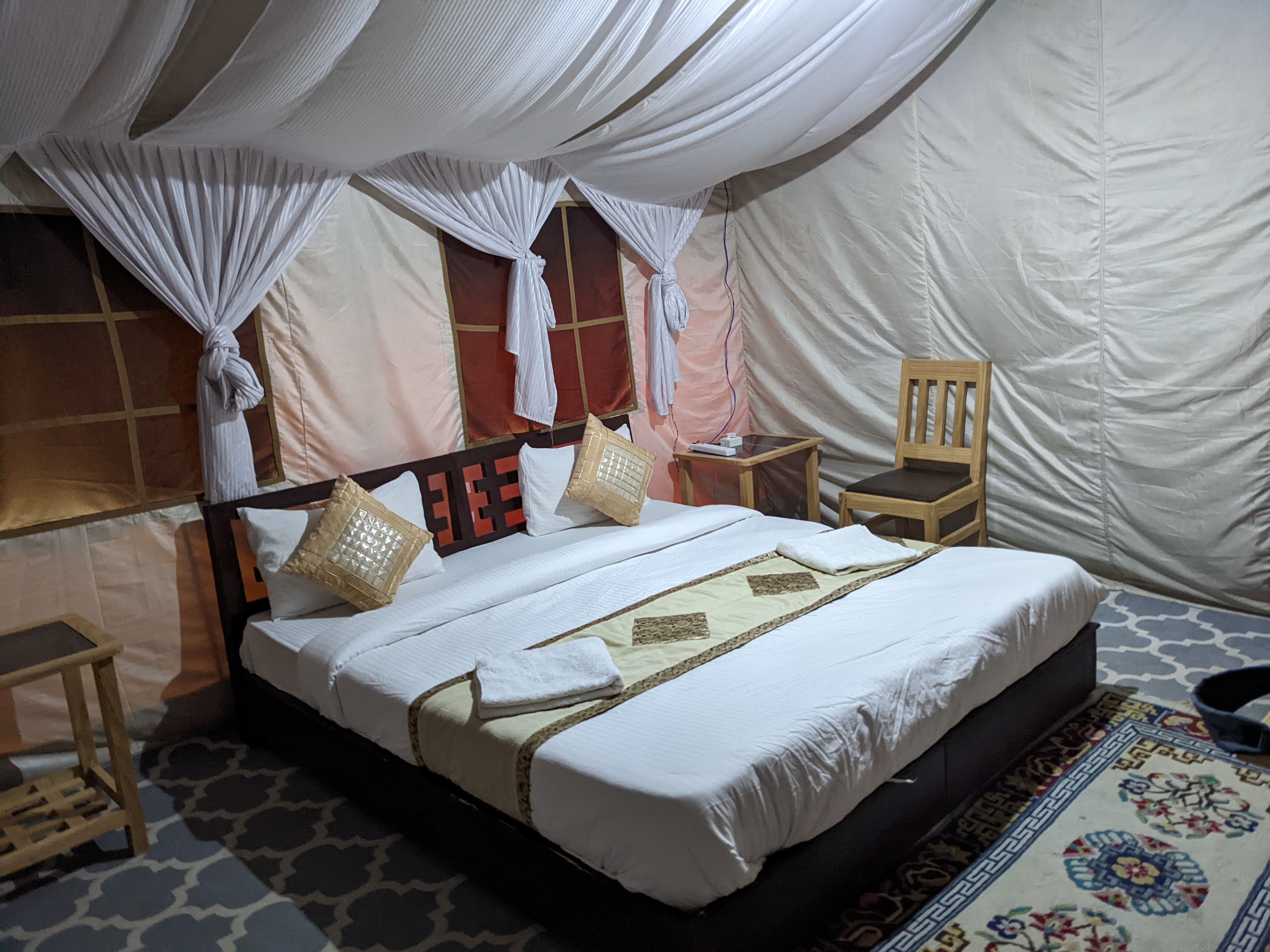
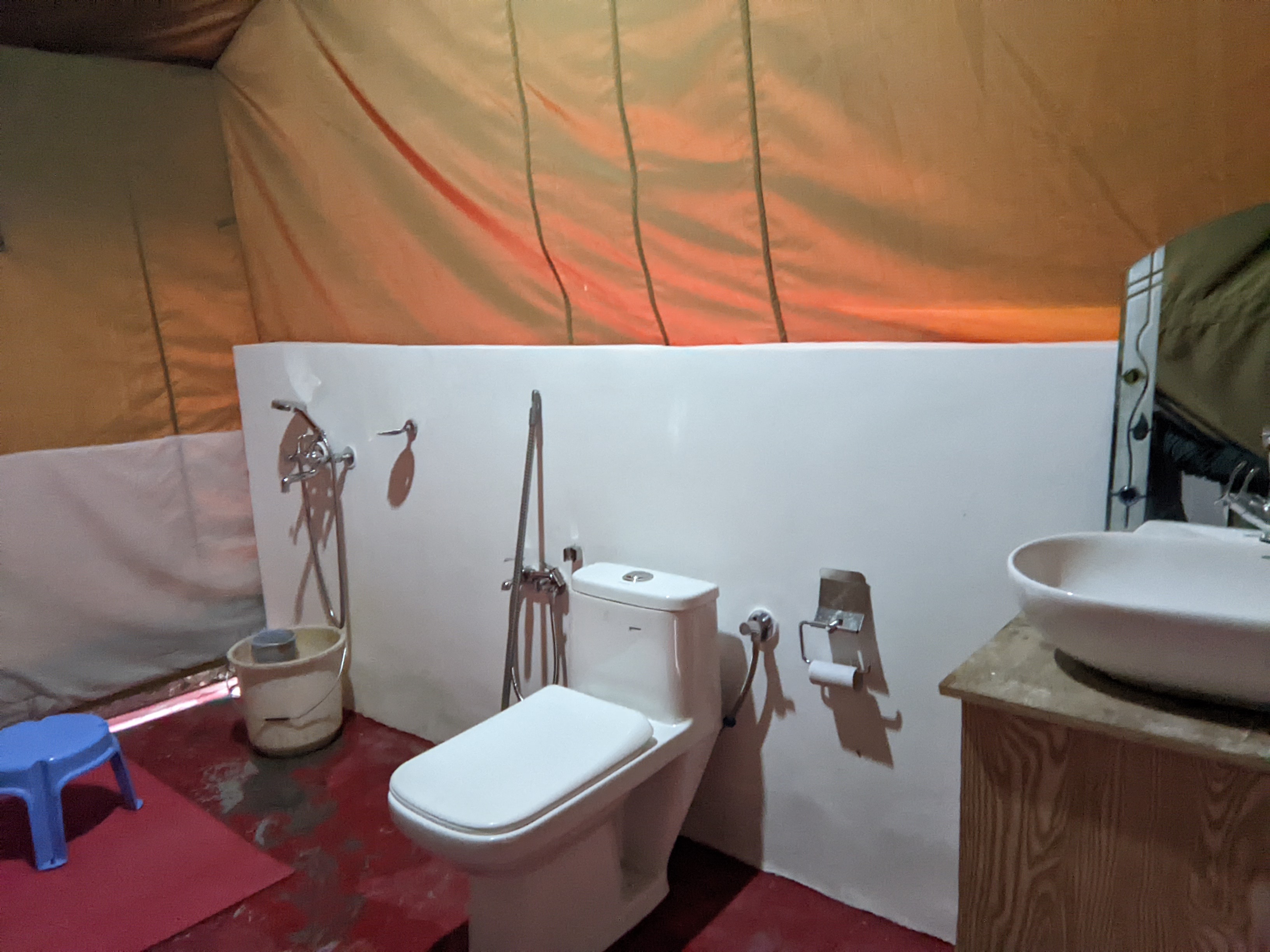
As you can see, a tent camp here is not what most people would be expecting. While the idea is initially novel, I figured that it would probably make more sense to build more permanent structures, and in the mid term might even make more financial sense . Regardless, that seems to be the thing here.

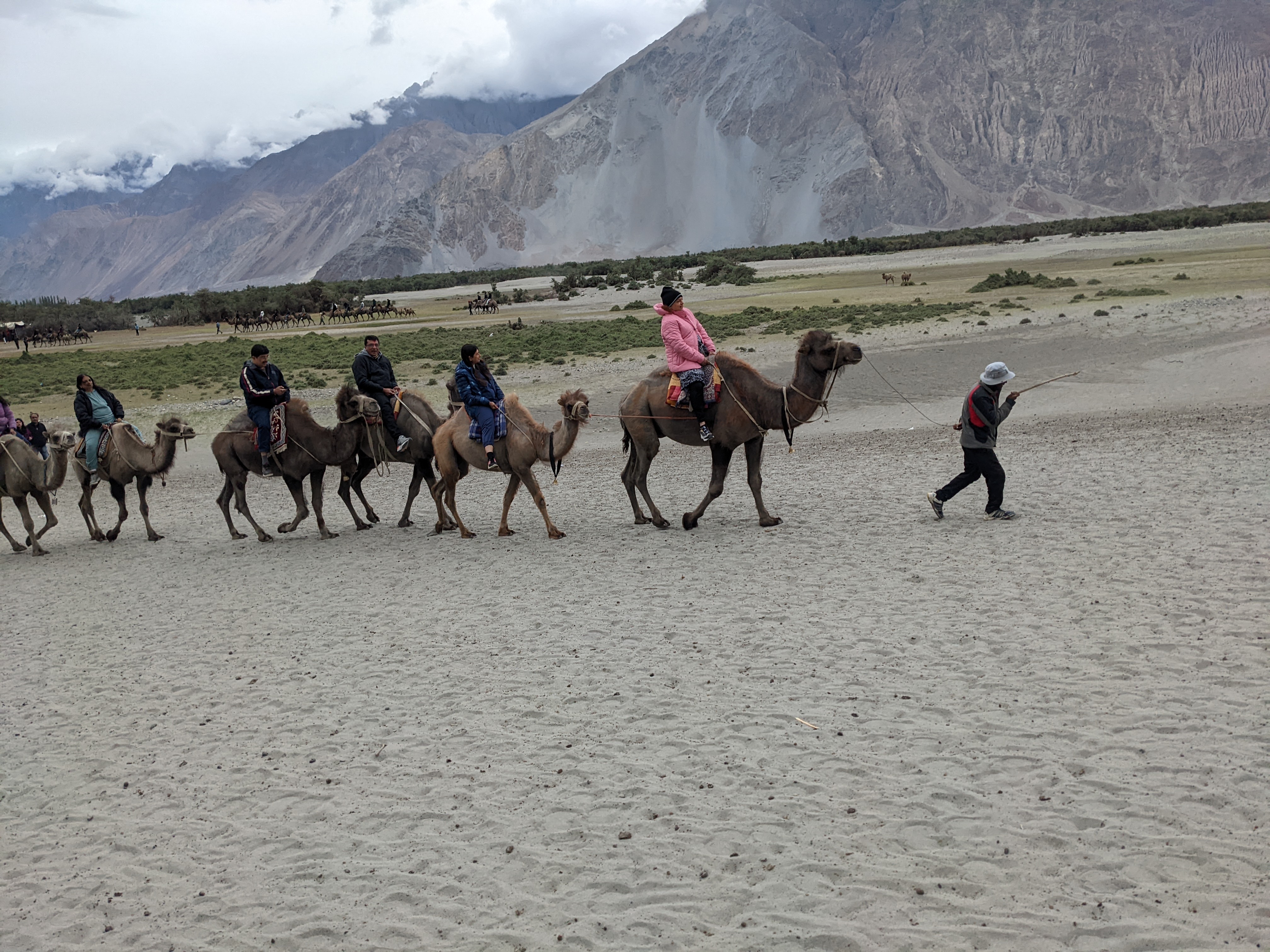
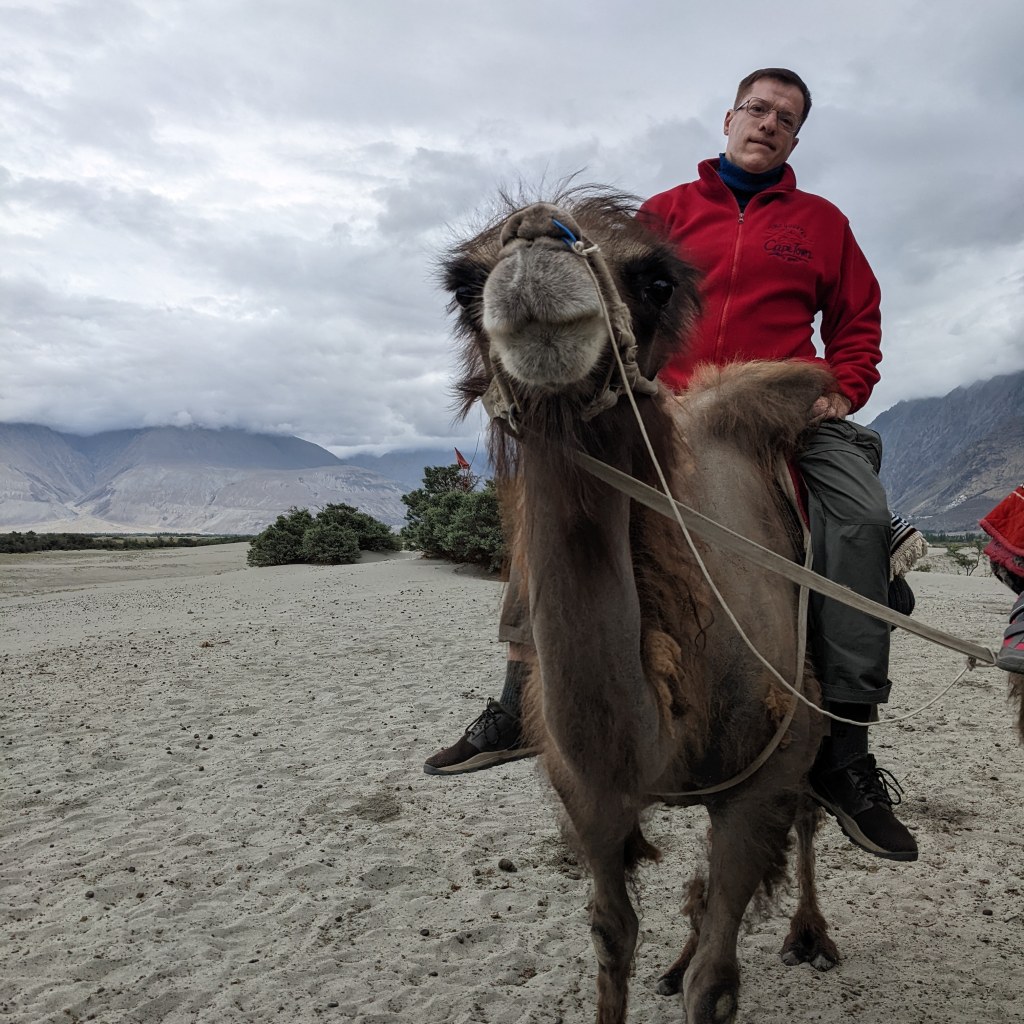
After having the obligatory cup of tea, I went into full on tourist mode. At the nearby sand dunes with the charming Mochu stream, there were quite a few people doing archery with rubber tips, ATV rides in a separate area which was far enough away to not be at all disturbing, a dress up station to wear traditional Ladakhi clothes and Bactrian (two humped) camels!

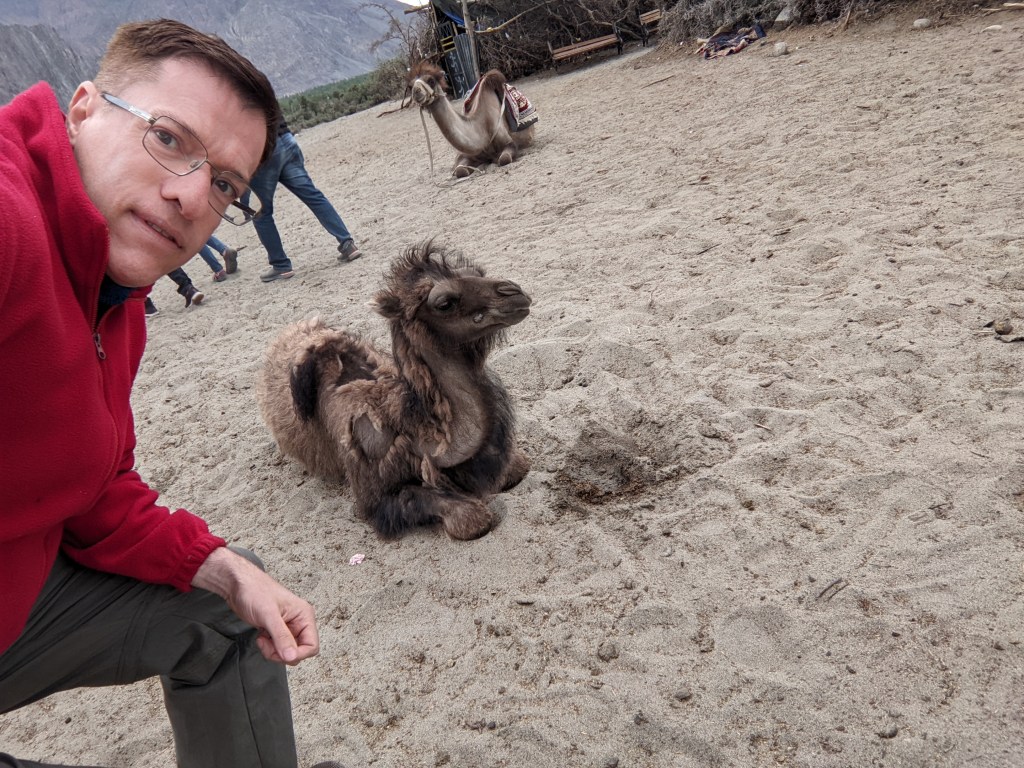
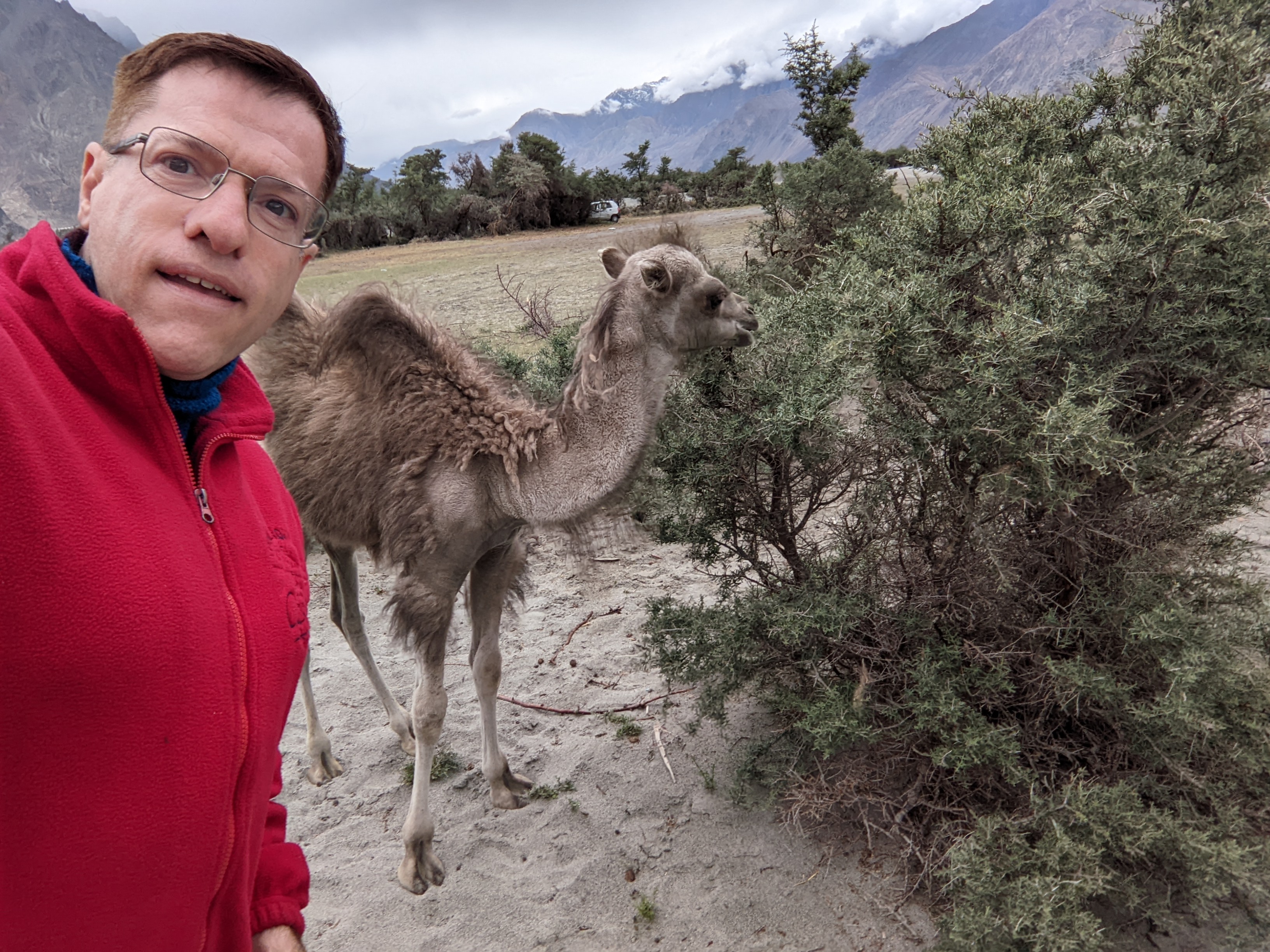
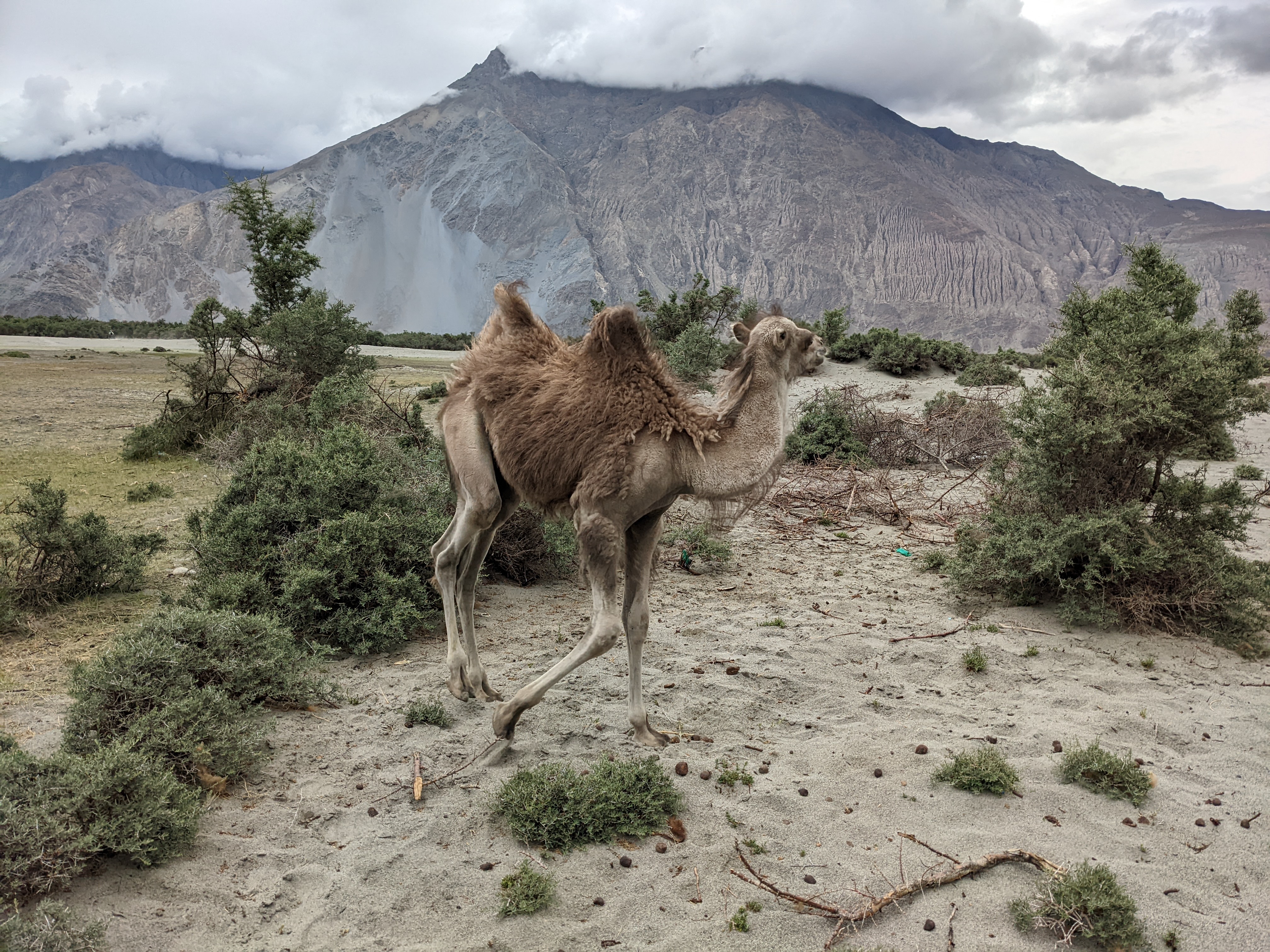
Like everywhere I’ve seen in Ladakh, the views themselves were simply beautiful (despite the throngs of people). I was also very happy to see that the young camels too small and untrained to be ridden were left to play as they pleased, sometimes just trailing along with their mothers. Dawa urged me to do a camel ride, and while I secretly felt I should be disdainful of the notion, I quickly relented and got in line to buy my 350 INR (4.50 USD) ticket for a roughly five minute camel ride through the heavy sand.

As is the norm in most of India, several people tried to push their way in front of us in the line. Whereas I generally patiently endure what I see as inconsiderate rudeness, Dawas was having none of it and politely but firmly instructed each interloper to head to the back of the line. The whole waiting process was only a few minutes (maybe 5?) And then I was greeting camels and getting on the back of one.

As far as I could tell, the camels were well cared for (no I’m not any sort of an expert) and were extremely docile, even allowing little kids to pet their faces. I’m not sure what I was expecting of an up close camel experience, but this exceeded expectations.

During this time of year, they are shedding, but their skin is thick and pleasant to the touch. Their fur was a bit rough, but also pleasant. Perhaps because of the cool temperature, there was no noticable odor. I’m glad Dawa talked me into the ride, since it’s unlikely I will ever again be this close to a camel (domesticated or otherwise) and I will certainly never have a practical justifiable reason to ride one.

After the ride, I spent a few minutes visiting with some of the calves.

If a friend had been along to tease me into it, I’m sure I would have played dress up. However, as it was just Dawa, my fake superiority won out and I walked by the “Be a Ladakhi ” stand with swift steps and my head high in the air.

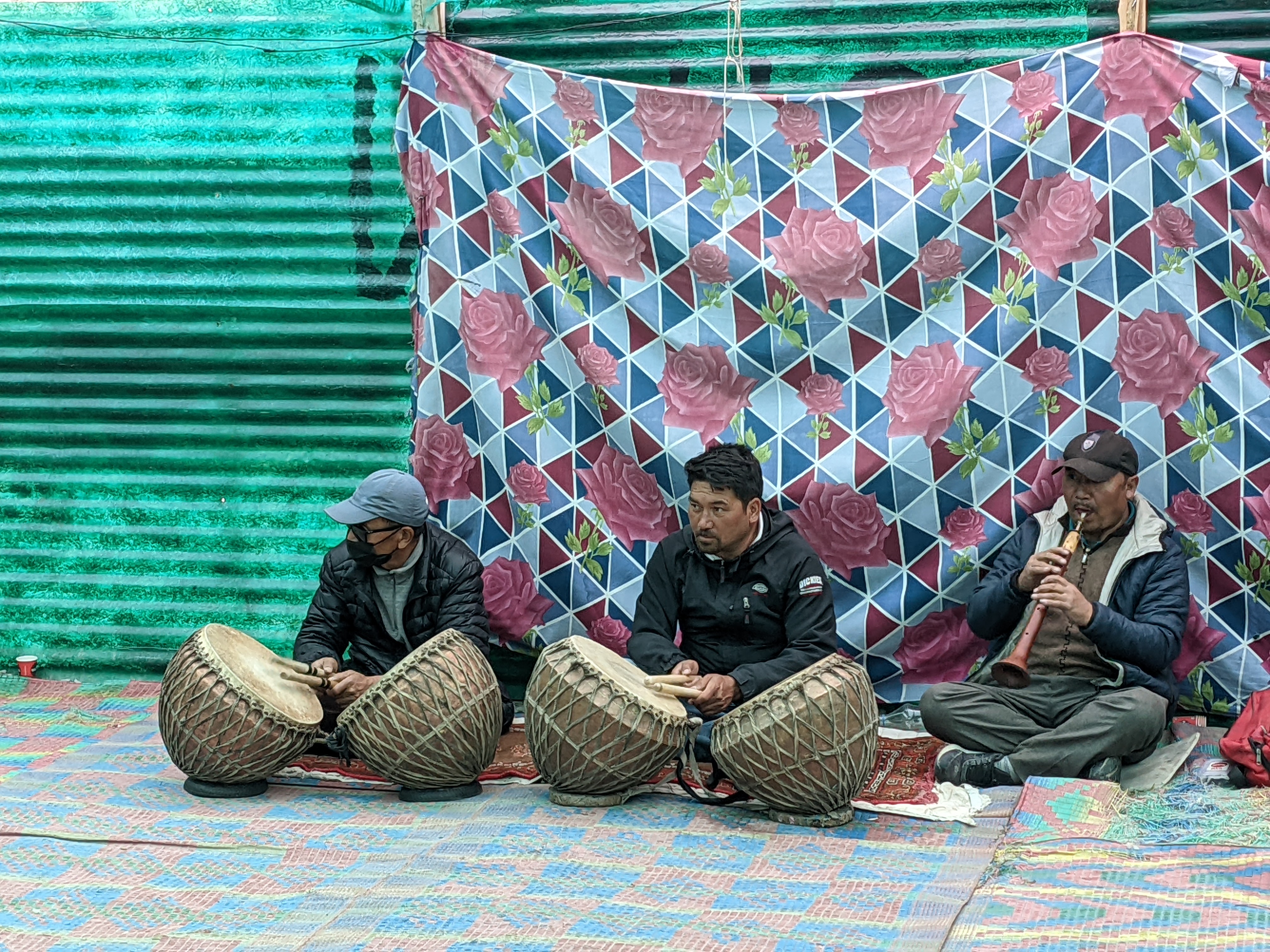
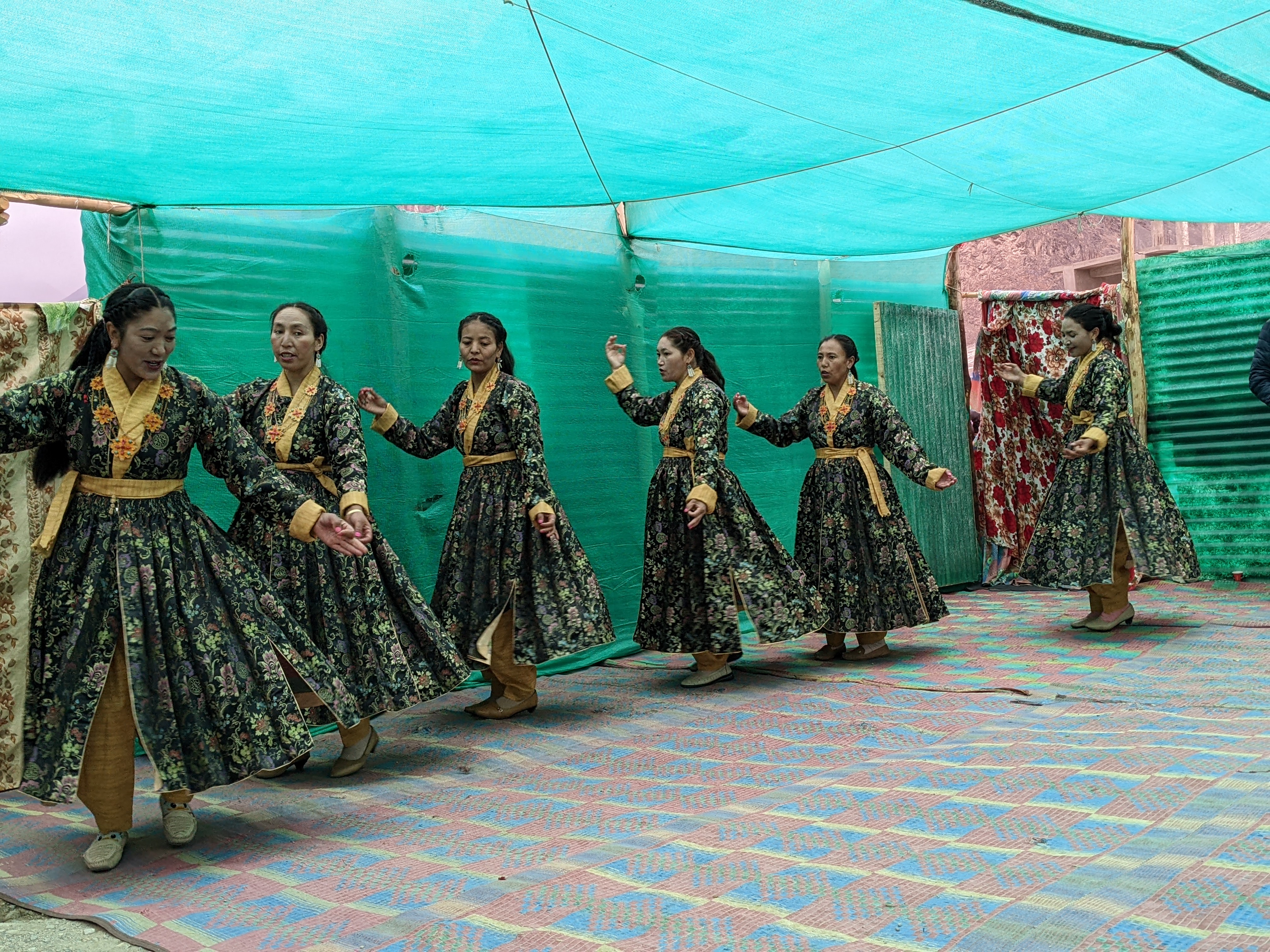
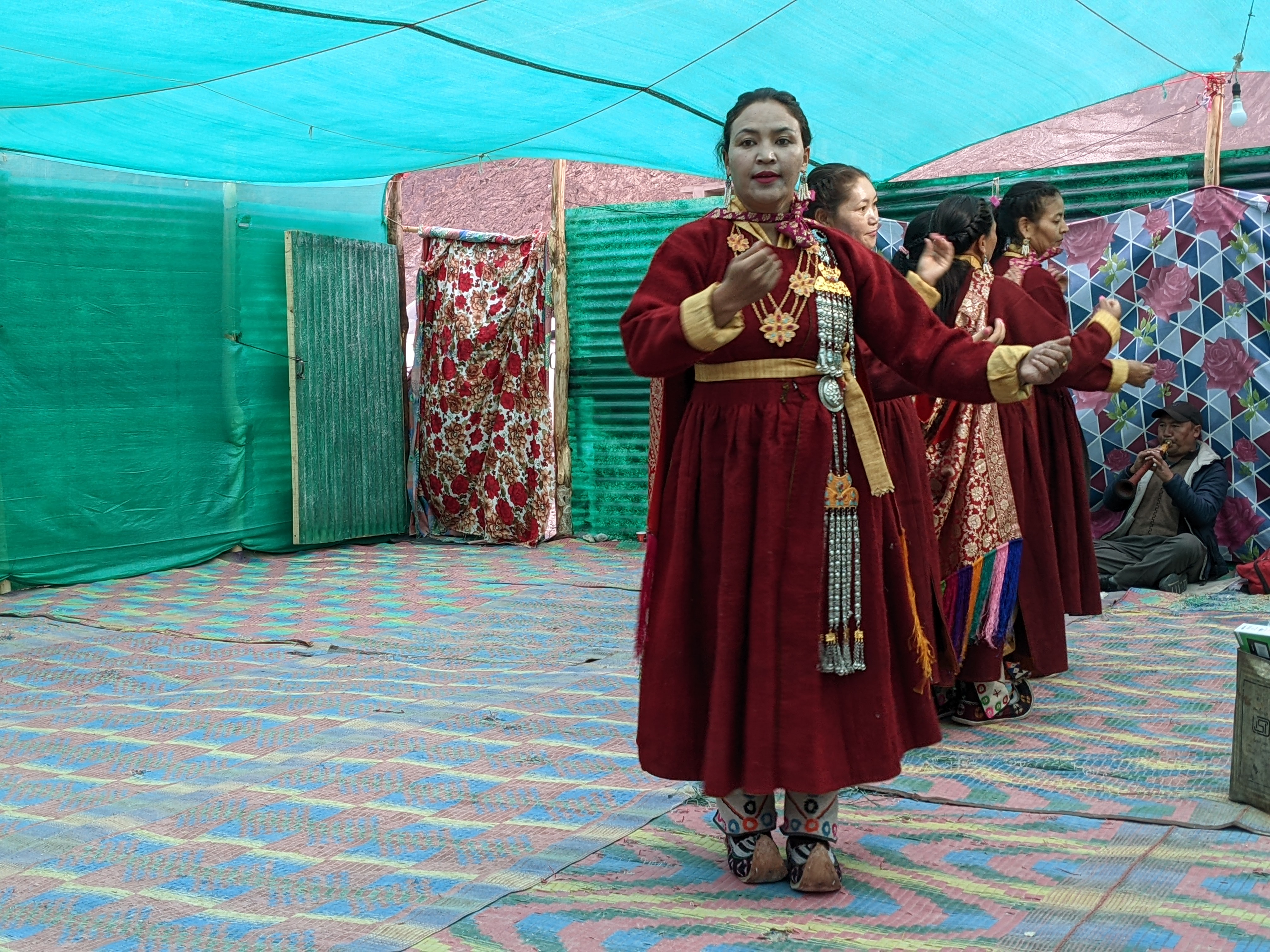
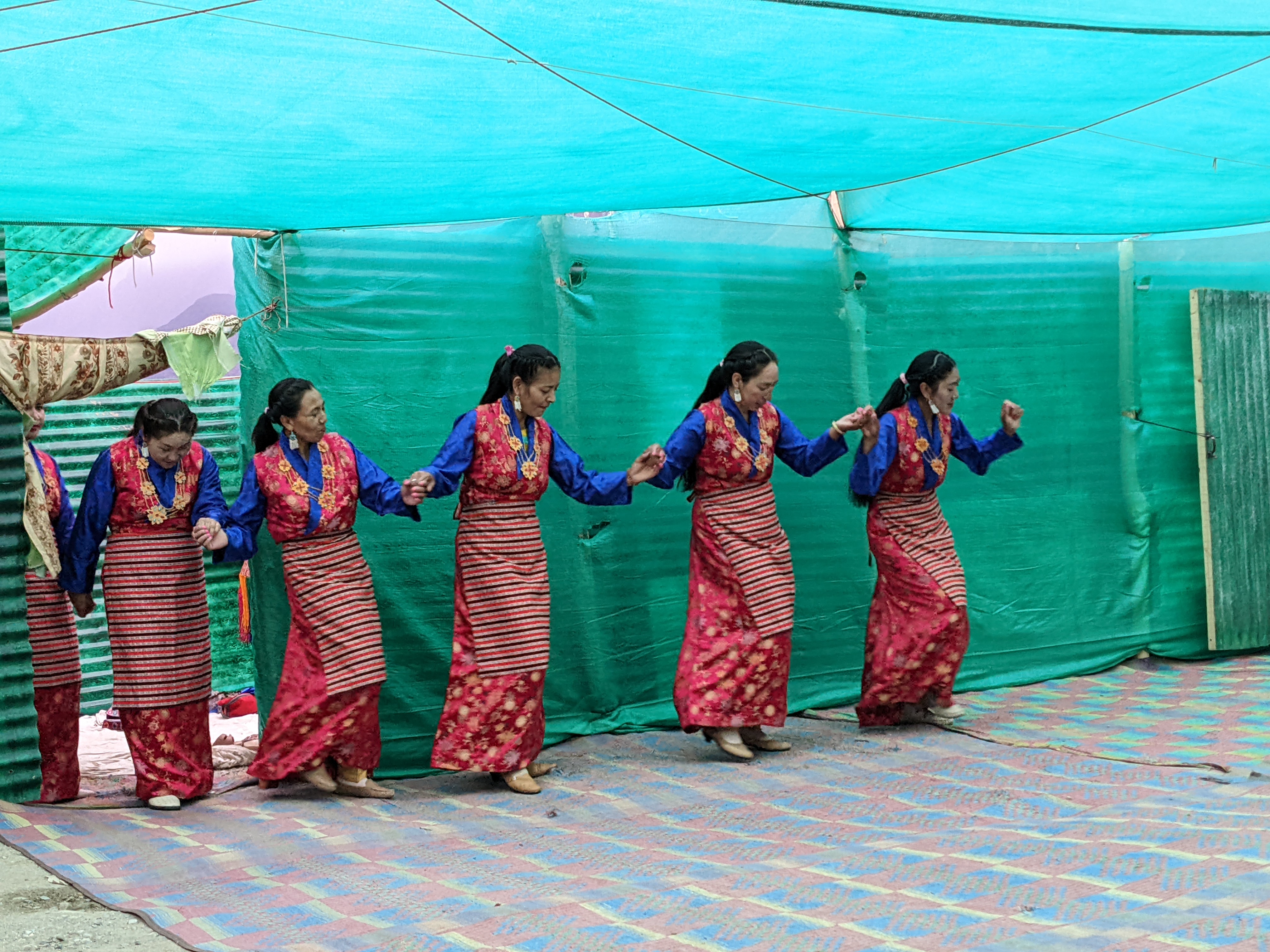
Dawa thought I wouldn’t really be interested in the traditional dance exhibition tent, cost of 100 INR (1.25 USD), but I begged to differ and I’m happy to report I was correct. I was a bit disappointed that there were only women dancing, but Dawa explained that most Ladakhi men, while knowing how to do traditional dances, don’t usually participate in these sorts of events because there are few of them, and they are off doing better renumerated jobs.

By then it was already 7:30 PM so we headed back to the camp. Dinner started quite late, so we spent about 90 minutes with Dawa telling me his ideas about Buddhism and also the economic outlook of the region. The former was quite positive with the latter seeming rather bleak. Still, unlike many/most men from Ladakh, he expressed a strong interest in sticking it out, trying to be successful in the land of his ancestors. I wish him the best, but with tourism which is really only feasible 3-4 months out of the year being the primary private sector endeavor, the prospects don’t seem great. Of course there are multiple ways to define success and certainly numerous roads to happiness.

Dinner itself was unremarkable, and then at 10:00 PM. I headed to my tent. Without going into great detail, this was the first night I was genuinely COLD. I used all three blankets and was also thankful to Thinlas who had earlier explained to me how most Ladakhi people will position the covers for maximum warmth; I finally got a chance to apply that lesson.

Anyways, let’s see what tomorrow will bring. For now, bye everyone.

Ladakh trip: Days 7-8 (16-17 June)

Hey all, so I’m not sure if it makes sense to try this, but I’m going to do both days 7-8 as a single entry, and then I will be all caught up.

With some honestly heartfelt goodbyes, we had our last breakfast with the family in Ang and then at 8:00 AM headed out on the next portion of our trip.

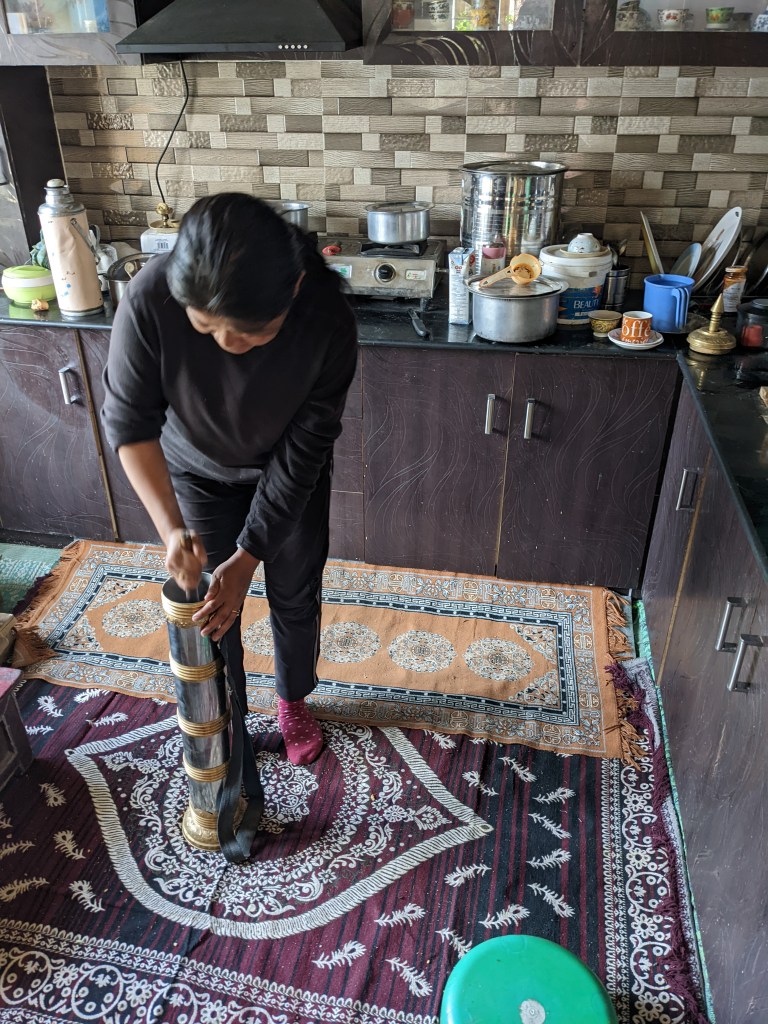
As a special treat, they prepared butter tea for our departure. In case it’s not obvious, the preparation process is hard work!
Songba is not pictured here because she was taking the picture. Thankfully she has replacement shoes which won’t hurt her feet.

We all departed together in a small van. Upon reaching the most favorable connection to the mountain pass for the next section of their trek, we would part ways.

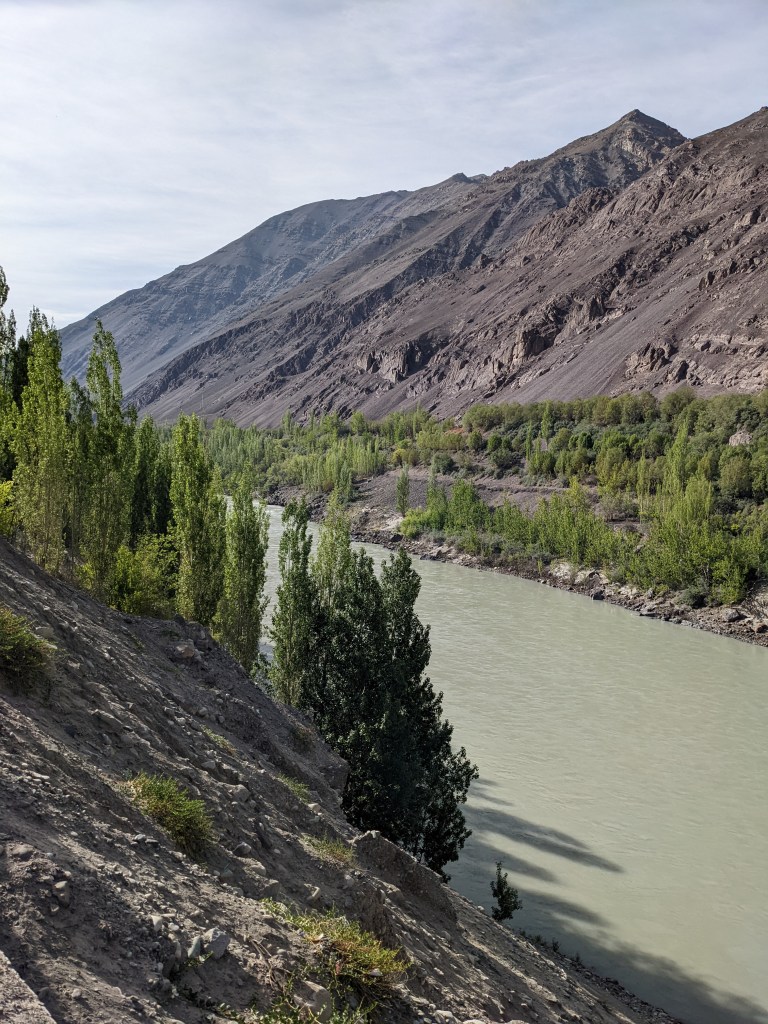
The Indus river

When we reached the Indus river, we said our goodbyes. The members of the original group were continuing on with their original adventure, and it was now time for me to make a new one for myself.

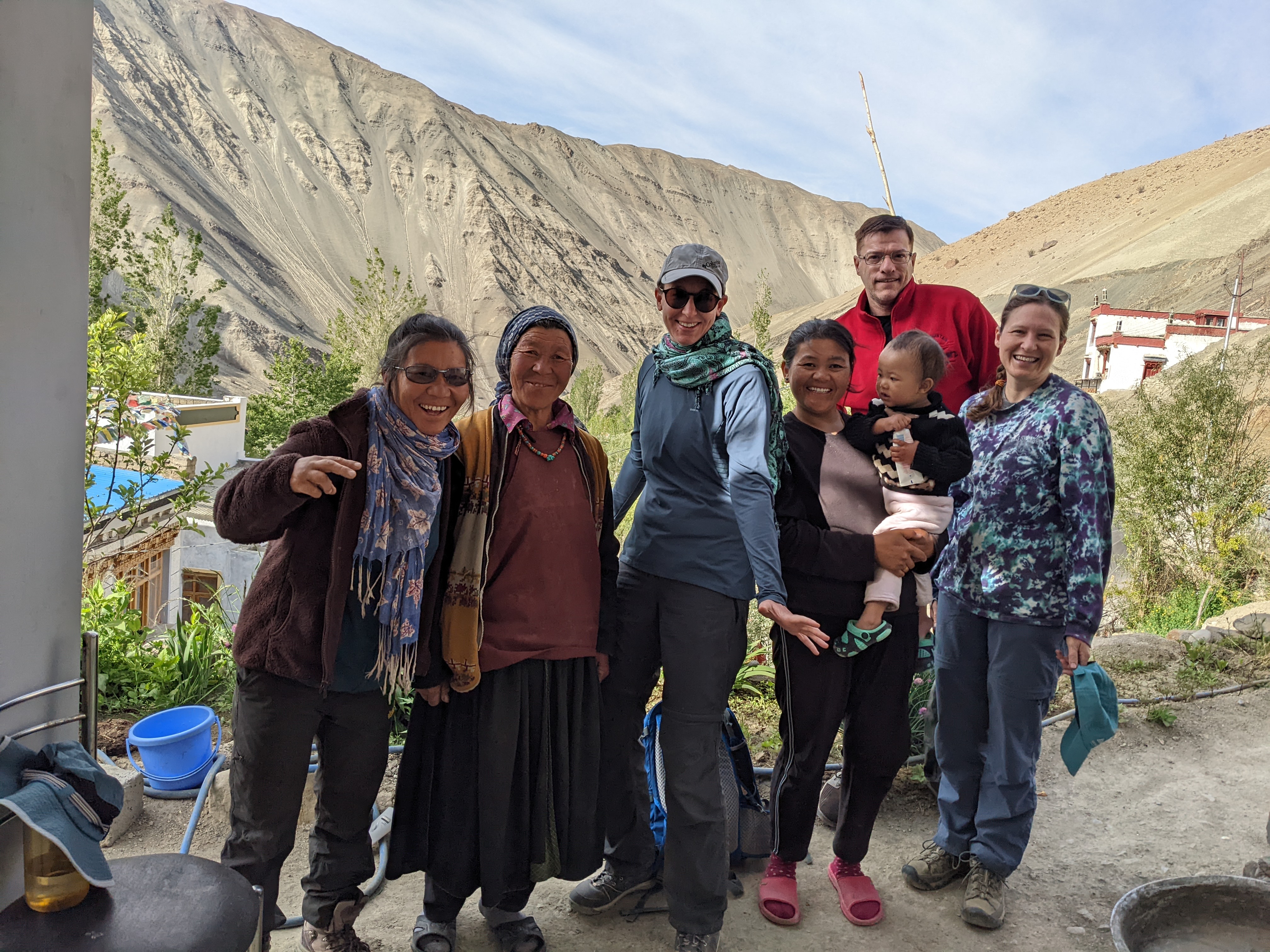
You will have to take my word for it. Songnam is the second from the right, next to Dorothée.

Thus, my solo Ladakh adventure began, albeit in a comfortable van as we started the 75 km drive back to Leh. Along the way I really started paying attention to the signs which had been put up by BRO (Border road organization). Obviously, someone had really put some time into coming up with various ways to say: “Don’t be an idiot while driving!”. Here were some I noticed.

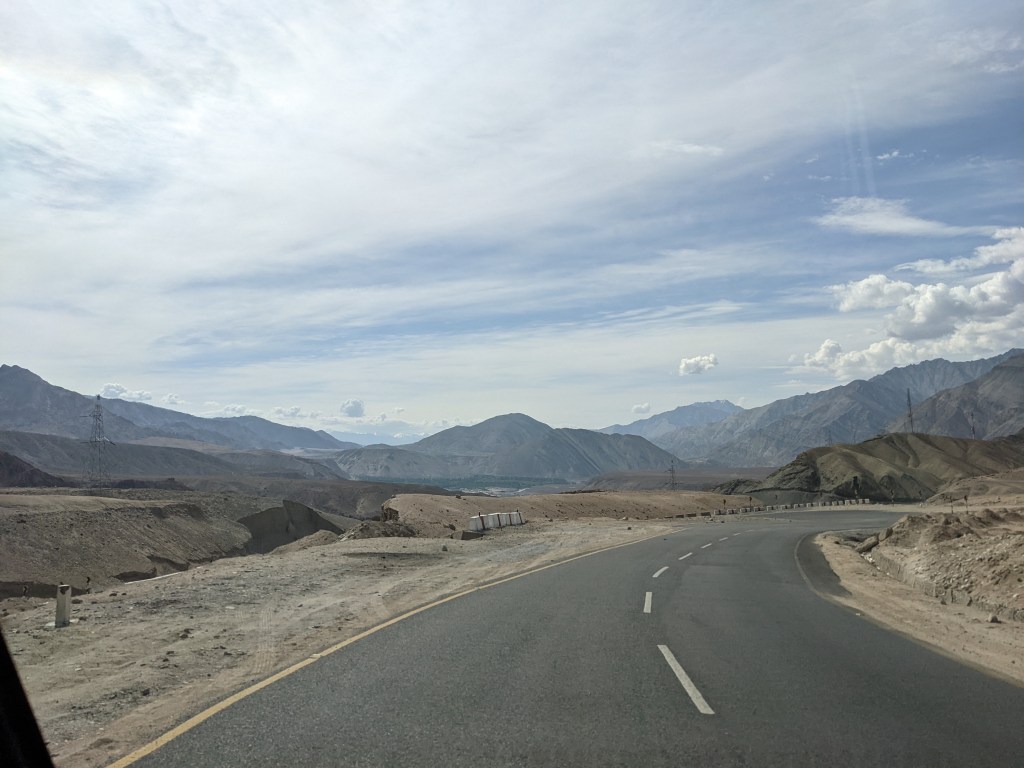
More empty road. This is only significant of course if you’ve never experienced most roads in India.

You booze, you cruise, you lose
Drive like hell, soon you’ll be there
Be gentle on my curves
Down slope, check your brakes
After whiskey, driving risky
Stop accidents before they stop you.
Better late than never
Smooth roads for smooth ride
Start safe work safe finish safe
Fast drive could be last drive

Around 9:30 AM we arrived back to Gangba homestay where Betsy and Dorothée’s old room was waiting for me, but it would only be available for two nights. Keeping in mind that my departure ticket was for June 21st, I dropped off my bags and immediately headed out to see what I could put together for my remaining time in Ladakh. After a few rather unsatisfactory visits to different agencies, I reluctantly decided the best option would be to get an early return flight to Bangalore, departing either the 17th or 18th.  I was hoping to just be able to change my ticket, but was prepared to pay up to 25,000 INR (320 USD) for a separate ticket if necessary.

Despite making it clear that I had just abandoned a trekking trip, this agency was trying to convince me to go on another, albeit shorter one!

It seemed though that I was not fated to leave earlier. There were no spots available on any flights for the next several days, even with theoretical one way ticket costs upwards of $500 USD! So with that in mind, I decided to first find a place to eat lunch and then once again dedicate myself to putting together some sort of a plan of activities until June 21st. Ladakh was not yet ready to let me go.

By chance I spied a tiny sign for the Ladakhi women’s cafe. I had earlier read that this was a recommended, inexpensive and very unpretentious lunch option. If you are looking for fancy decor, don’t try here, but my delicious lunch of Skyu and butter tea was only 170 Indian rupees. They accept UPI (it’s sort of like Indian Apple pay) payment, but mine was not working due to a poor connection, so I happily just paid 200 INR in cash. Certainly it was worth that and more.

Skyu is basically a stew made with tiny dumplings and a mix of root vegetables.

While eating, I remembered that my friend and co-worker Jenny had spent several weeks in Ladakh and another friend, Ranmali had suggested that if I were in a pinch. I should ask Jenny for help. As Jenny was currently vacationing in Himachal Pradesh, I thought it likely that she would be without a phone connection, but I figured it would be worth a try.

Success! Jenny was available and happy to share her contacts. The guide/agent that she suggested, Lamo, immediately understood both my physical needs, personal interests and my budget constraints. While it was still a bit more than I would have ideally paid – the solo traveller tax (beggars can’t be choosers and she was at least highly recommended by a trusted colleague), she quickly put together a three day itinerary to Nubra valley and Pangong Lake with a departure date of June 18th. At 3:00 PM I dropped off my passport with her so she could get the inner line permit and then headed directly to the nearby Central Asian Museum of Leh.

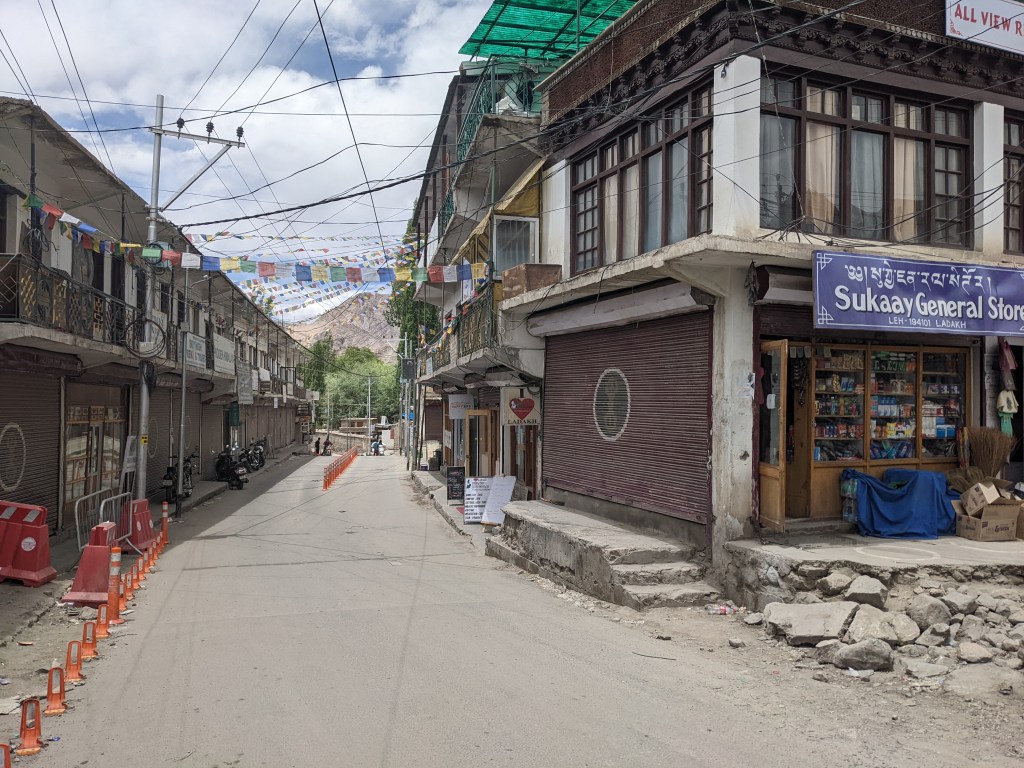
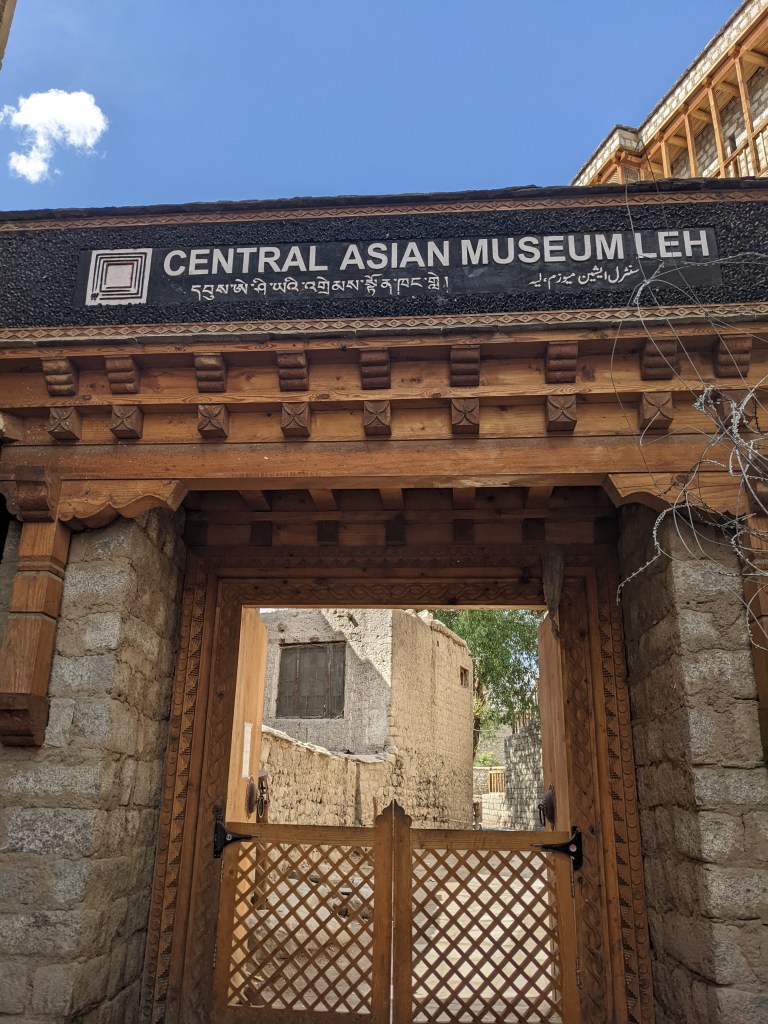
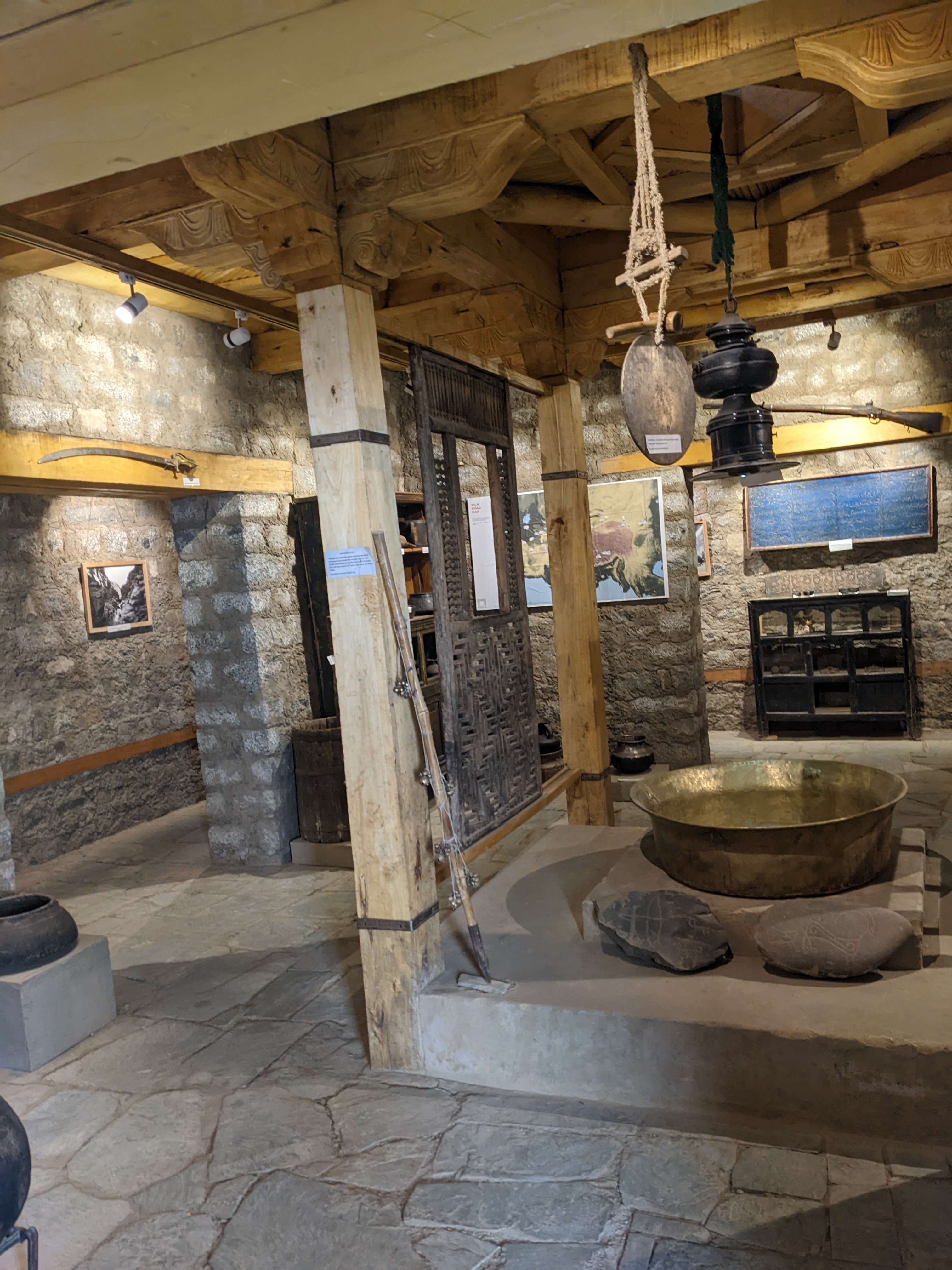
Despite its size, it’s unlikely you will find this unless you are actively seeking it out. The entry fee is only 100 INR (1.25 USD) and that cost is more than justified just by the building itself. The museum recounts a highly digested version of Leh and Ladakh’s history, doing a good job of making one appreciate its full breadth of various cultural highlights without overwhelming the casual visitor. I liked that it was not jam packed, since this allowed for one to comfortably navigate all the displays in roughly 60-90 minutes. Unfortunately, as seems to be the norm in India and especially in Ladakh, it’s definitely not accessible to people with special mobility needs.

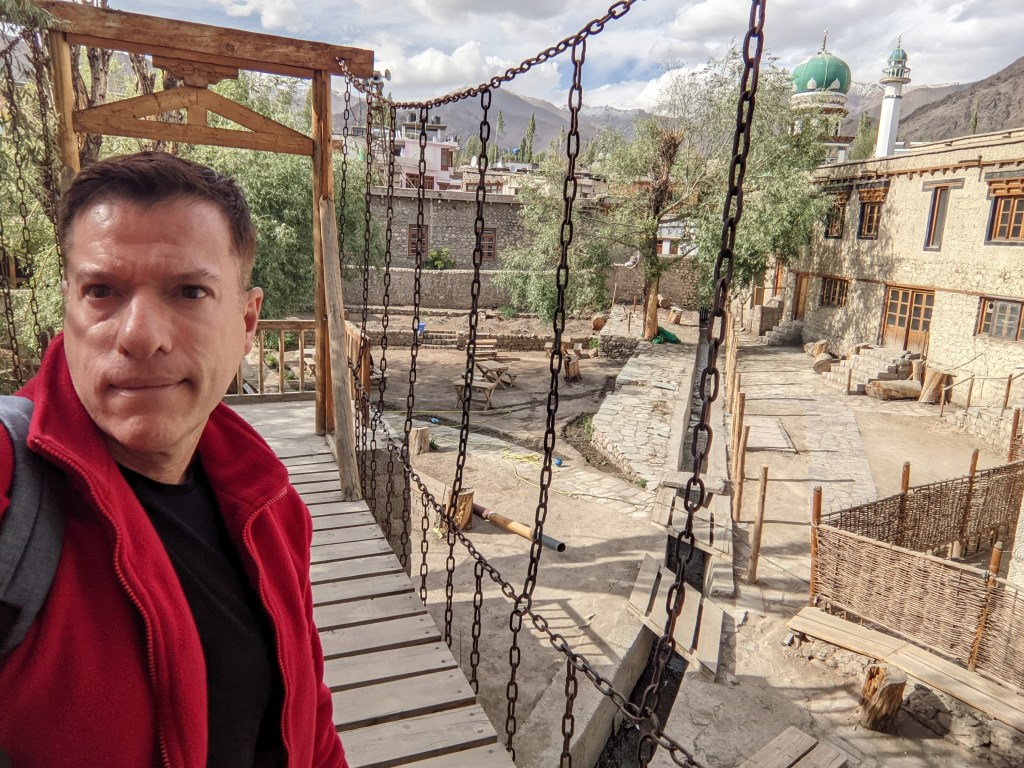
The museum is basically just a small tower. On the left is a view of the same with a white mosque showing in the background.
Each of the four (I think) floors is a simple square with each floor dedicated to a certain period in Ladakh’s history. The first floor focuses on when Leh was at its height as an important stopping point on the old silk road.
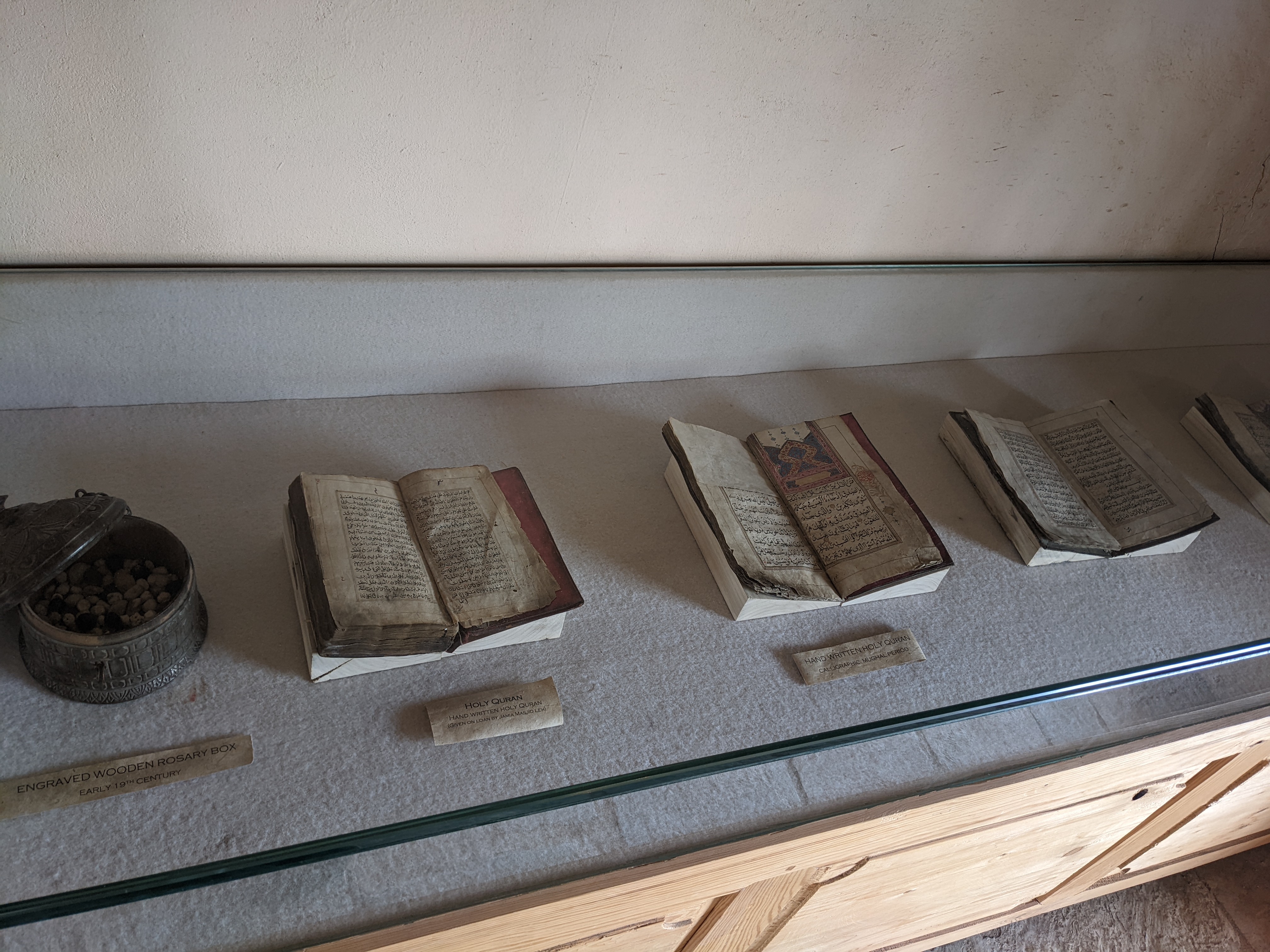
Some visitors may prefer more complete descriptions of the display items, but if you want that, I’m sure you can just do a guided tour. I liked the concise labelling done off each item.
The top floor focuses on the important cultural contributions made by varying Muslim groups, which according to the museum, have mostly existed in harmony with the majority Buddhist population of Ladakh.
There are many great picture opportunities in particular on the top floor of the tower.
You take this little bridge as you exit. It leads to a planned garden area which is currently just a dusty square

It had been my plan to head straight back to the homestay, but then I noticed these 20 stands which had been set up on the main boulevard. They seemed to be drawing quite the crowd, so I decided to check it out.

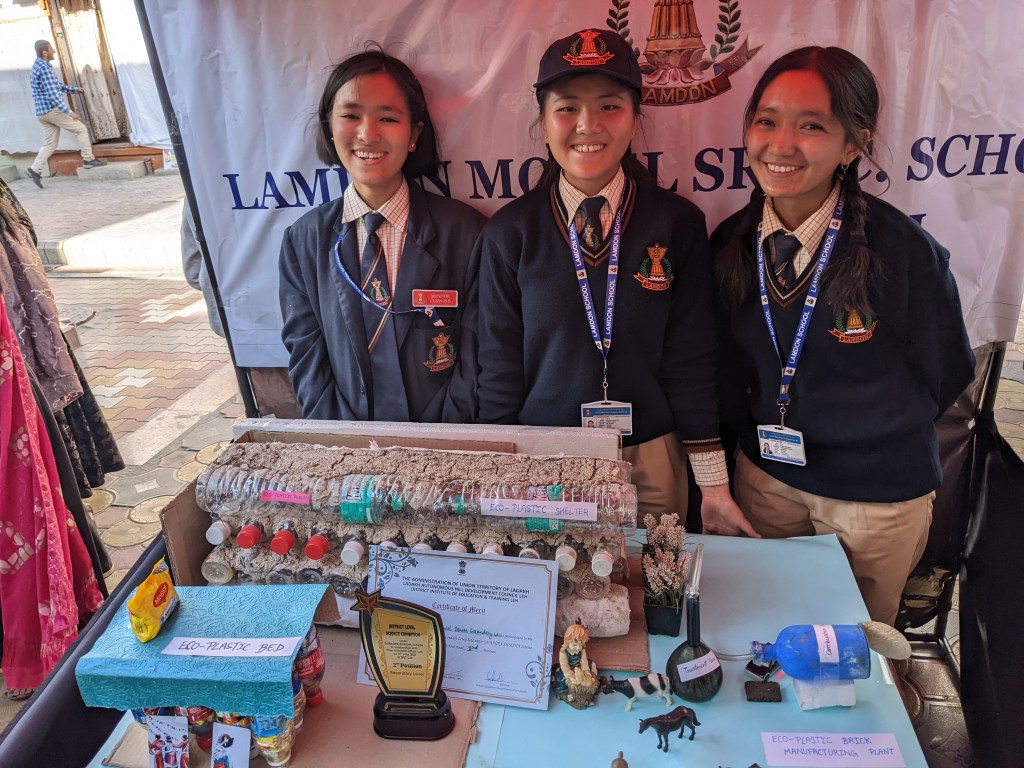
Evidently these were science fair winners from different parts of Ladakh, or maybe it was only just different schools in and around Leh. Regardless, it seemed like a great initiative to have the stands set up in such a public place, and the general public really seemed very interested in seeing their work.

Ways to reuse disposable plastic bottles for construction
Solutions to blind curves which are common on winding mountain roads

I then finally made my way back to Gangba homestay where I had a delicious dinner before turning in for the night.

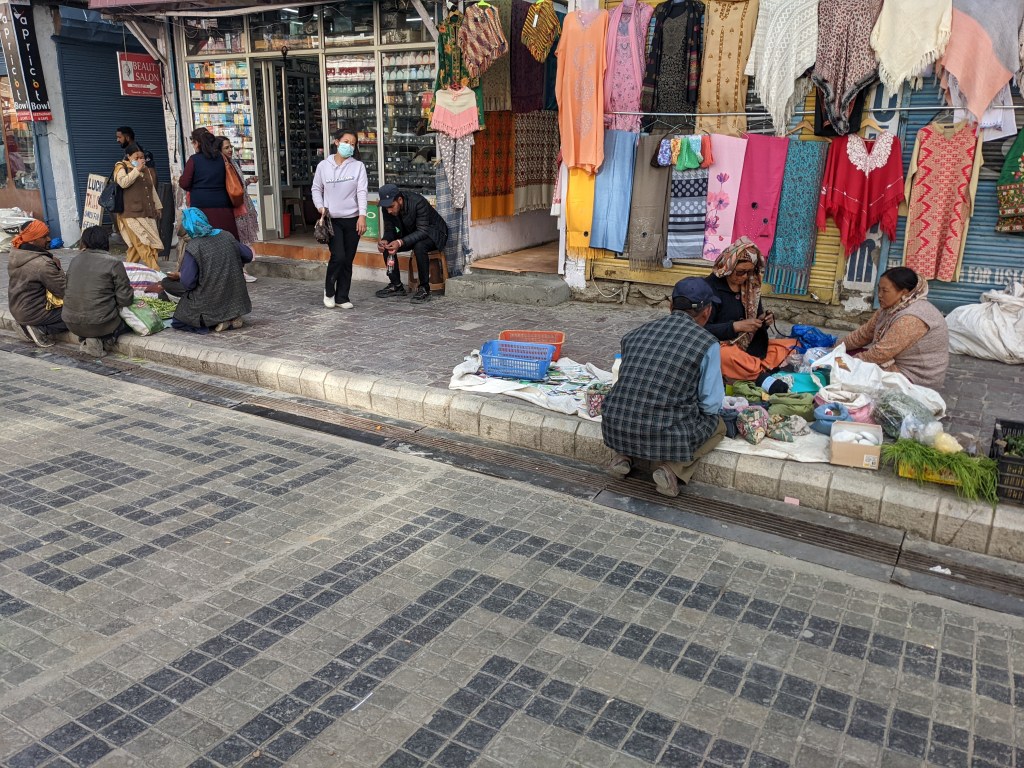
Vegetable sellers along the pedestrian boulevard were frequent, but the road was wide enough that they didn’t obstruct traffic.

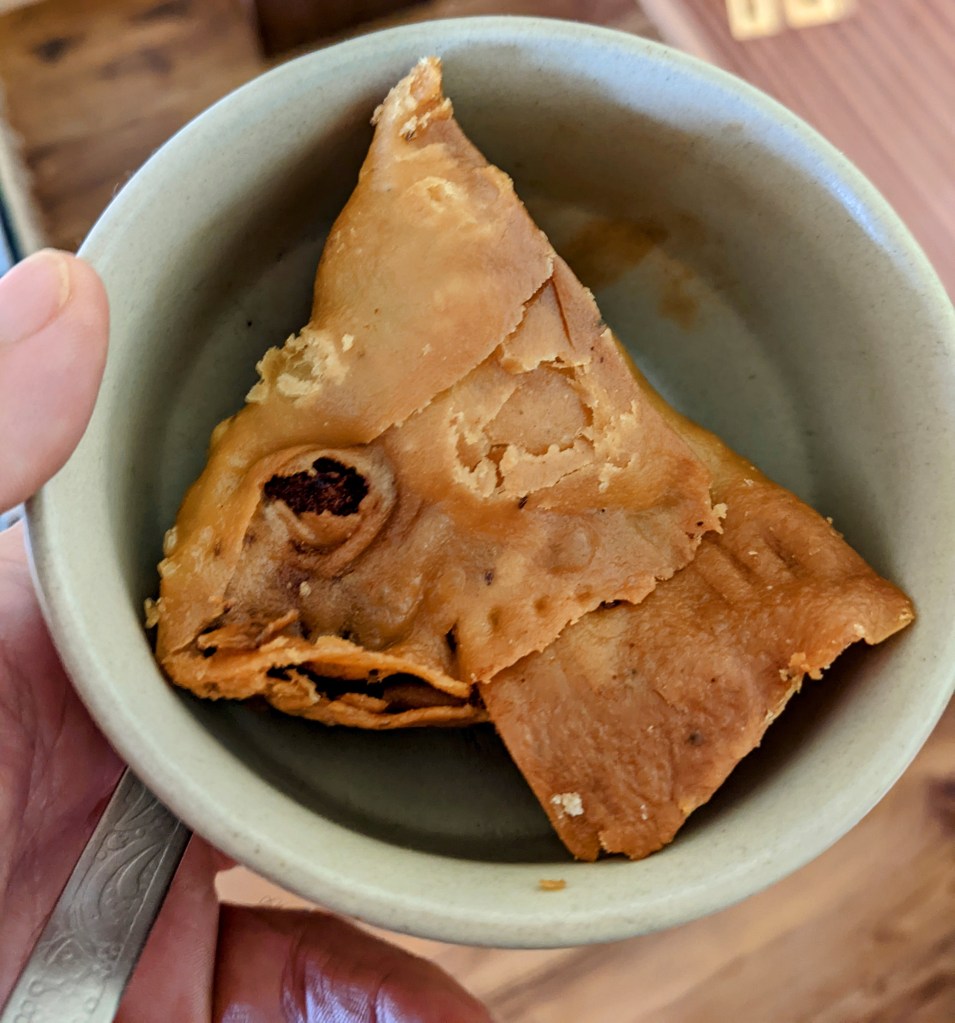
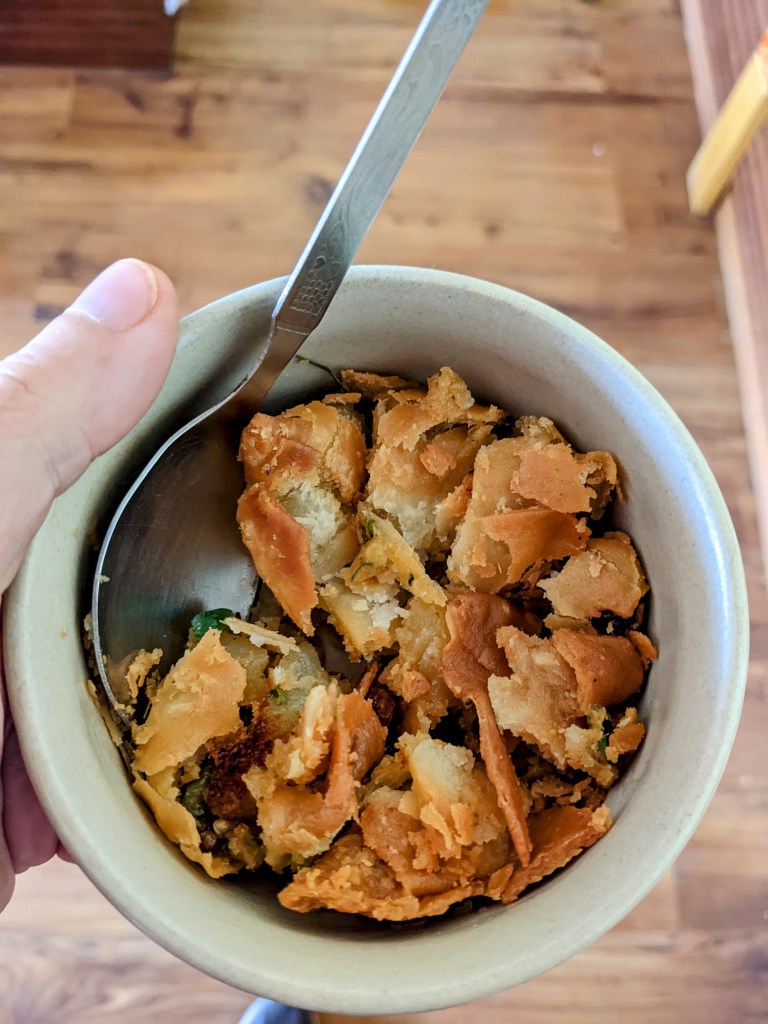
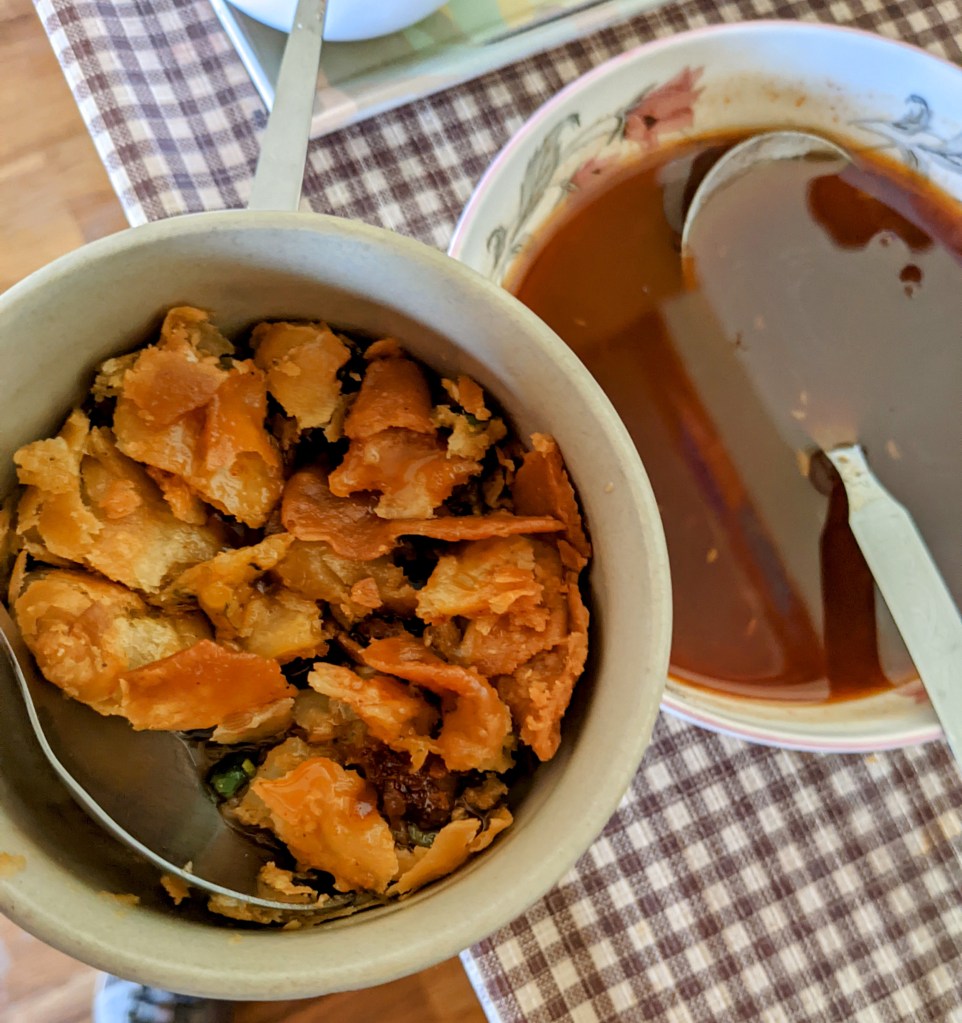
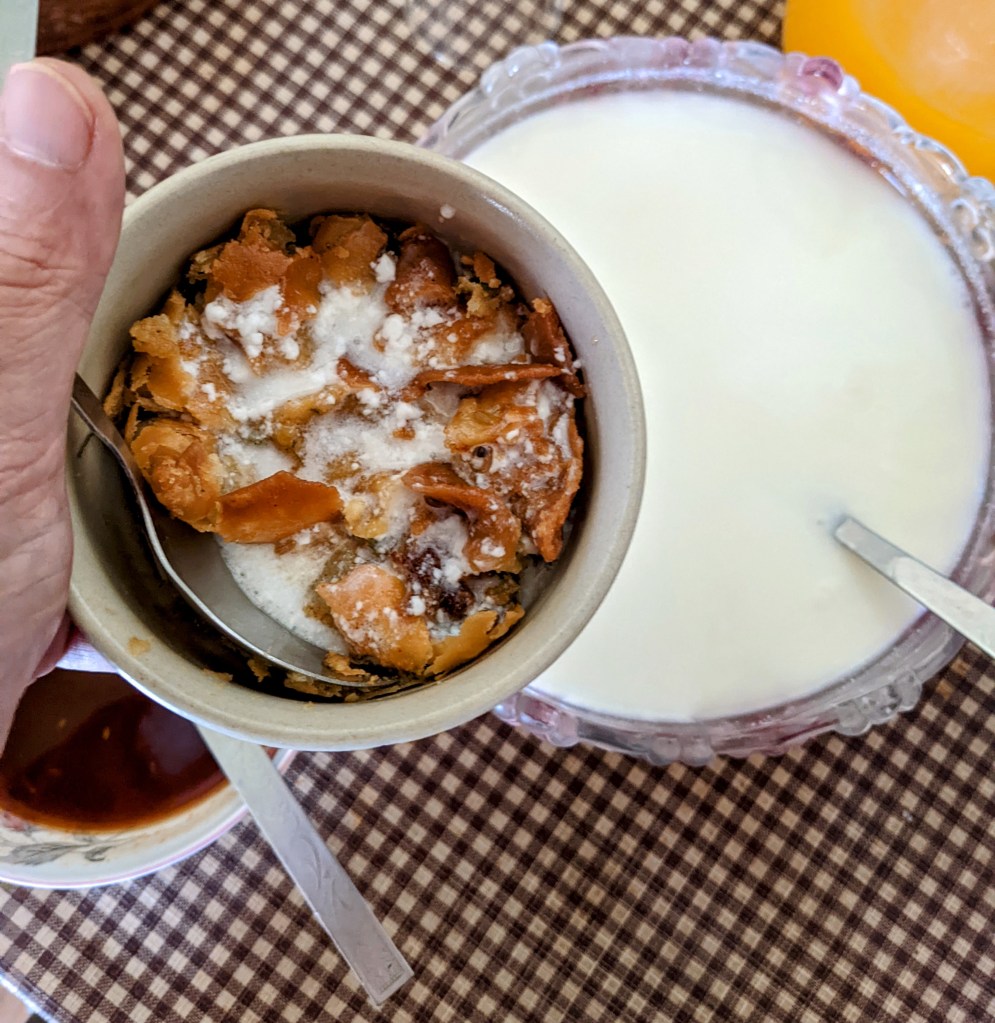
Next morning ( June 17th), I went for a 8:30 AM Breakfast of smashed somosas with sweet and tangy syrup and curd, stewed chickpeas, admittedly uninspiring toast with some sort of a toxic jelly substitute and of course the ever present milk tea. There is a whole process to preparing the breakfast somosas but the end result is delicious.

Step 1, get a somosa
Step 2, break the somosa into chunks with a spoon
Step 3, drizzle the sweet, tangy sauce over the somosa chunks
Step 5, add a bit of curd and eat! The end result is much tastier than you might expect.

Amazingly, the hookah smokers (at this hour reduced in number)  from yesterday were still out, but they had moved to a different area closer to the main entrance of the homestay. I wonder if they came from central India to Leh, Ladakh for the express purpose of smoking hookah all day long? I mean it seems like a rather expensive undertaking, but maybe they just wanted the cooler weather?

Around 10:30 AM, I decided to head back to town.

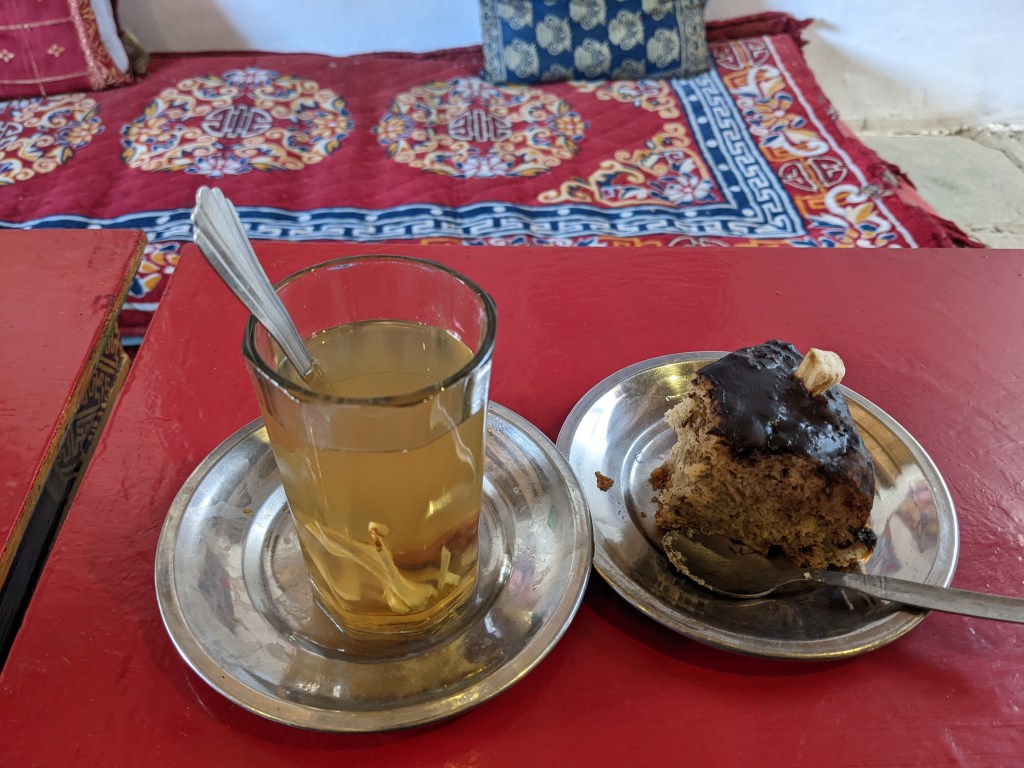
After wandering aimlessly around the narrow alleys and ruined building, trying to find LAMO (Ladakhi media and arts organization), even though I had seen a sign supposedly pointing me in the right direction, I finally gave up and decided to just go by Lala’s cafe for a honey ginger apricot tea and maybe a small pastry.

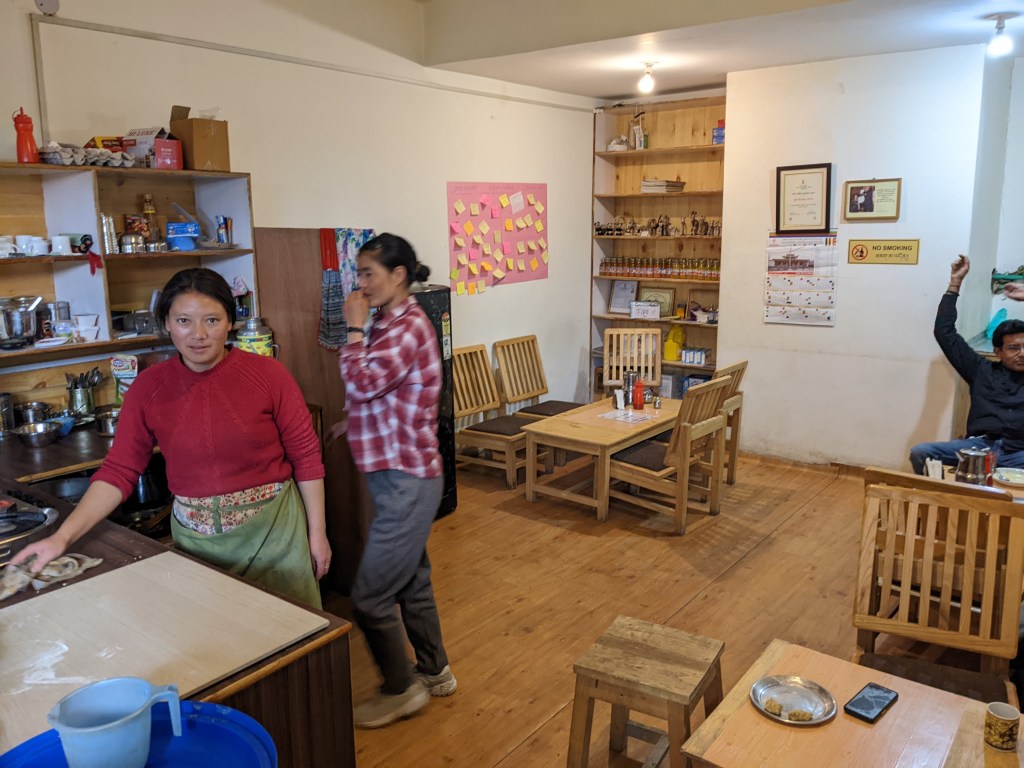
Honestly the banana bread wasn’t the best, but the tea was great. More importantly, the woman working behind the counter gave me meticulous instructions on how to find LAMO. Even with her guidance, it was tough, but she had even took me up to the rooftop to point out the exact building, so I was able to find it just on that basis.

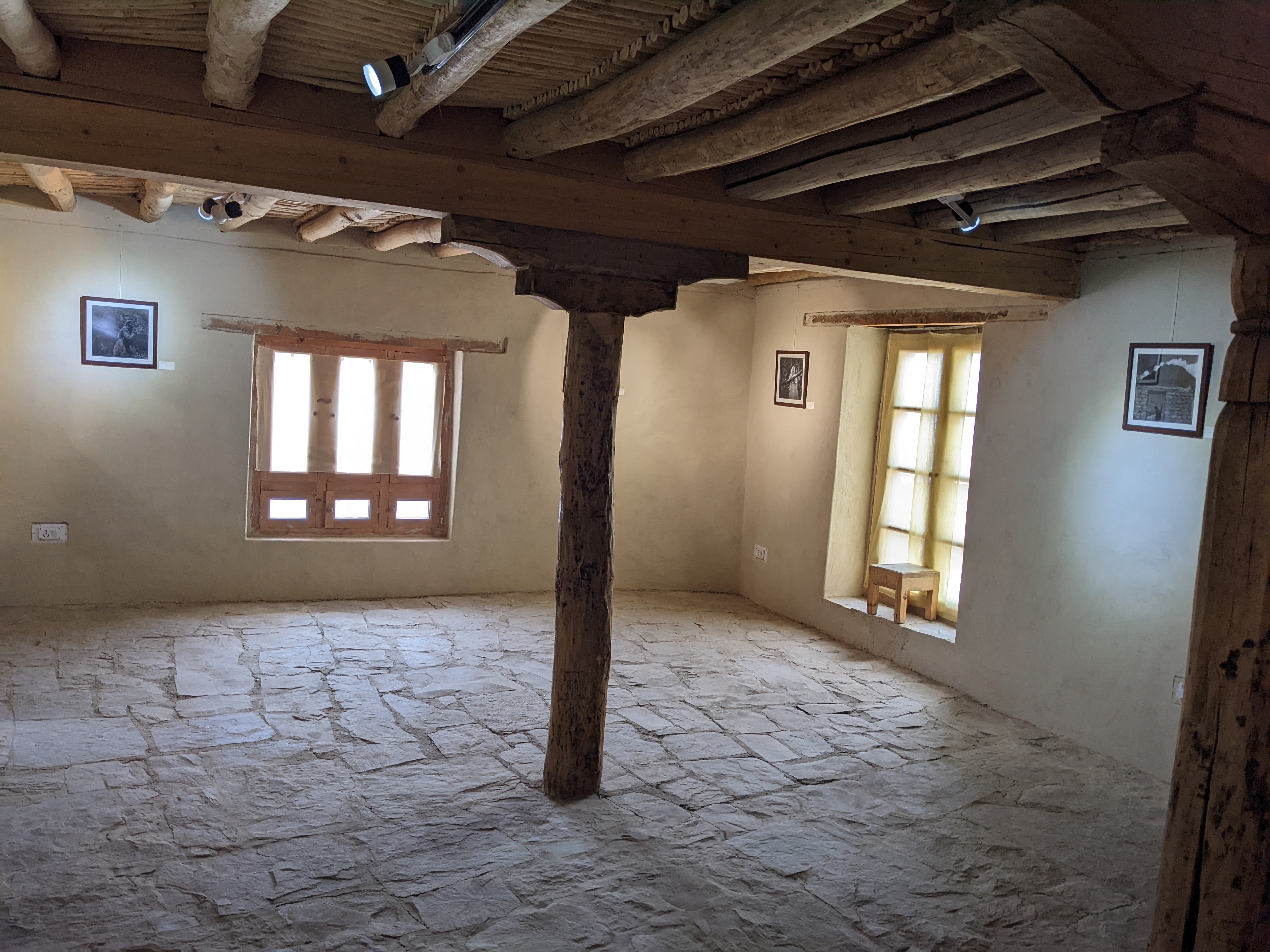
With an entry “donation” of 100 INR (1.25 USD) a visit to LAMO is worth it even if it’s just for the architecture. The building, which used to be the residence of the chief secretary to the king, has been lovingly restored and now primarily serves as an art gallery and a library.

I especially liked the collages which had been done by some local high school students.
A few of the rooms are dedicated to “special exhibits”. When I visited, there was a black and white photography exhibition. It’s not generally my thing, but a couple were very nice.
The library has two floors jni, primarily serving as a general reading collection focused on children and adolescents, but there is also a small section of art specific resources
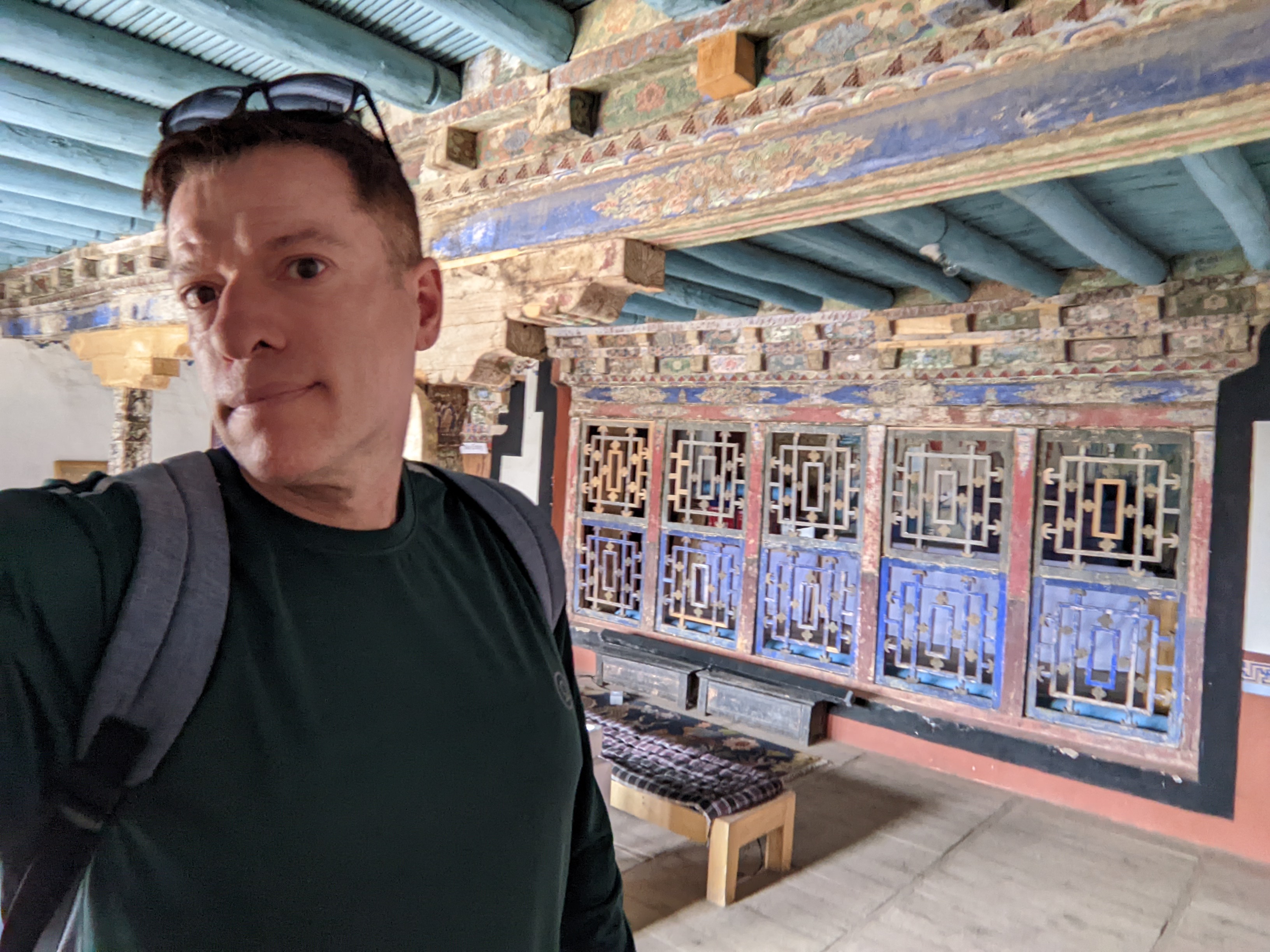
While much of the building had been in relative ruins, in the background one can see some original painted woodwork from when it was still the king’s secretary’s residence and offices
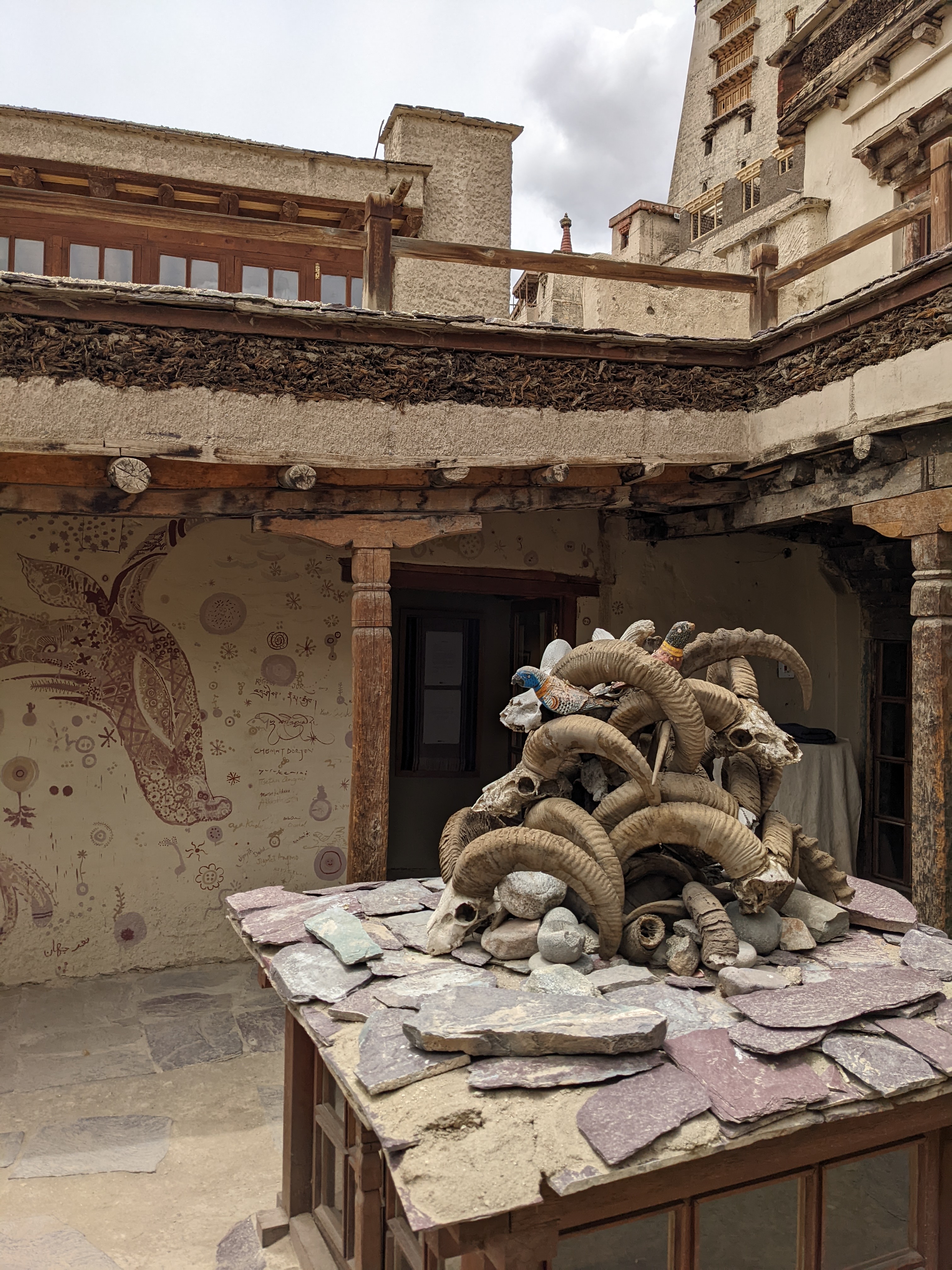
A sculpture made primarily from yack skulls

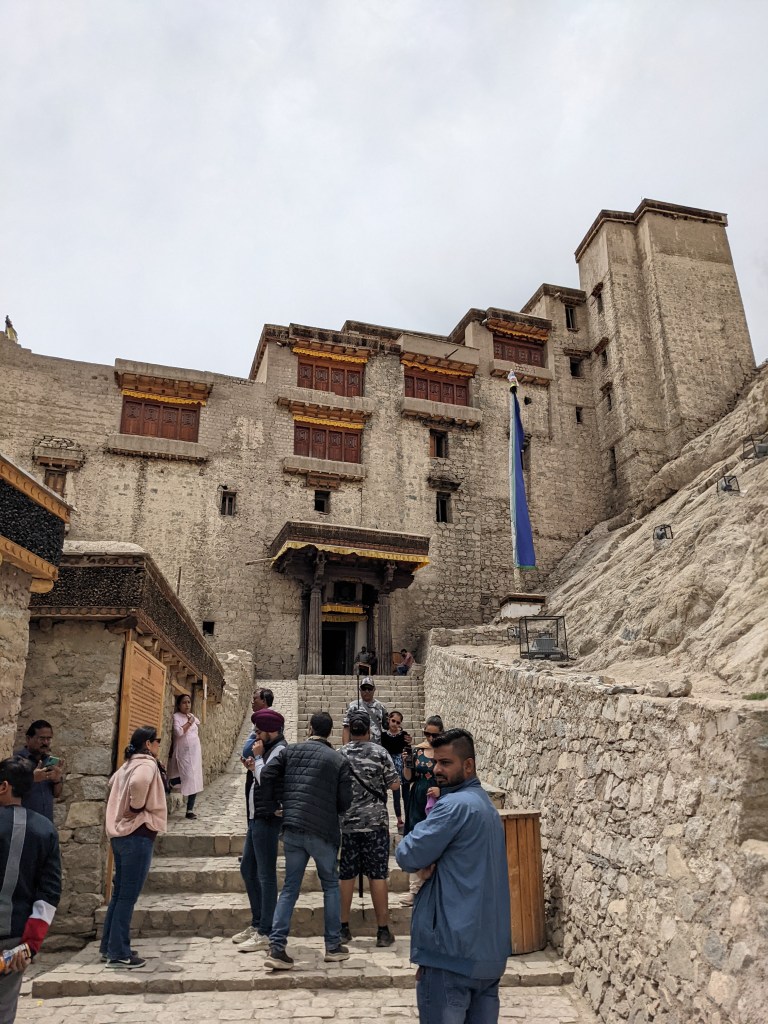
Although I had read that there wasn’t really much to see, the old palace was right next door, so I figured that I may as well visit. It does seem that a lot of renovation work has gone on during the past couple of years. Entrance for foreigners without local identification is 300 but as I had my residence card, it was only 25. If you are tight for cash as a foreigner, it might not be worth paying the 300, but for a local, it’s definitely worth 25 INR (0.30 USD).

Entrance to the palace
Some renovation work going on right next to the palace
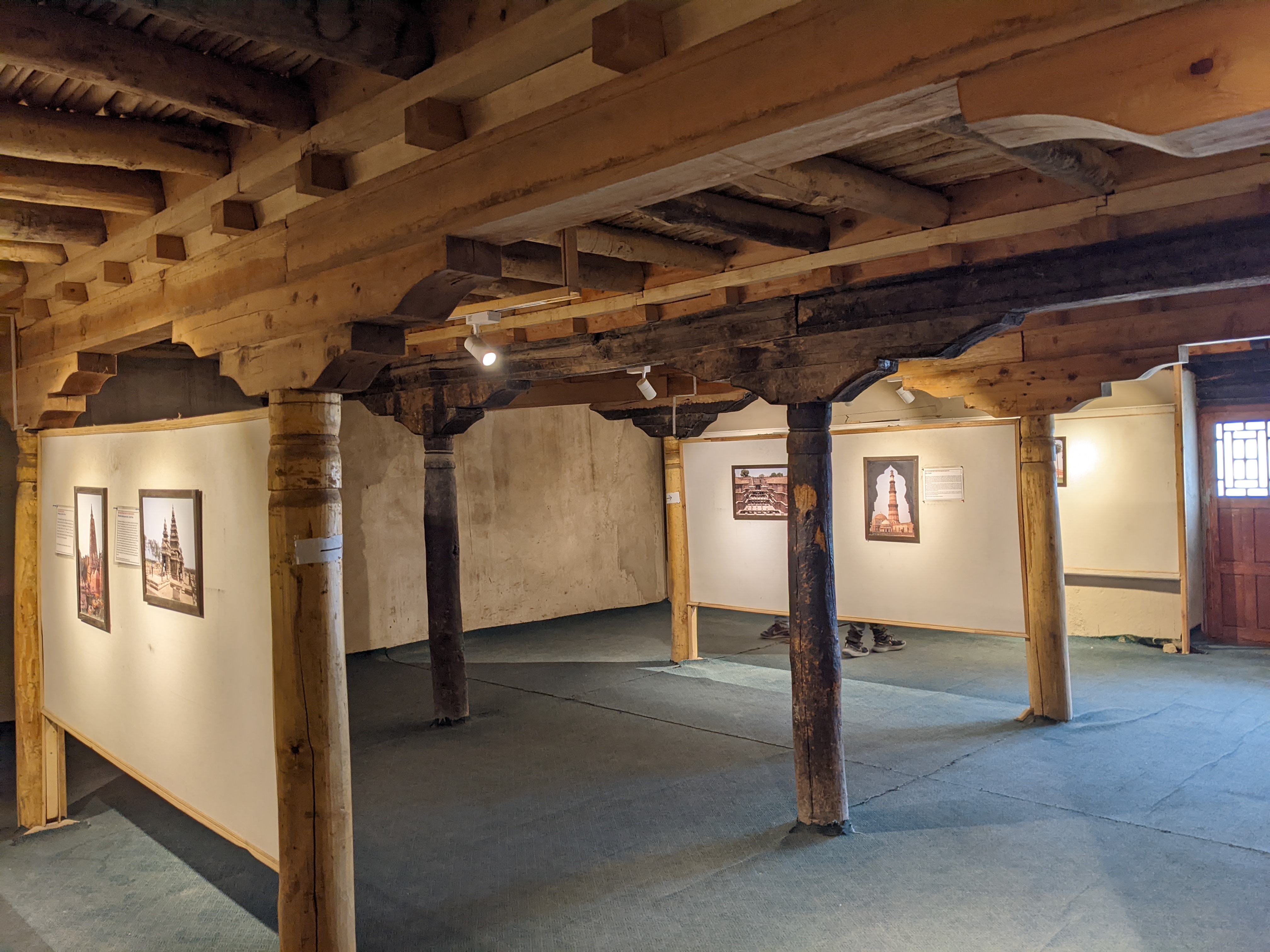
Aside from the restoration work on the structure itself, the first main room has nothing to do with Ladakh. It’s pictures of famous sites in other parts of India.

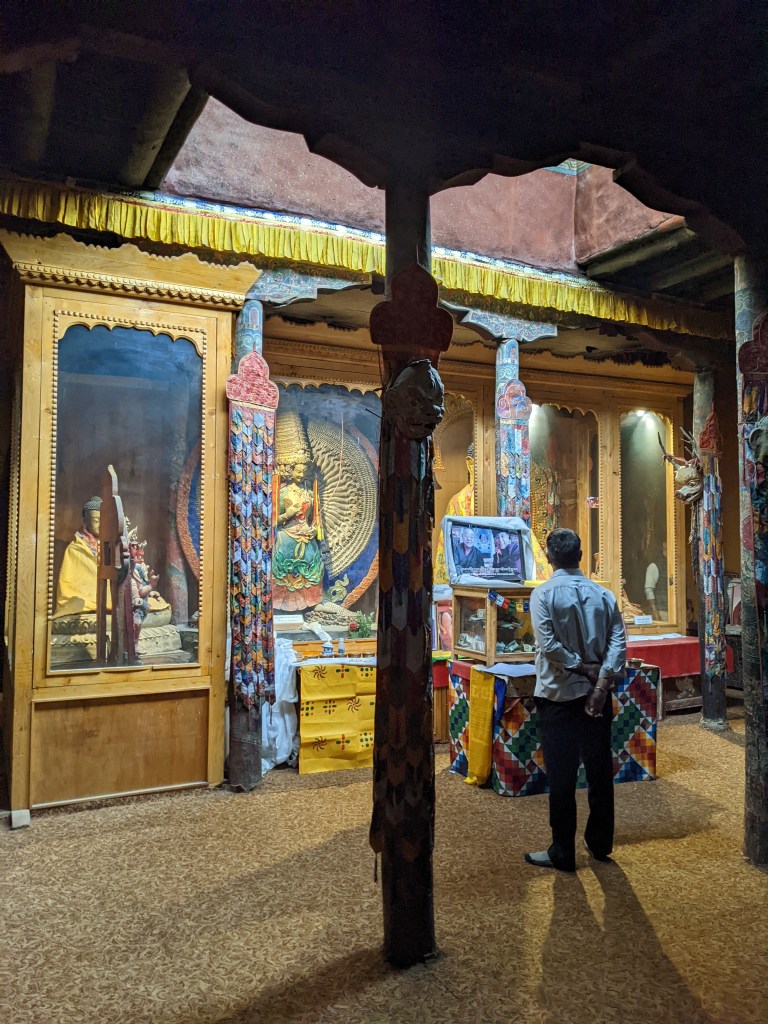
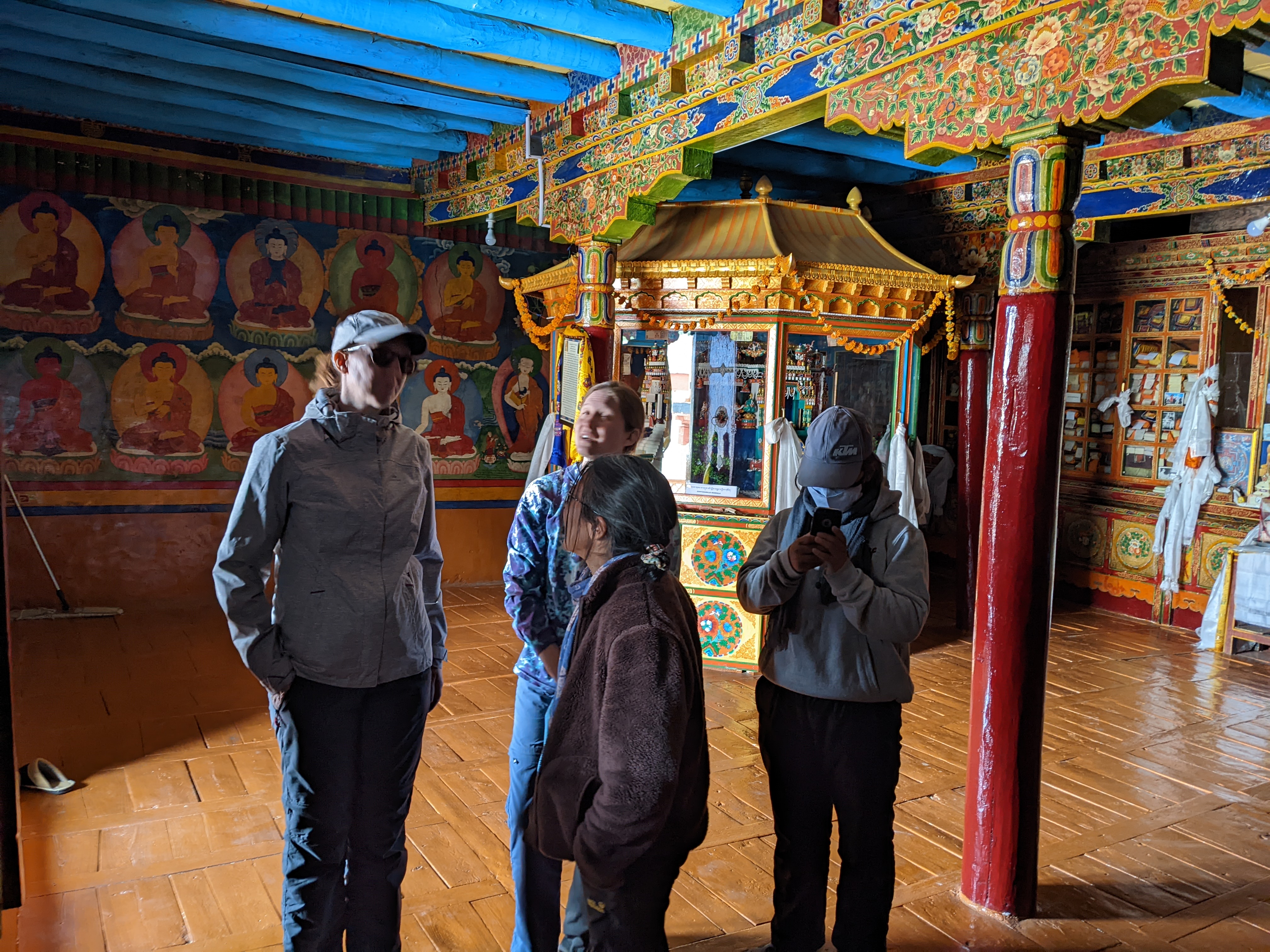
Without a doubt, the most interesting part of the palace is the prayer room. Photos are strictly prohibited, so I of course took several.

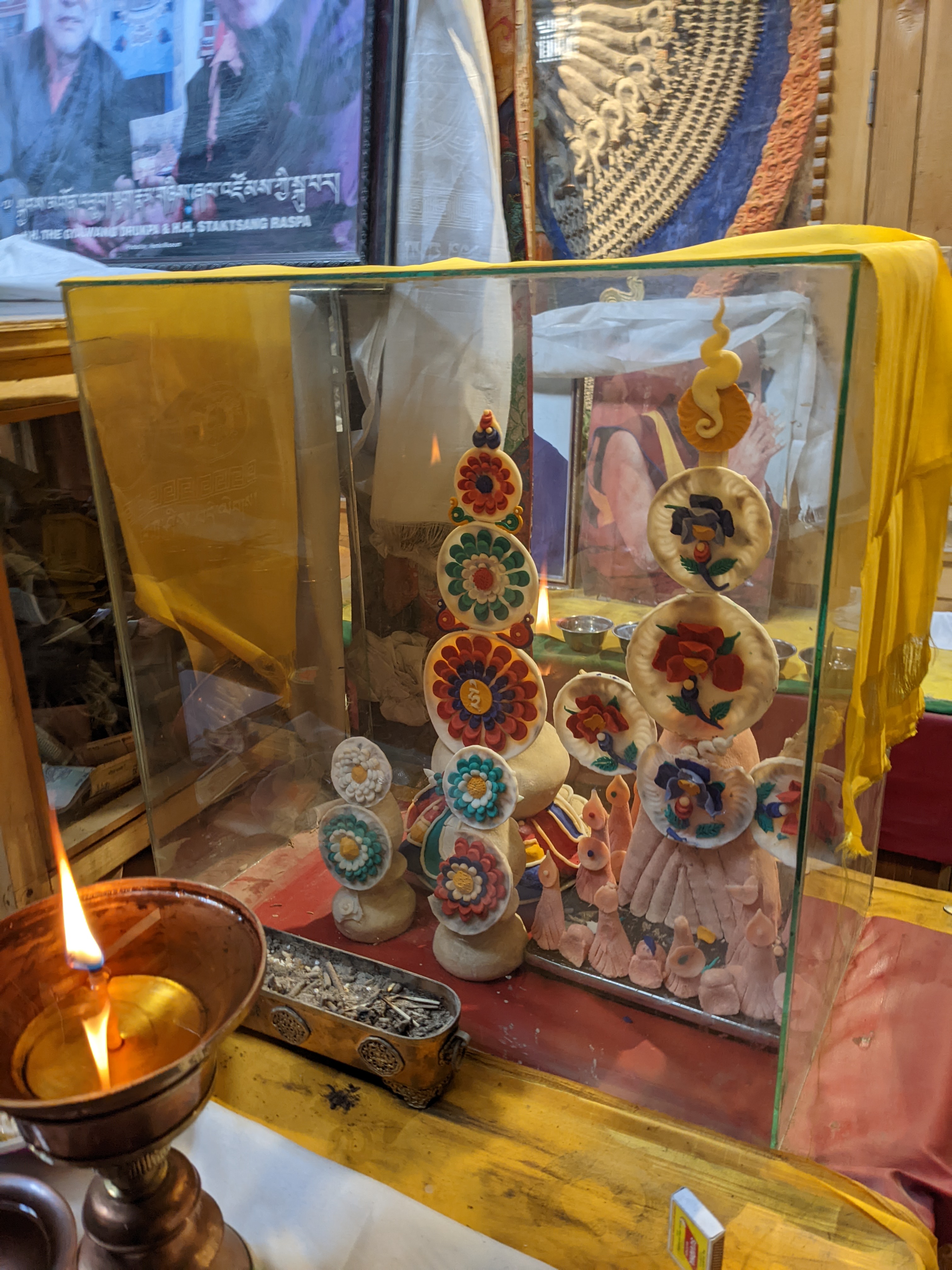
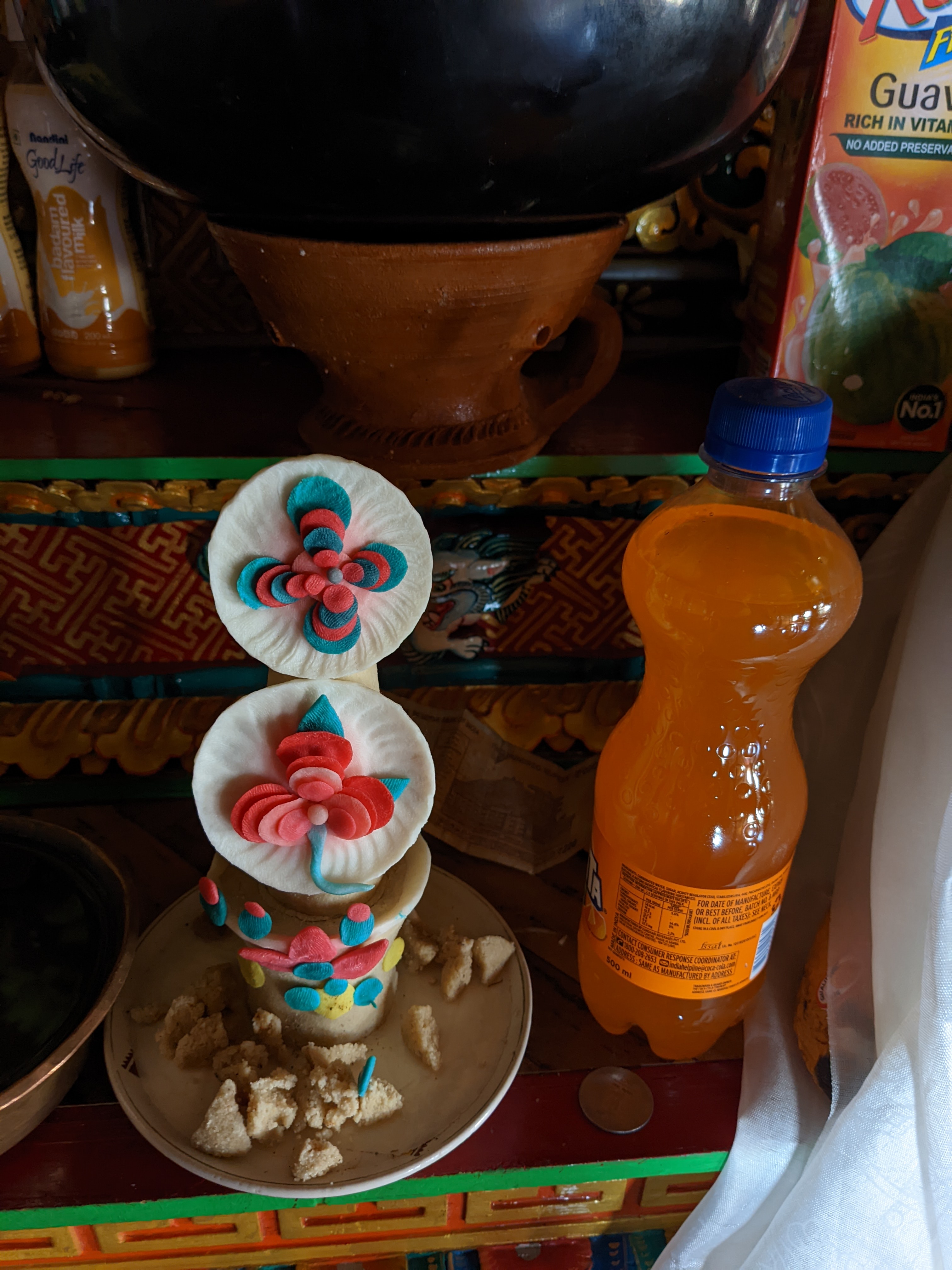
Some beautiful butter flowers which had been left as offerings.
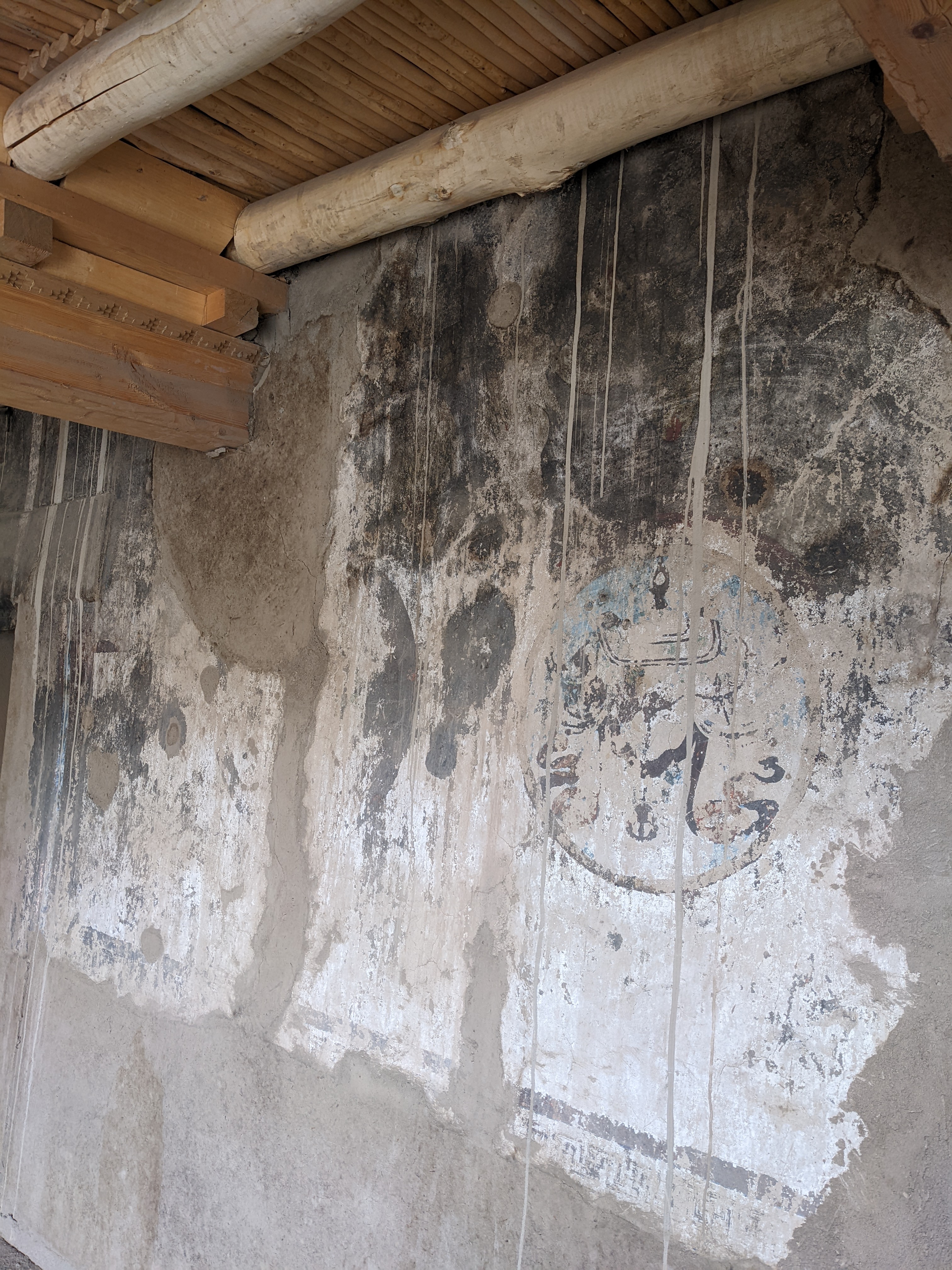
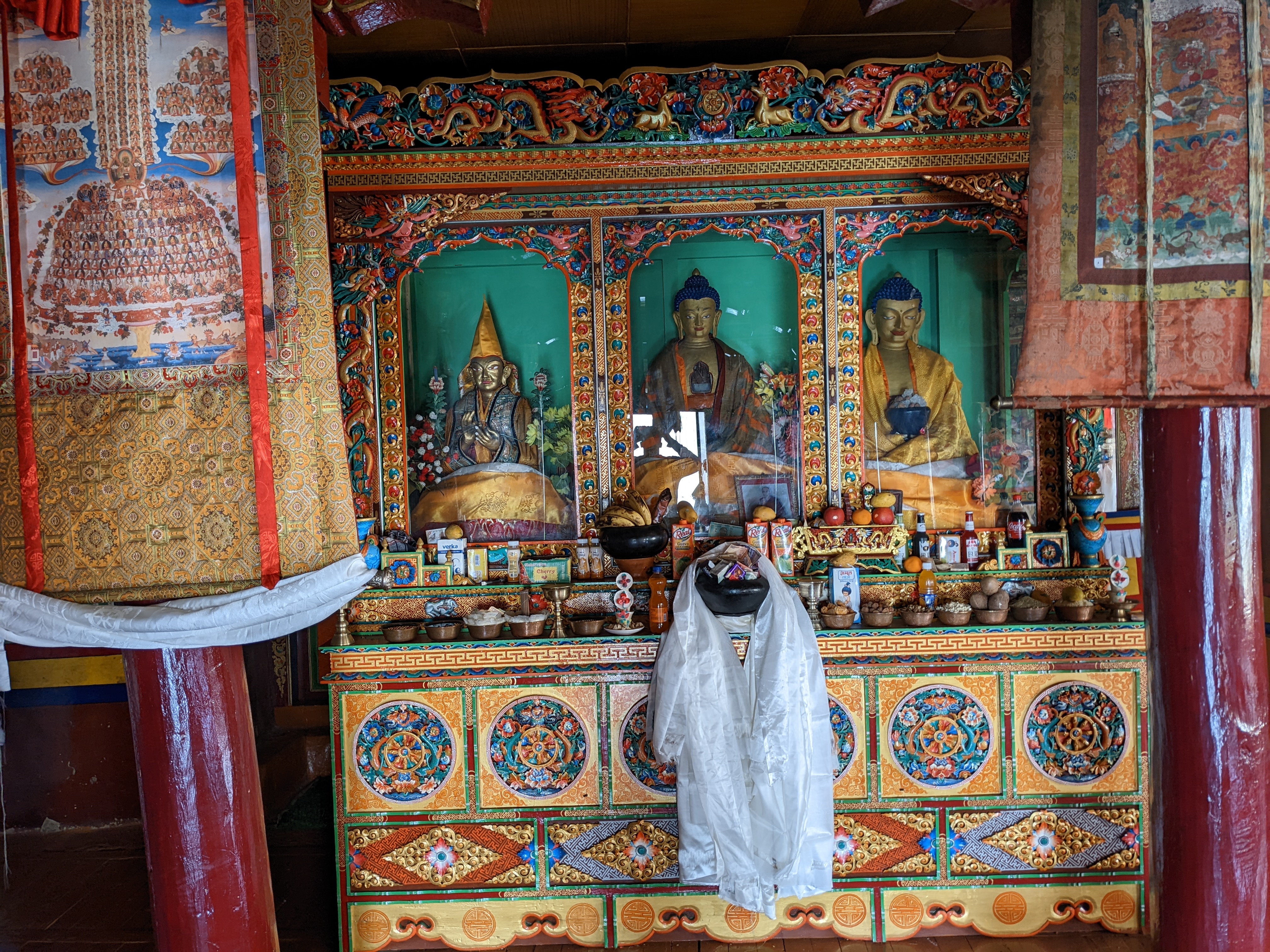
I’m assuming the painting on the high walls is original

To be honest, that’s pretty much all there is, but there are some nice views from the upper floors.

Some wall art which had obviously been damaged during an earlier poorly done “restoration”

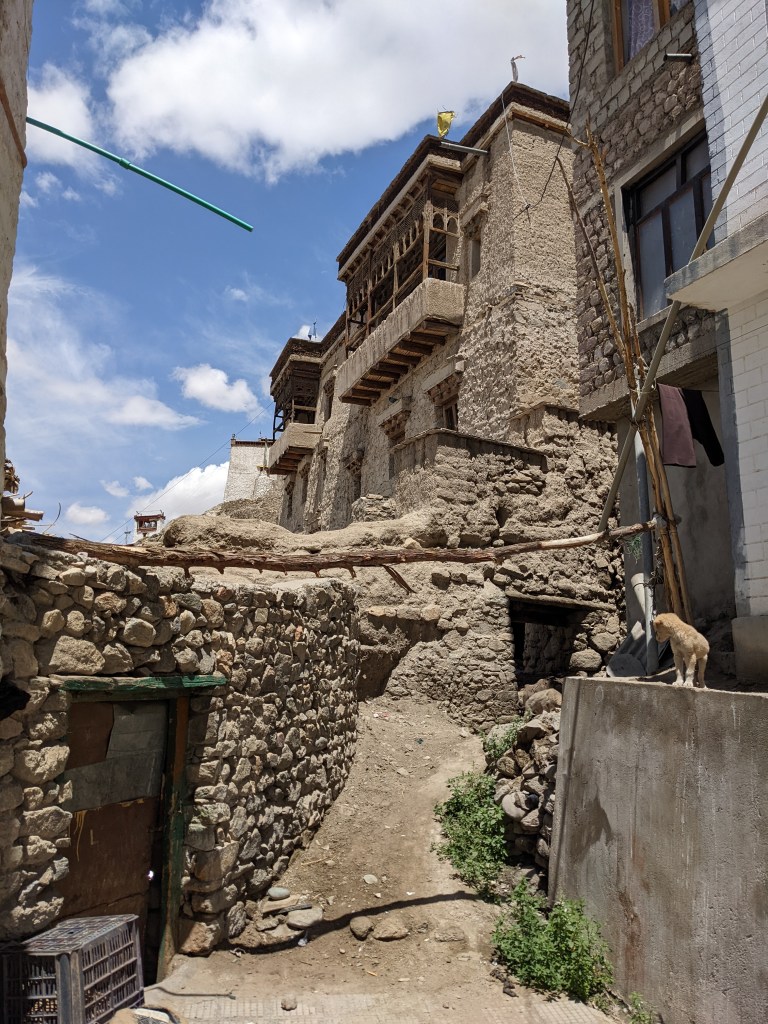
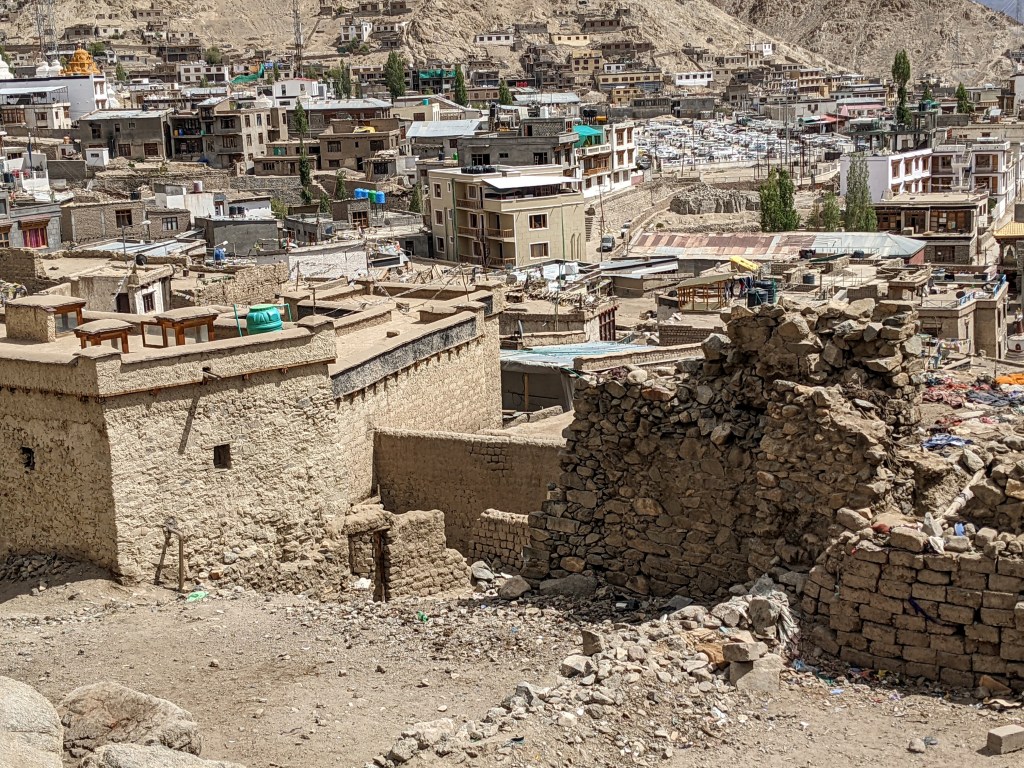
When I exited the palace, I went back down through old Leh and then headed back to the center of the city. As always, I was fascinated by the different buildings and ruins.

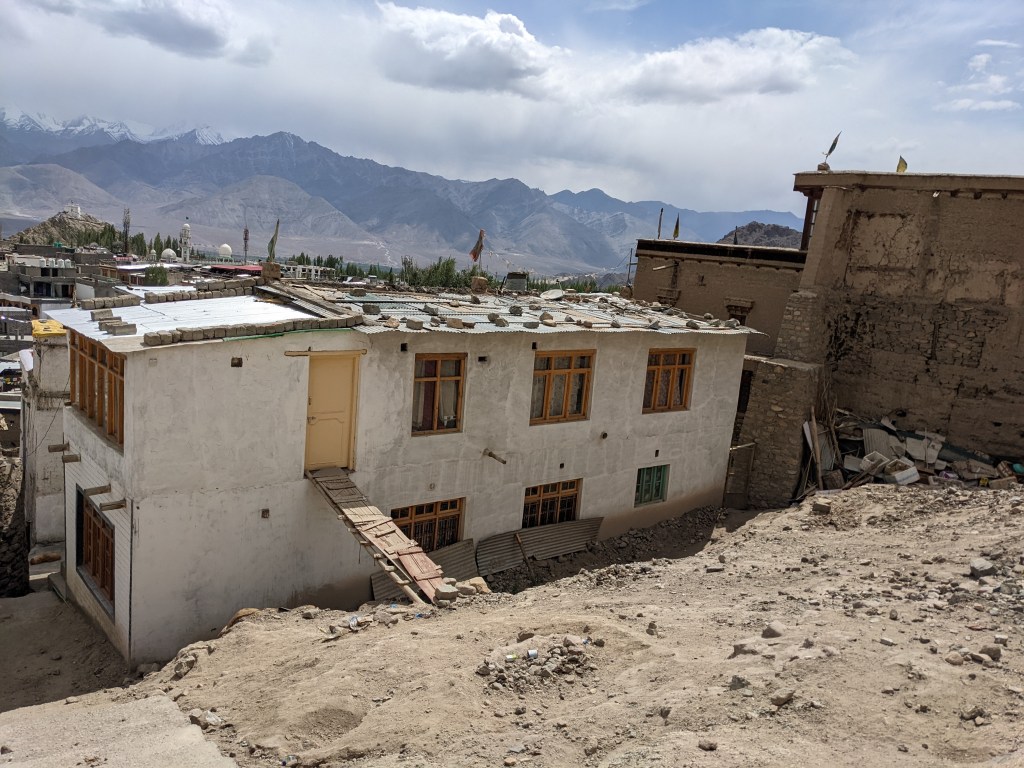
I actually liked this relatively modern “real house” which was very close to the palace. Of course restoration proponents probably hate it. But I liked that this was a real family just trying to live in their regular home which happened to be in the middle of a mostly fallen down area.
I liked the doorway to the left of this image

It was quite late by now, almost 4:00 PM, but I decided to go back to the Ladakhi women’s cafe for a late lunch. As I came up the stairs, one of the women recognised me, and I was greeted with a huge smile of recognition. I had considered going somewhere new, but I had been so happy there the day before, I figured may as well return. This time I had another traditional Ladakhi dish, Chutagi.

Finally I headed back to Gangba Homestay to start packing again and also to rest a bit before dinner.

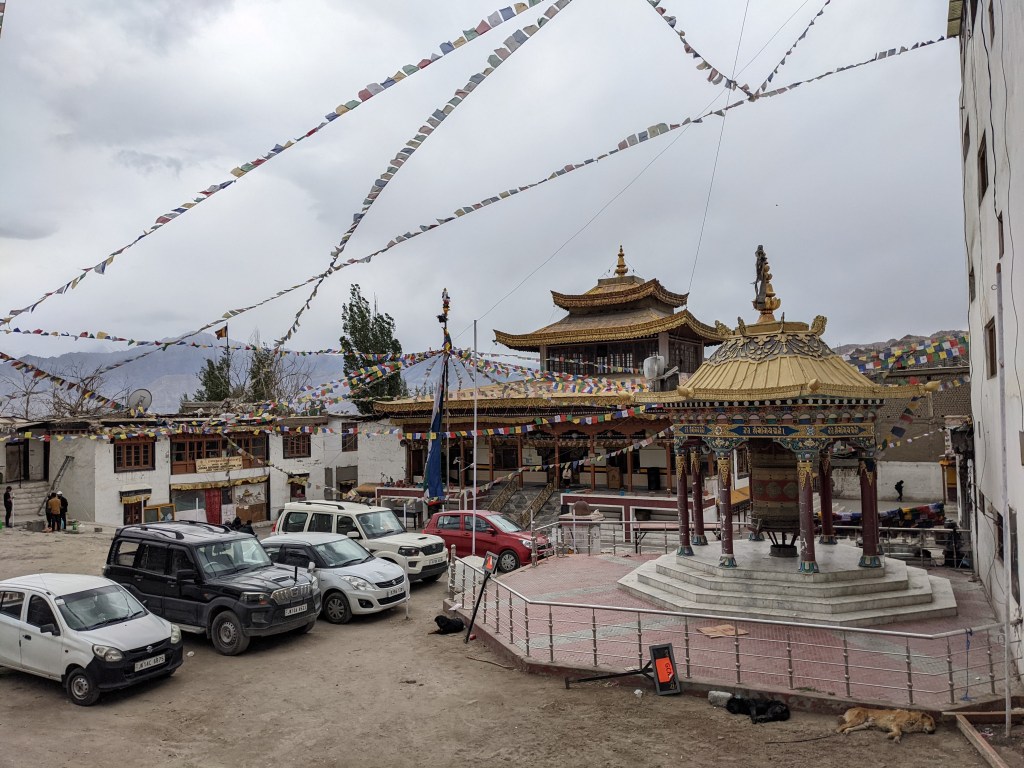
A rather large Buddhist temple in the center of Leh.
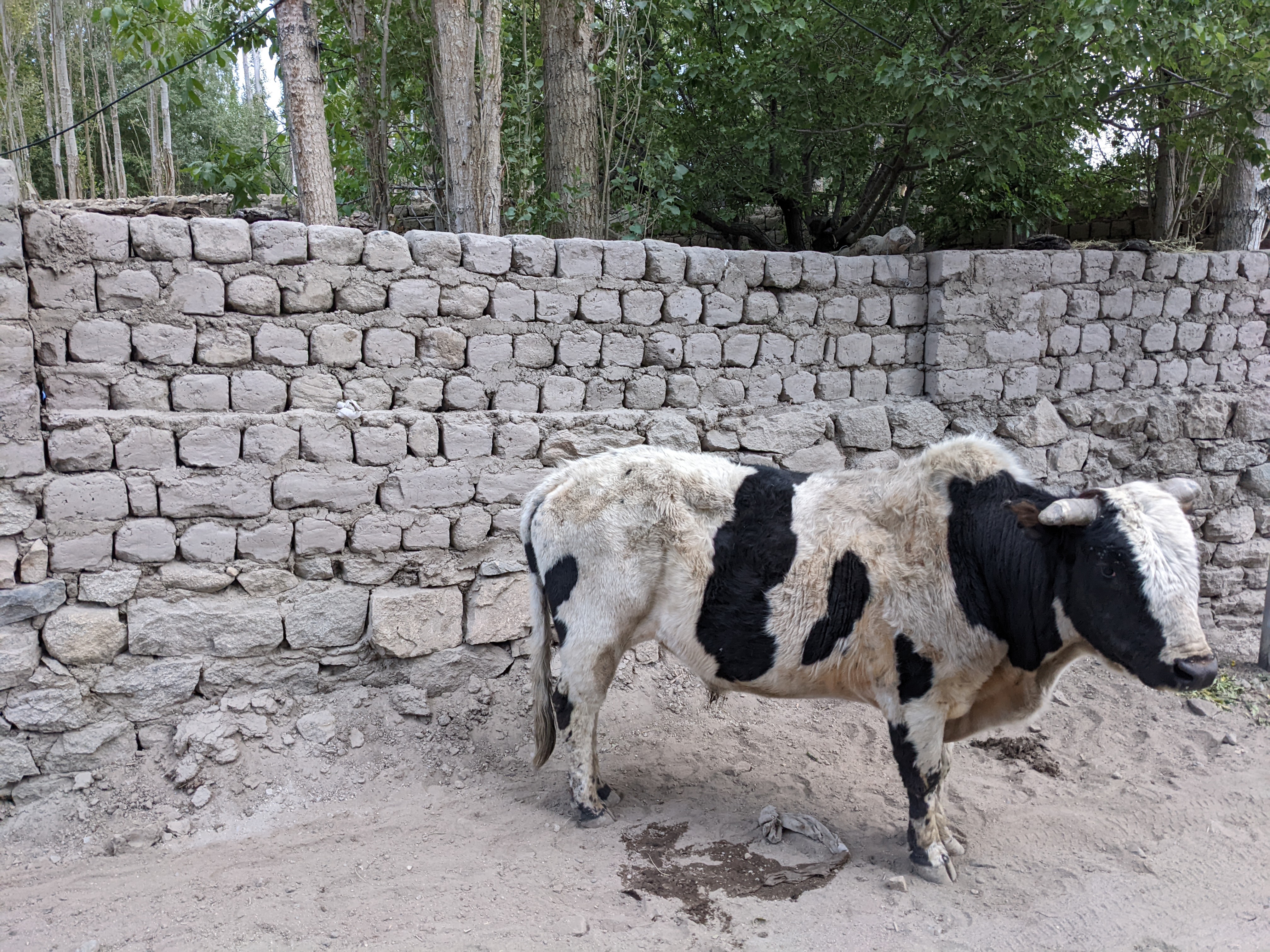
I think this is a cross between a domestic cow and a yak. It’s the second time I’ve seen one in Leh.

Assuming all goes well tomorrow morning, we will depart for Nubra Valley at 8:00 AM. I really have no idea what to expect, but I have an open mind, and I’m hoping for the best. For those of you who have been following along since the beginning, I hope you’ve been enjoying my journey, and for those who are just joining today, look forward with me, to great things to come!

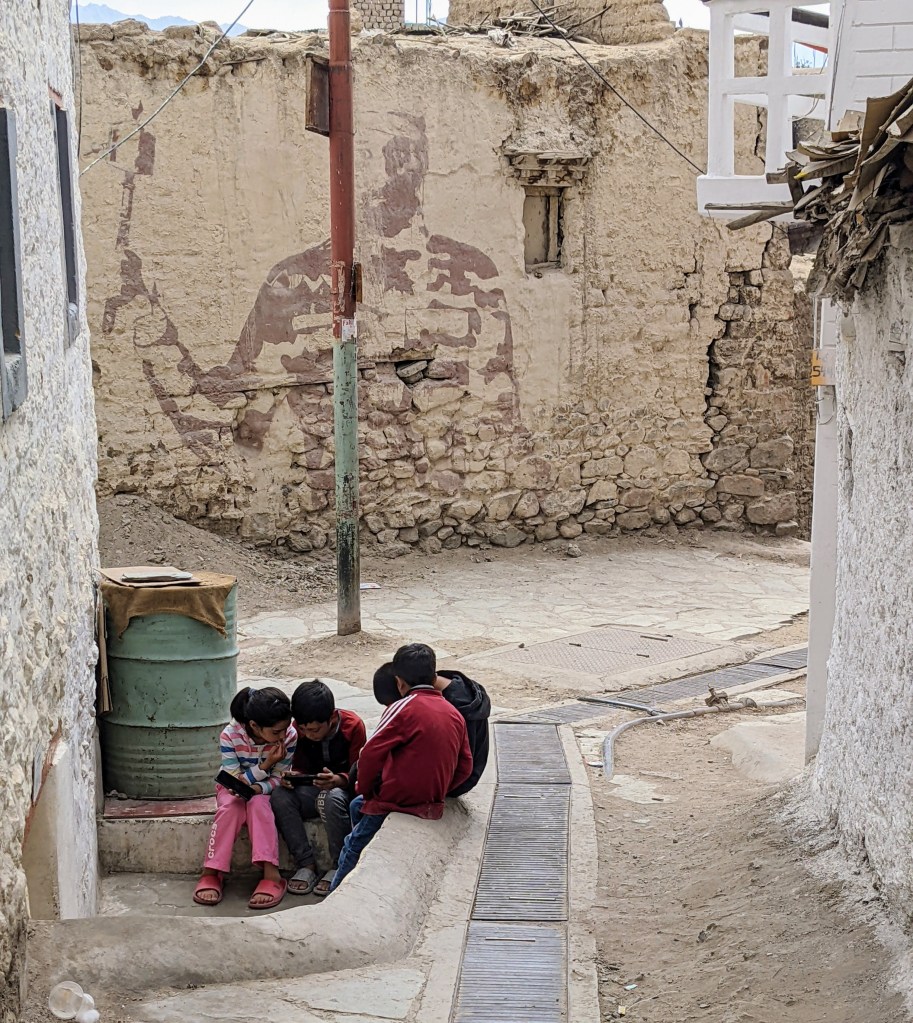
Local kids playing on cell phones.

Ladakh trip: Day 6 (15-Jun)

Hey all, it’s a new day in the mountains here in Ang, Ladakh.

I was wakened by the toddler’s laughs at 7:00 AM, quickly dressed, and went for a simple breakfast. At  7:45 AM Dorothée, Betsy, Thinlas and Songnam headed out for a half day hike.

The previous evening I had noticed that Dorothée’s hands looked very chapped and burned and had thought to offer her my thin gloves since I was no longer hiking. However, having travelled in the past a few times with Dorothée and knowing she could be a bit particular with the use of personal items. Certainly there was no way to wash and dry them before offering them. However, I was pleasantly surprised when she actually asked me if she could use them. I was delighted to lend them and so happy to know that they would be of good use to a friend in need. Next time around I should just offer; even if someone says no, it’s better to attempt to help.

Shortly after their departure, at around 8:20 AM I also decided to go out to explore. The plan was to just walk along the road, getting a better look at some of the nearby scenery and just appreciating the new environment.

Most of the houses had bundles of drying grasses on top. These are used for animal feed during the winter.
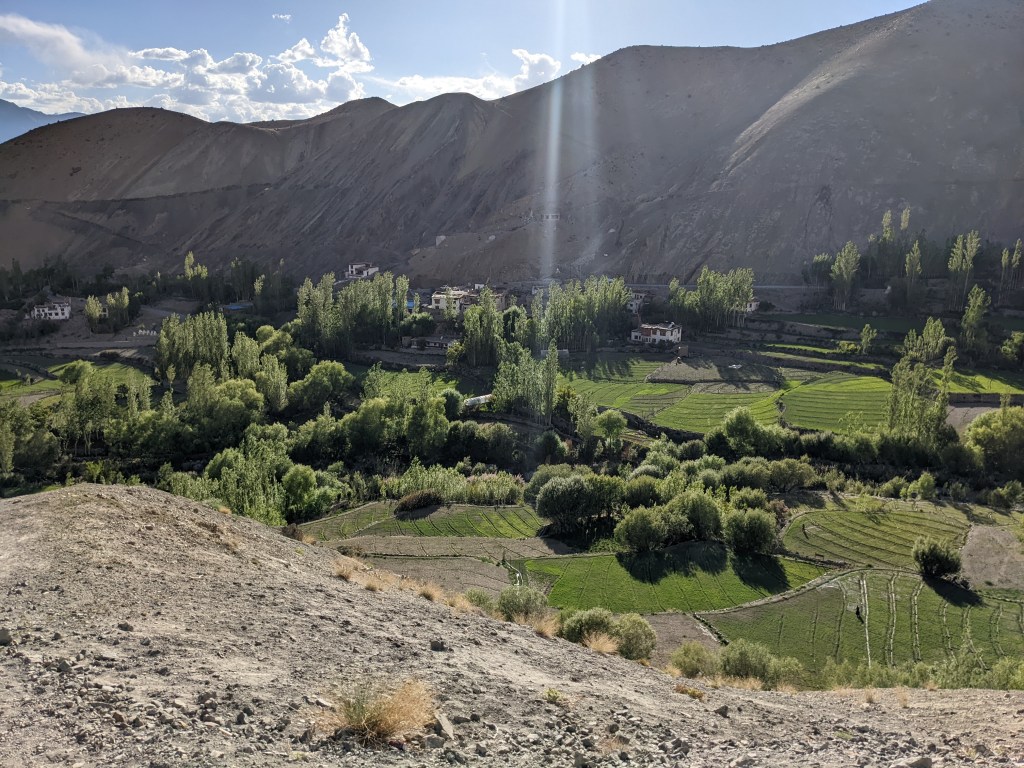
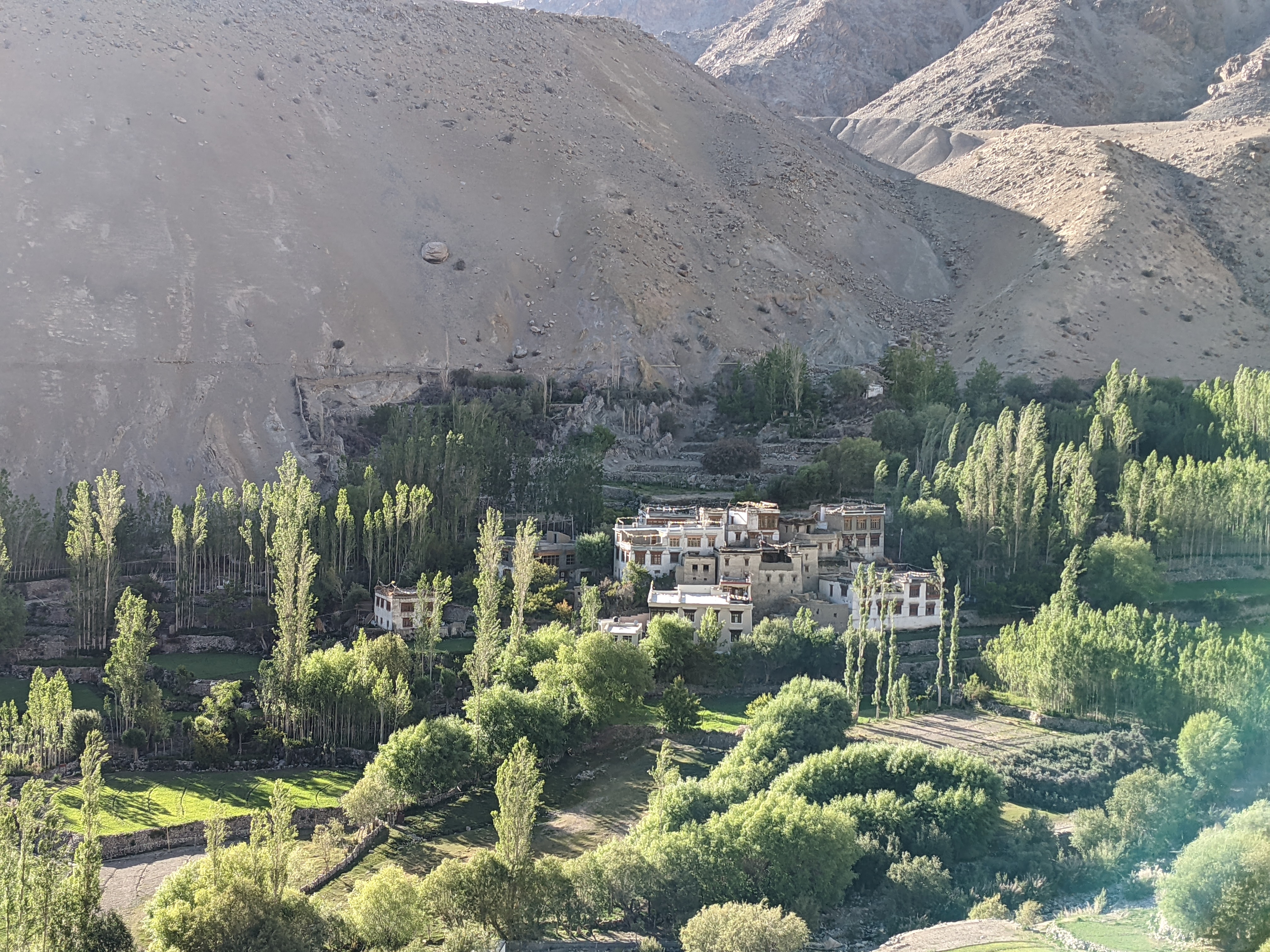
Ang is mostly in a valley, and they carefully manage their water through a simple mini canal system which keeps most of the village green during the summer months.
I think this is a juniper bush. They were all over the place in the village.

Within less than 20 minutes, even though I was walking right along the side of the road, there were no sounds at all of humanity. I closed my eyes for at least five minutes and just let the sounds of the mountain entrace me: there was the faint but constant sound of running water, two different types of birds, the wind, every now and again the intermittent sound of a fleeting insect and then finally, very faintly in the background, the sound of someone calling out to someone else . . . The voice so modulated and changed by the distance that it was more a song than speech.

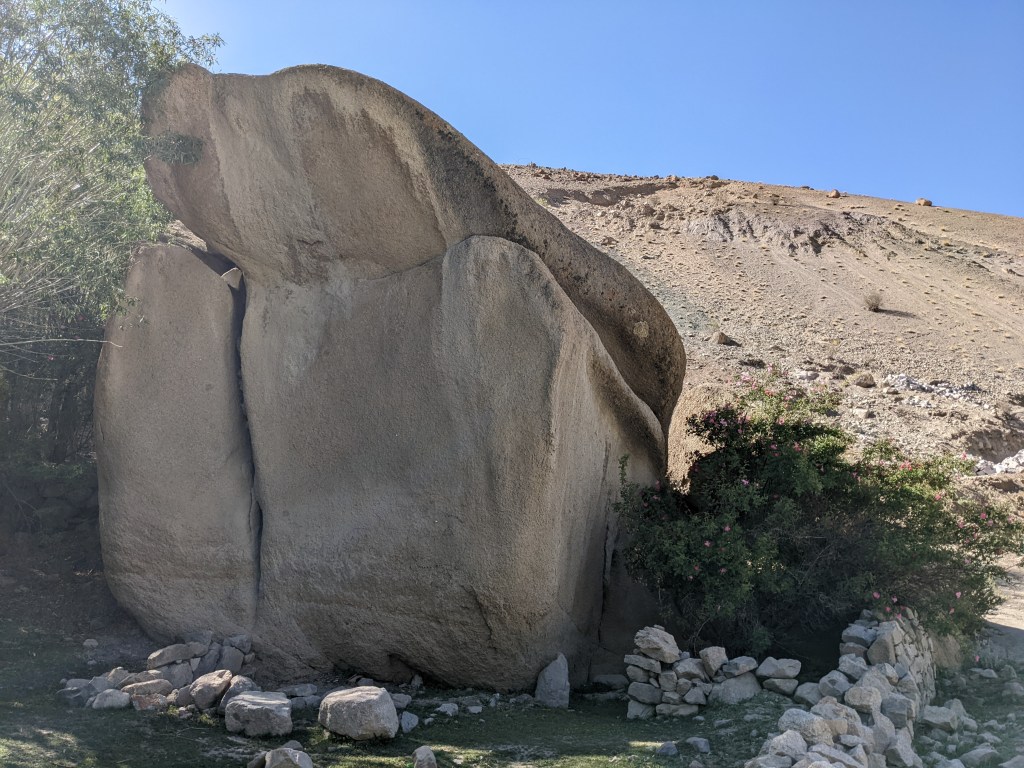
I was fascinated by the small stone in the crevasse of this large boulder which was at least five meters tall.
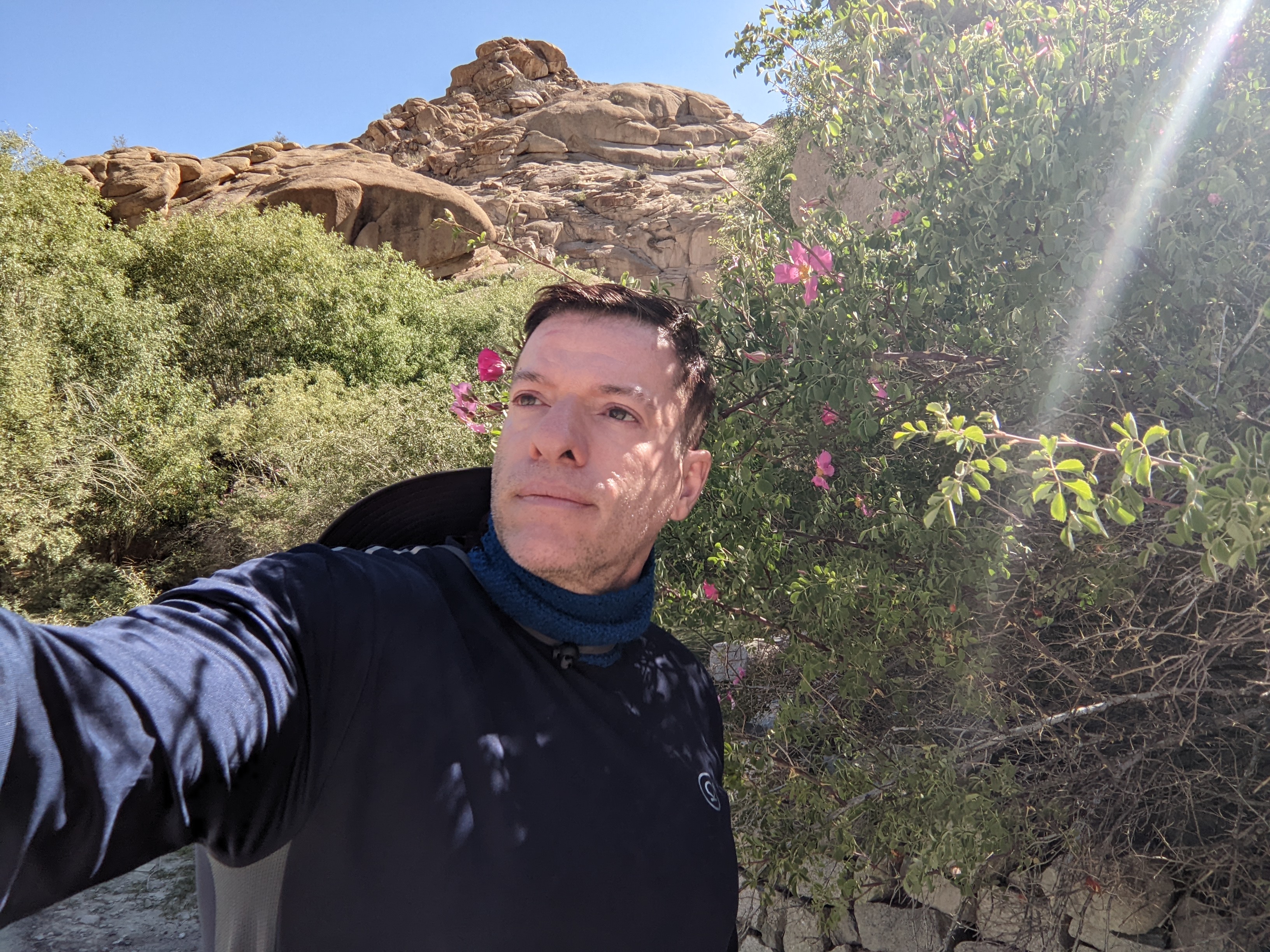
Just what it looks like, a selfie with a floral background
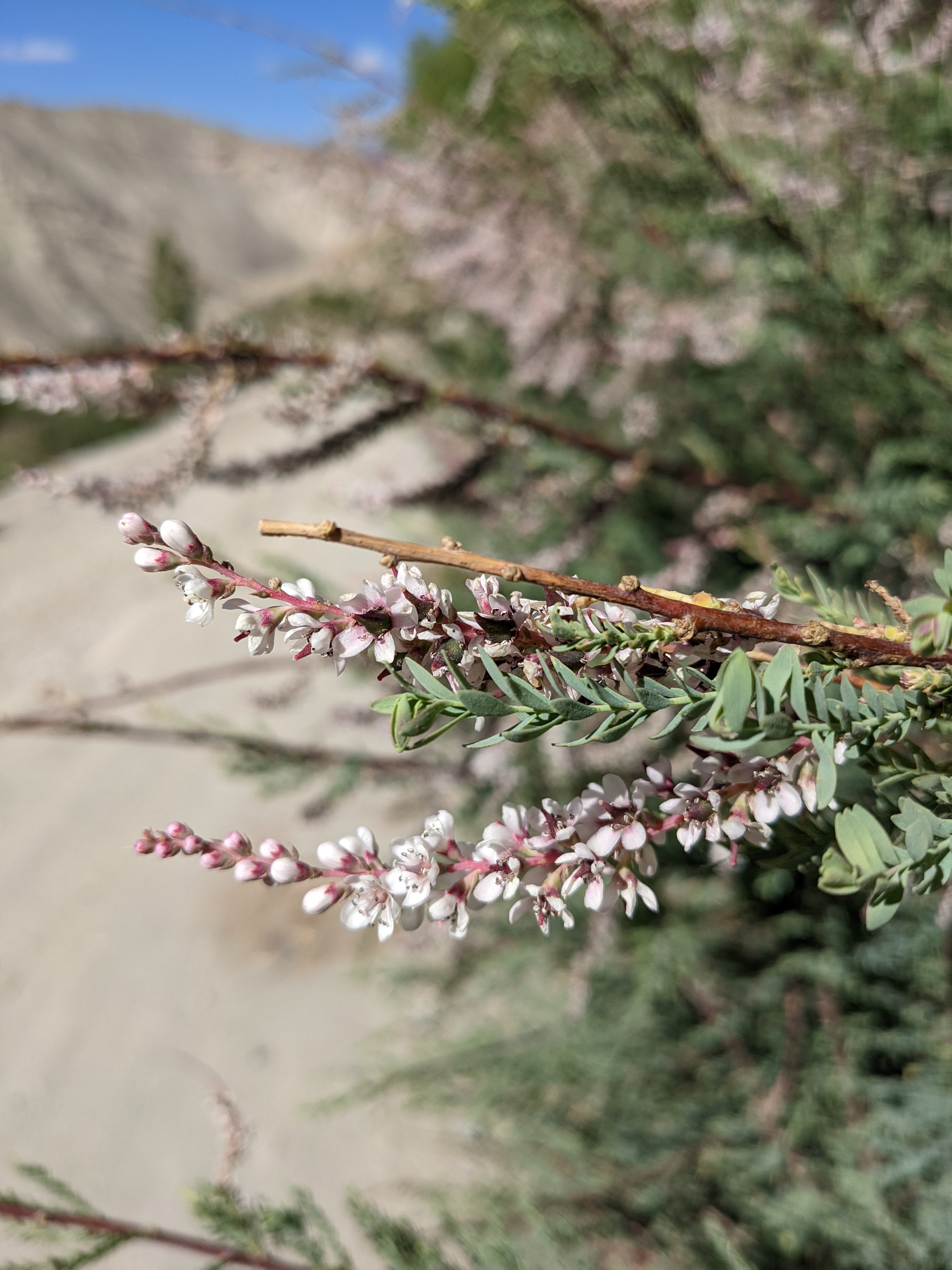
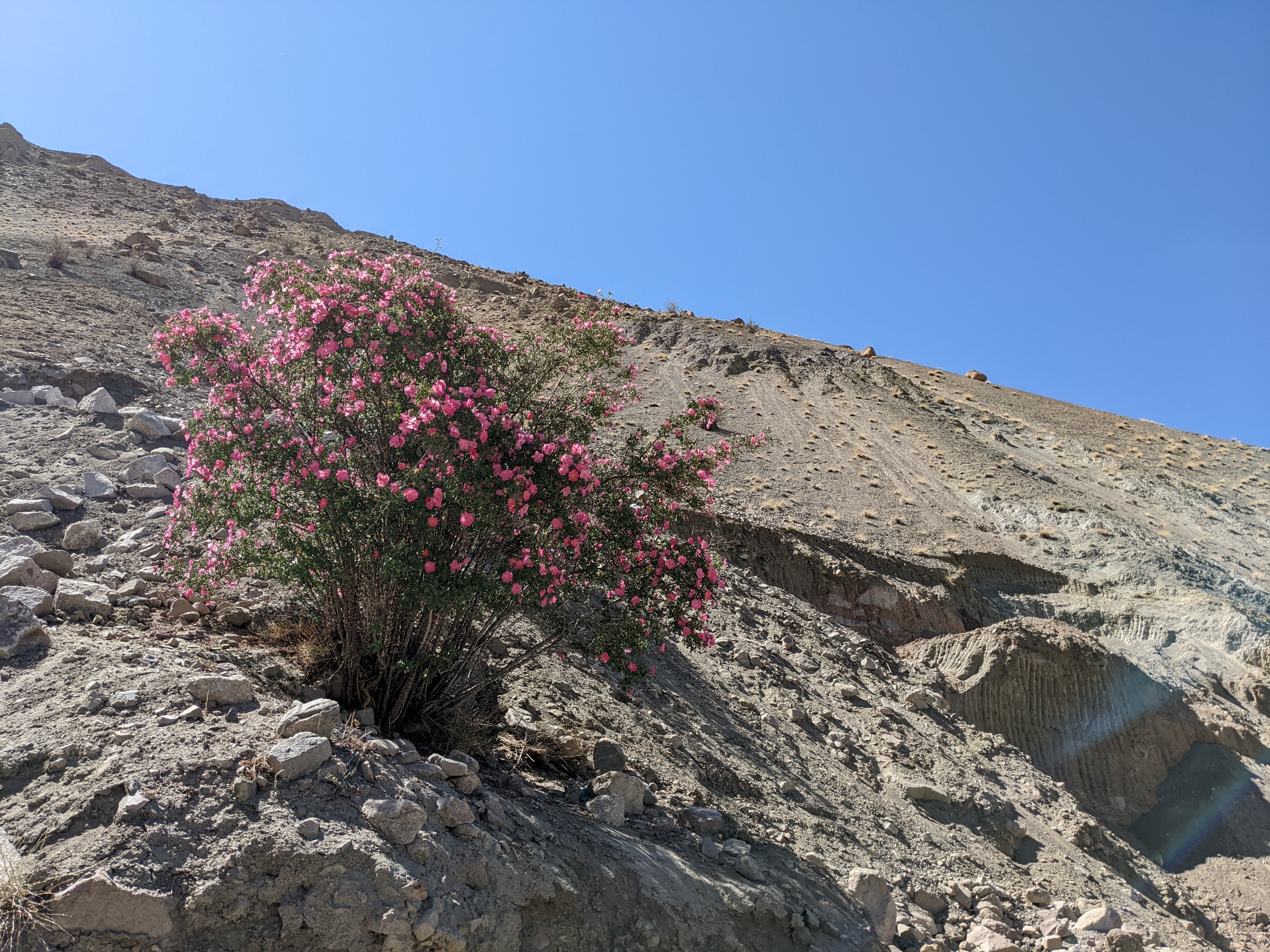
It’s hard to appreciate in this photo, but at this point as far as I could see, there was no vegetation. Miraculously though, there was this one flowering bush, perhaps some sort of wild rose?

As I would come across different views, I loved being able to just pause and look, contemplate on the feel of the wind on my skin, the mixture of soft background sounds, the mixed types of beauty: both the barren and stark beauty of the natural world left to it’s own devices, and also the gentle landscapes which had been teased out by humans . . . All the while knowing I didn’t have to get to anywhere, nor was anyone impatiently awaiting so that we could continue on our journey.

Annoying, even in this barren untouched landscape, someone had thought to decorate with trash.
As there is a small natural stream here, the surrounding area is green. A little water seems to go a long way.

Although I wasn’t particularly eager to do so, one of the hosts had been eager that I would walk up to the new monastery which was under construction. So on the off chance that he would ask what I had thought, once I had decided to turn back, I walked up to the new construction site. Having previously seen several ancient monasteries, it was at least interesting to see a new construction. As it is still under construction, I couldn’t enter, but I could see through some very dirty windows that there were already three statues. Aside from the statues themselves, the building looked very modern with stark white walls both inside and out. Honestly, it looked a bit small to be a monastery; maybe it is actually simply meant to be a Buddhist temple or shrine, but he didn’t know the word. I suspect it’s just meant to be a place of nearby worship for the local village. Still, as construction is clearly still under way, it may look very different should I return in ten years time.

The “new monastery” far off in the distance
The view of the monastery as I approached
A large boulder with engraved writing. It was next to the new monastery.

After finishing up at the monastery, I decided to double back to the little oasis I had seen earlier. I was hoping to capture some birds on camera, but more than that, I just wanted to see what could be heard and hear what could be heard. It was a very peaceful resting spot, but the birds kept their distance, so while I was able to see and hear three different types, I couldn’t get any pictures. Regardless, I really enjoyed just reclining on a rock for awhile and basking in the gentle sun as it filtered through the precious tree cover. Then I noticed it was already 11:30 AM, so decided to head back to the homestay.

It’s hard to see here, but I loved the tiny yellow flowers on this patch of greenery in the oasis.
As I couldn’t get a picture of any birds, I decided that I would have to be the representative of the animal kingdom.

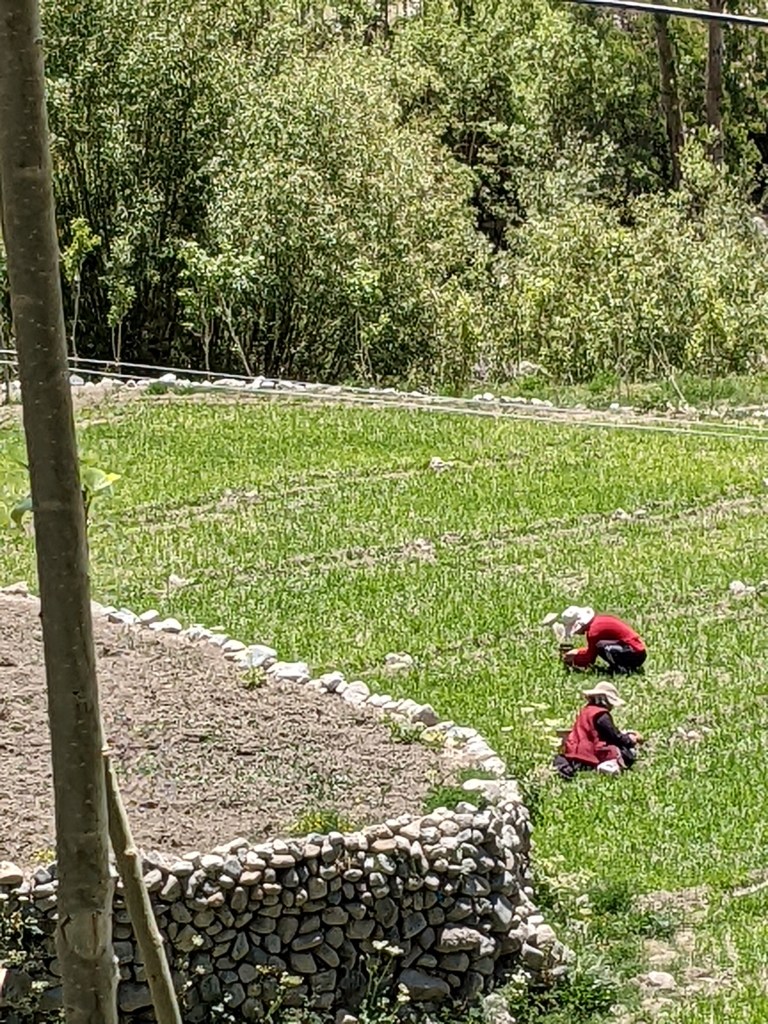
As I walked, far off in the distance I could see women tending the fields. As far as I can tell, this is subsistence or even more likely, supplemental agriculture. Maybe some excess is traded or sold at a local market? Upon arrival back to the homestay, my hosts confirmed that most of the local farmers buy their staple foods of wheat, rice and barley, using the vegetables grown both to supplement the household diet and also in some cases selling excess at a local market.

Women working in the fields. All the ones I saw were wearing the same red clothing. I’m not sure why.

Once I arrived at 12:15 PM, it was baby play time for awhile before having a simple lunch of rice, mustard greens and a hard boiled egg. Then pretty much everyone else turned in for an afternoon nap, but I wanted to stay awake since the previous night I had woken at 3:00 AM and had never been able to get properly back to sleep. I didn’t want a repeat of the same!

While sitting on my own, I began to think about what I might do with the 4.5 days I would have once I get back to Leh tomorrow. I think I would actually be just fine with only lazing about the homestay, but having come so far, it seems that for at least three of the days I should try to get out to do some activities and see some of the local sites. I don’t want to wear myself out too much since my muscles are still recovering from all the cramping a few days ago, but I’m sure there is much I can do that would not overly tax me physically.  I wouldn’t normally be that concerned, but since I will have a more or less all day flight to Barcelona just two days after I get back to Bengaluru, I want to make sure I’m in good condition to fly.

Various green vegetables, apparently drying in the sun.
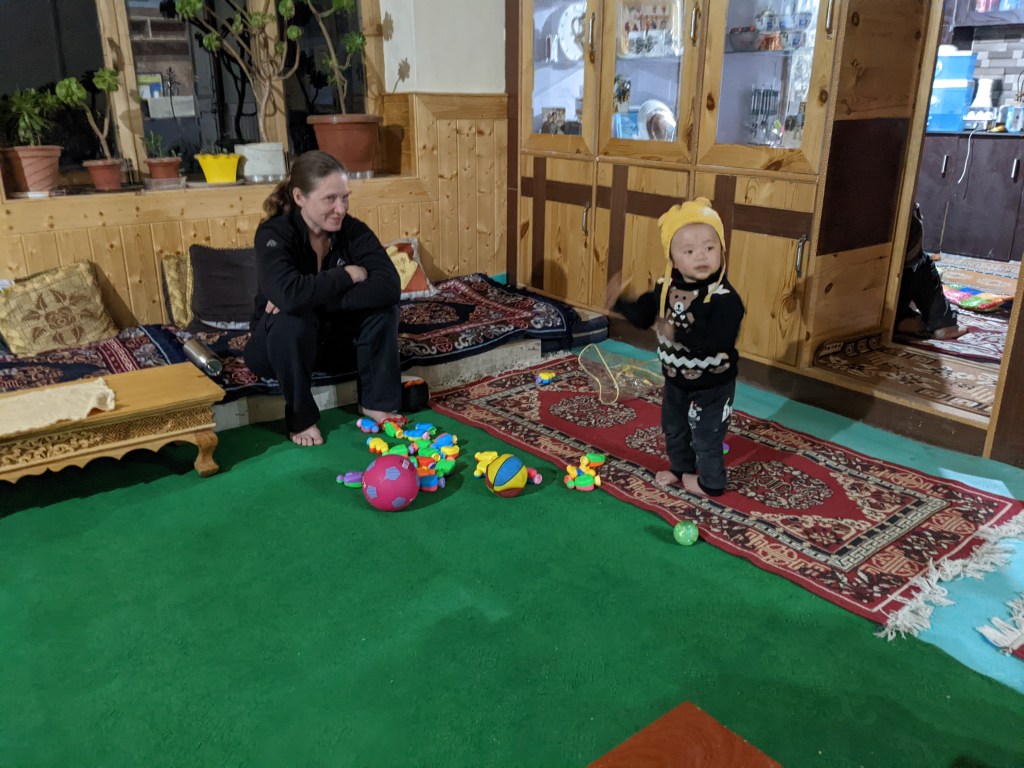
I wasn’t the only one who stayed awake. Here the grandmother was sitting outside the front door preparing vegetables for our meal later in the day.

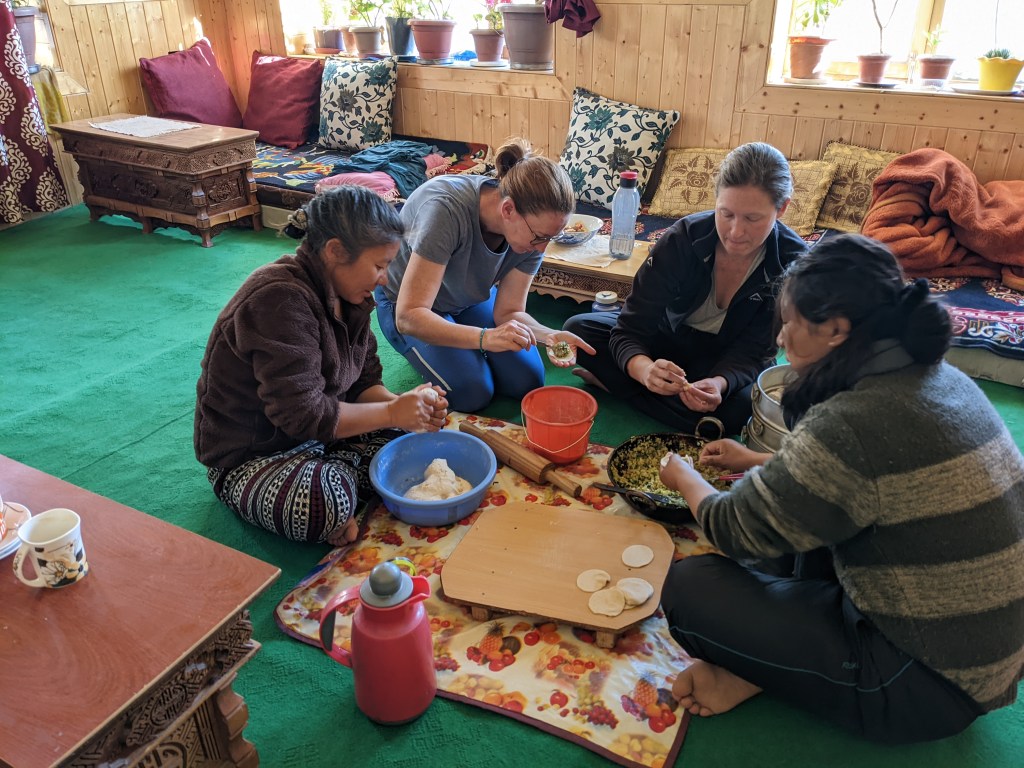
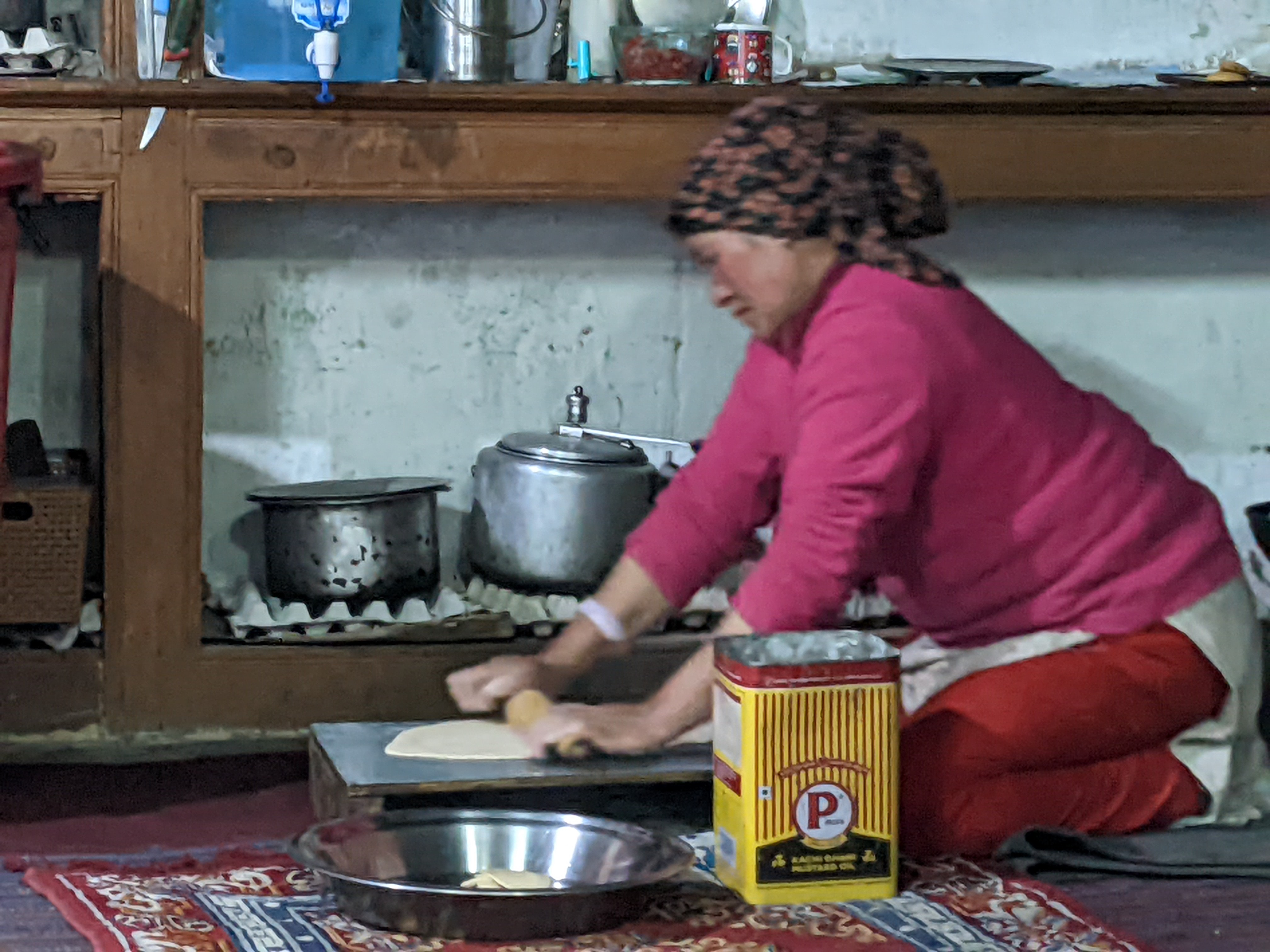
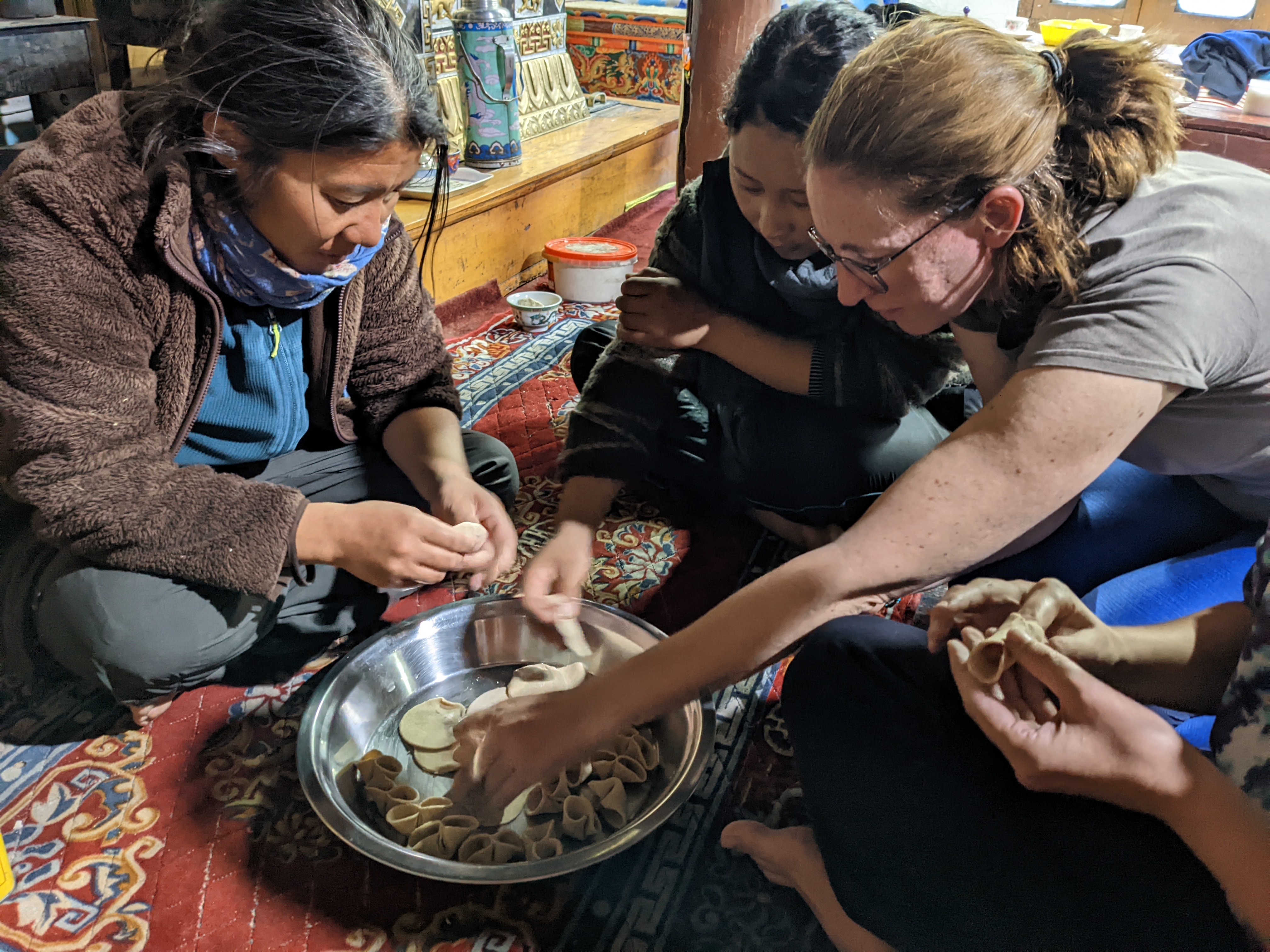
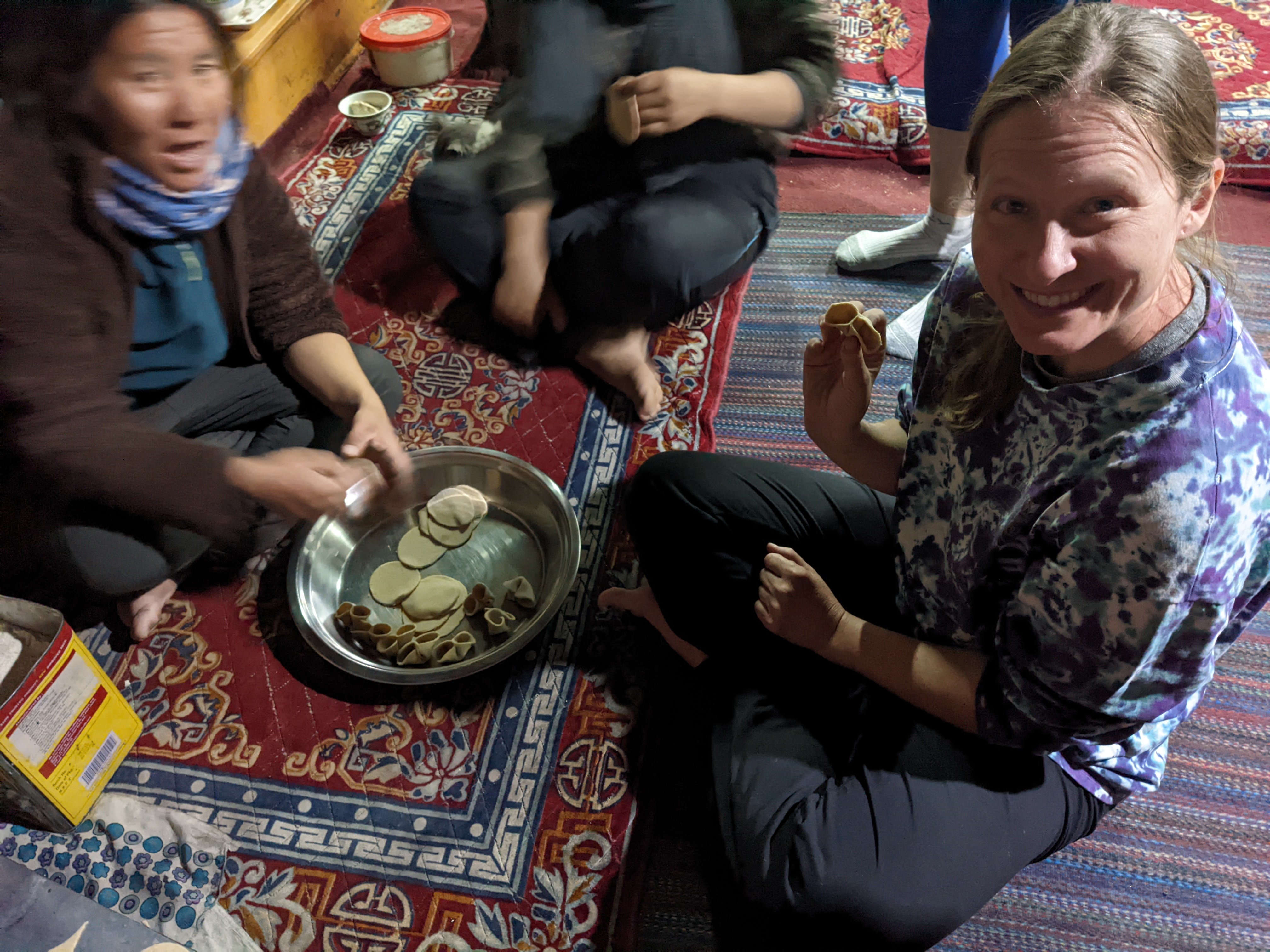
Later on things continued much the same as they had the previous late afternoon and evening. The biggest difference was that we helped make momos. Believe it or not, even I participated and was actually quite good at it. Unfortunately I have no pictures of me, since I was the one doing the pictures. So, you’ll just have to take my word for it.

Making momos
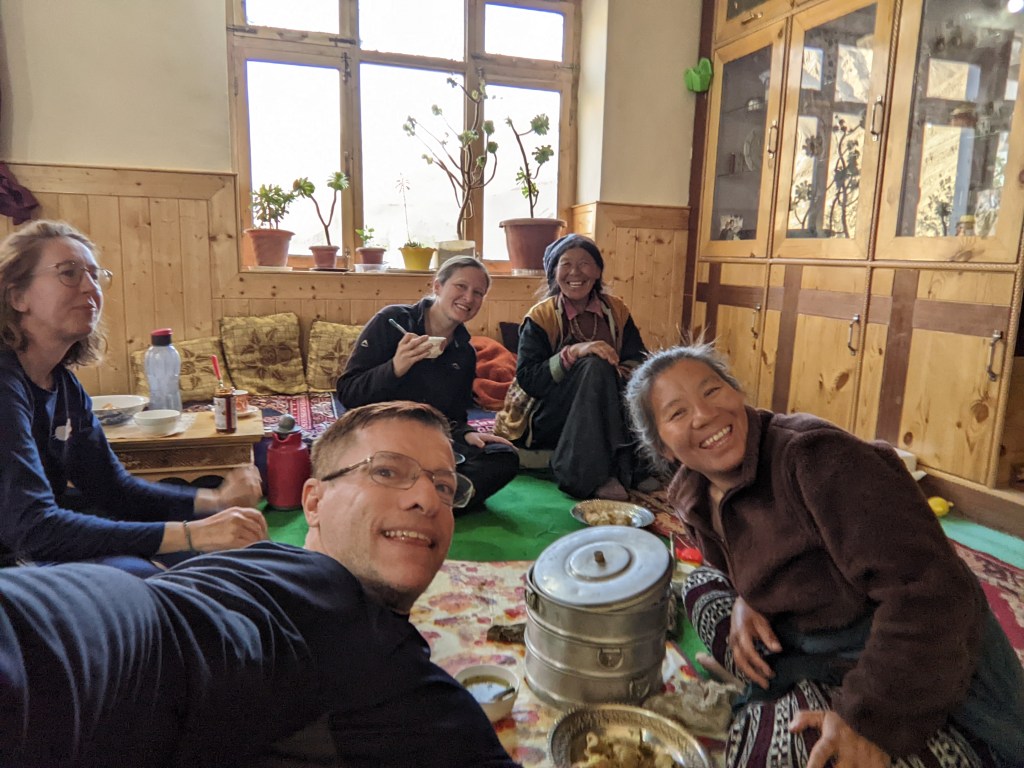
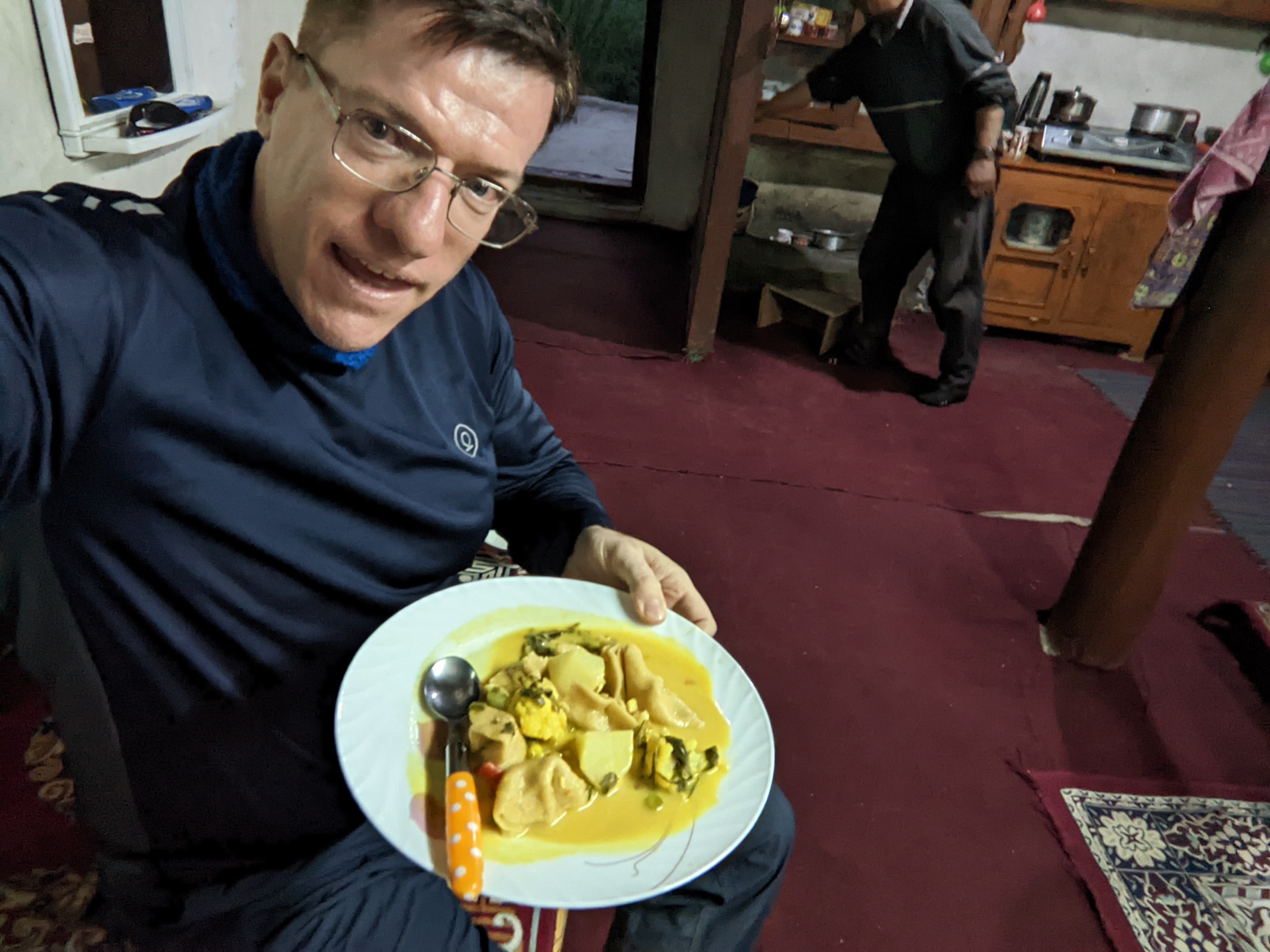
Even better, eating our homemade momos!

Tomorrow morning I will separate from the group and head back to Leh on my own. I will have many decisions to make. Regardless of what the future will hold, I’m eternally grateful for the amazing experiences I’ve had so far.

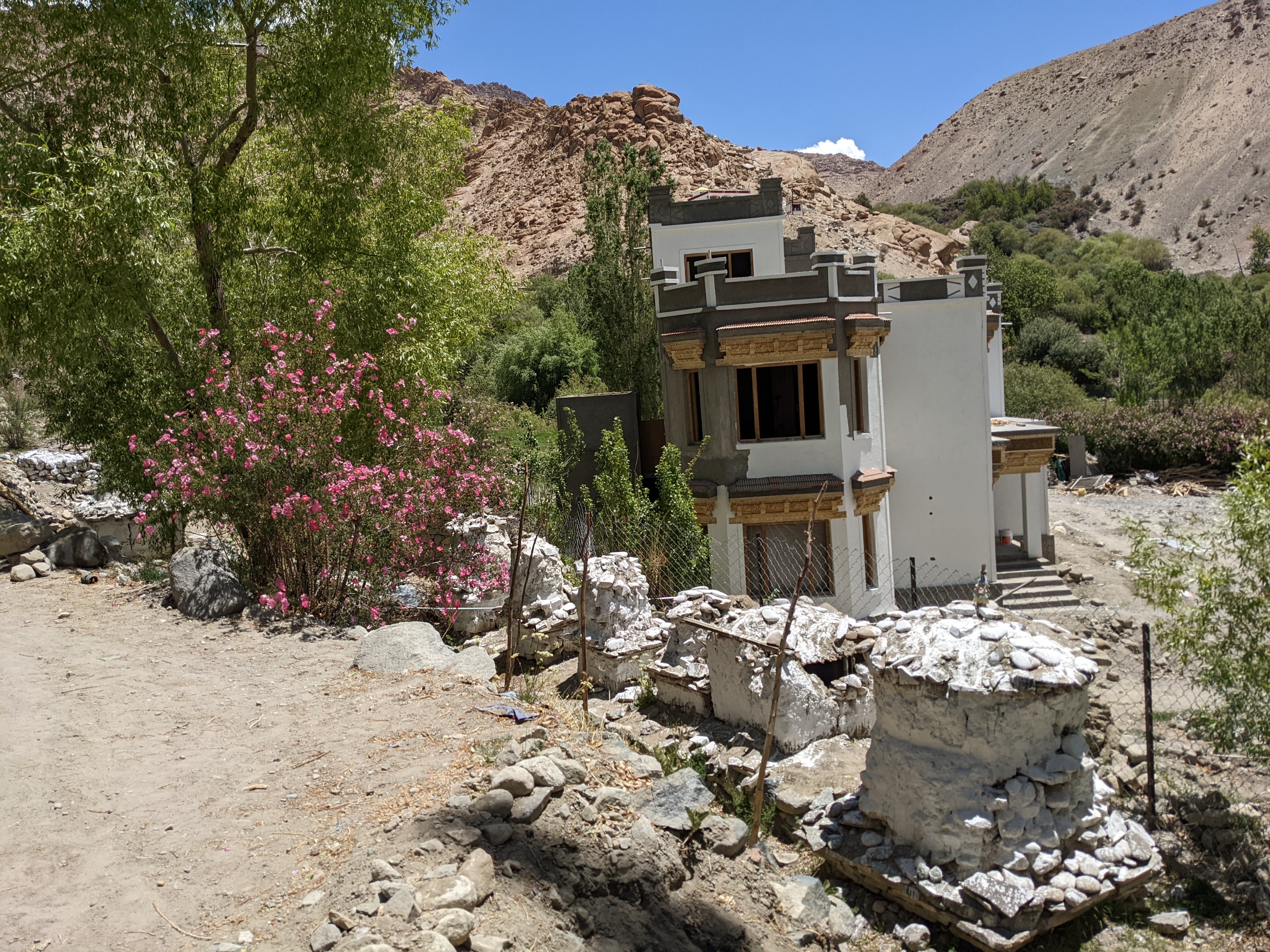
You see these mini collections of stupas all over the place in the countryside, as far as I could tell, usually in configurations of one, three or seven

Ladakh trip: Day 5 (14-Jun)

Hey everyone, after the events of the last 24 hours and the perhaps overly thoughtful interlude, you might be thinking that day 5 is going to be rather anticlimactic. While that may be true, I encourage you to keep reading. This is no longer the trip that I’d planned, but I’m still here, and there will still be plenty of interesting experiences along the way.

Around 7:00 AM I heard Dorothée and Betsy getting up, but I decided to stay in bed. We had already decided that there was no reason for Songnam and I to rush. Still, I didn’t want to miss saying goodbye, so when I heard them coming back from breakfast, I made sure to be up and out the door. We then discovered that Songnam, would actually be accompanying the others on the trek, but would leave Dorothée’s bag behind to be collected later on in the day along with me.

Betsy and Dorothée getting ready in the morning

This is all personal interpretation, but I felt that Songnam was eager to still make a good impression on Thinlas despite the problem with her shoes. As had been explained to us earlier, the porters are women who want to be guides, so they work as porters to get experience with the trails and also to improve their English. As her shoes were clearly hurting her, I thought it really didn’t make sense for her to do another full day of walking without properly fitted shoes, but it definitely wasn’t my decision. Still, I wondered about the sort of internal pressure that she night be experiencing. Meanwhile, I had just tossed at least $300 USD out the window in order to avoid further physical discomfort and that was even before whatever additional spending would come from my change in plans. There’s no denying it, while not near as much as many others, I have a privileged life.

So after some happy but for my part sort of poignant goodbyes, everyone else continued on with their trekc at 8:00 AM, and I stayed behind both with my and Dorothée’s backpacks. As today is some sort of a local festival day, it was unclear at what time I would be collected, but with both backpacks, I had no doubt that Thinlas would make it happen. I resolved to leave my things packed and ready to go at a moments notice and then settled in for the wait

From left to right: Songnam, Betsy, Dorothée, Thinlas and our Hostess (I’m sorry that I never got her name, as she spoke neither English nor Hindi)

After a short time, the husband suggested I leave the bedroom area and head over to the kitchen which is clearly the main social area of the home. I had a nice breakfast of, yes you guessed it, plenty of tea, more Ladakhi flat bread and a scrambled egg. Around mid morning, the husband made it clear that he had to go out to do errands, and I stayed behind with the wife. I’m sorry, but I never really got their names, since we couldn’t really talk.

One of the certificates proudly displayed in the center of the room

Shortly after the husband’s departure a friend and neighbour of the wife arrived and all three of us had a delightful conversation in which I understood nothing that they said and I understood nothing they said. Still, it was a surprisingly enjoyable interaction. I suppose at the end of the day it all comes down to intent. I was a bit cautious to ask for a picture since I feel that native and indigenous peoples are often objectified, but I really did want the reminder of our conversation, so I showed a few pictures of our voyage and then made clear a request to take a picture of the two friends together. They were both delighted with the end result.  I will ask Thinlas if there is a way I can send them a copy, preferably printed, but electronic world also be okay even though the phone they used to show me pictures of their grandson is very small and would not do justice to the picture.

My delightful late morning conversation partners

After a bit, the pleasant visitor left and my wait continued with my remaining host clearly suggesting that I eat the lunch she had prepared for me in a tiffin, no doubt a twin to those which were taken along by the others when they departed.

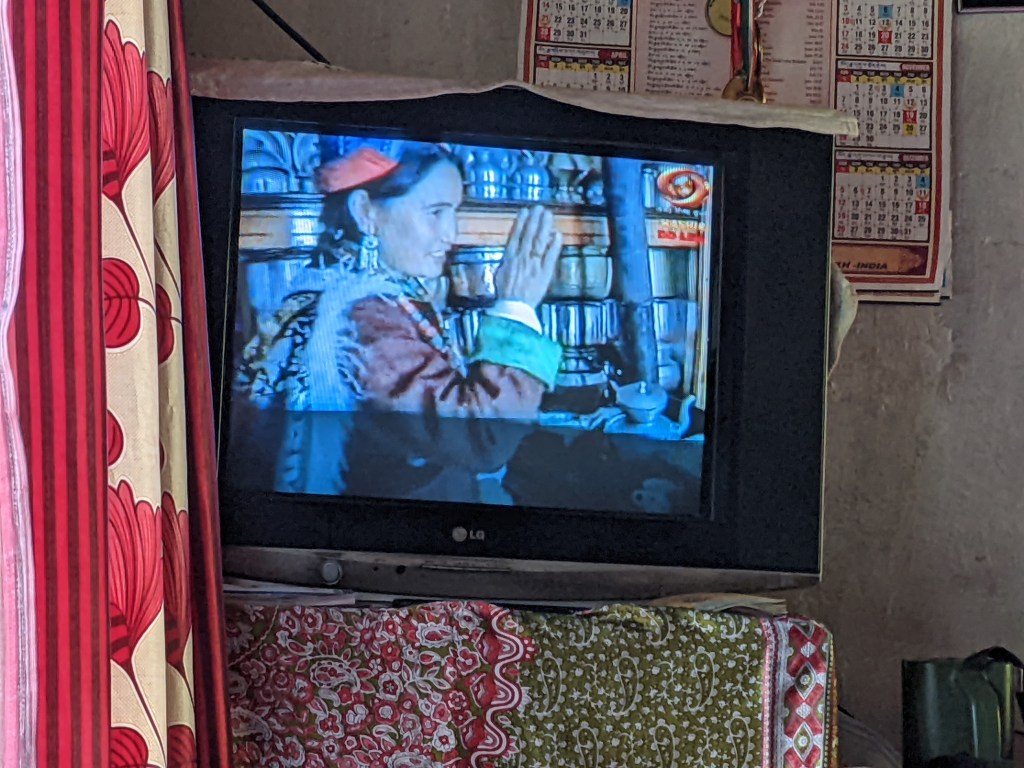
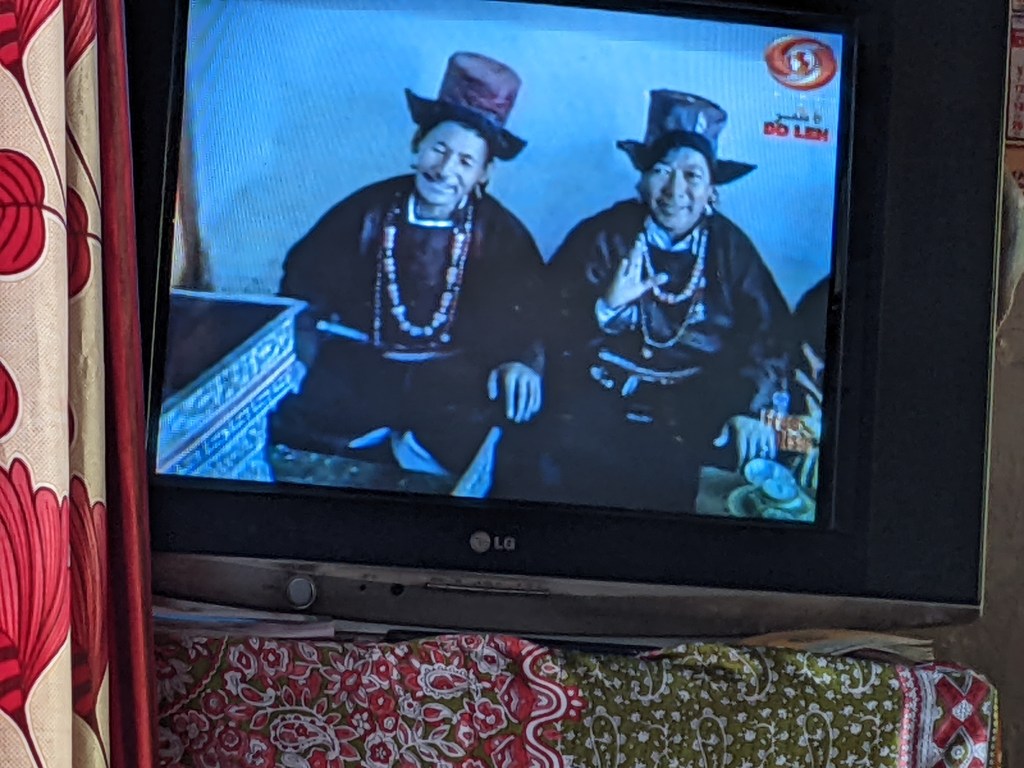
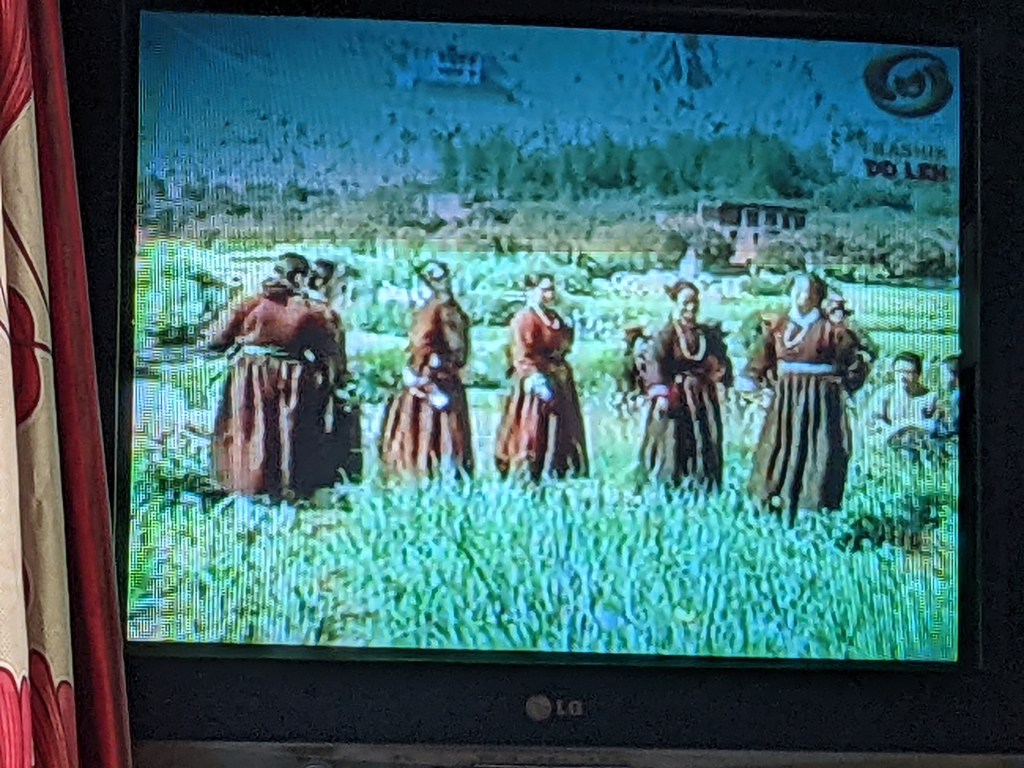
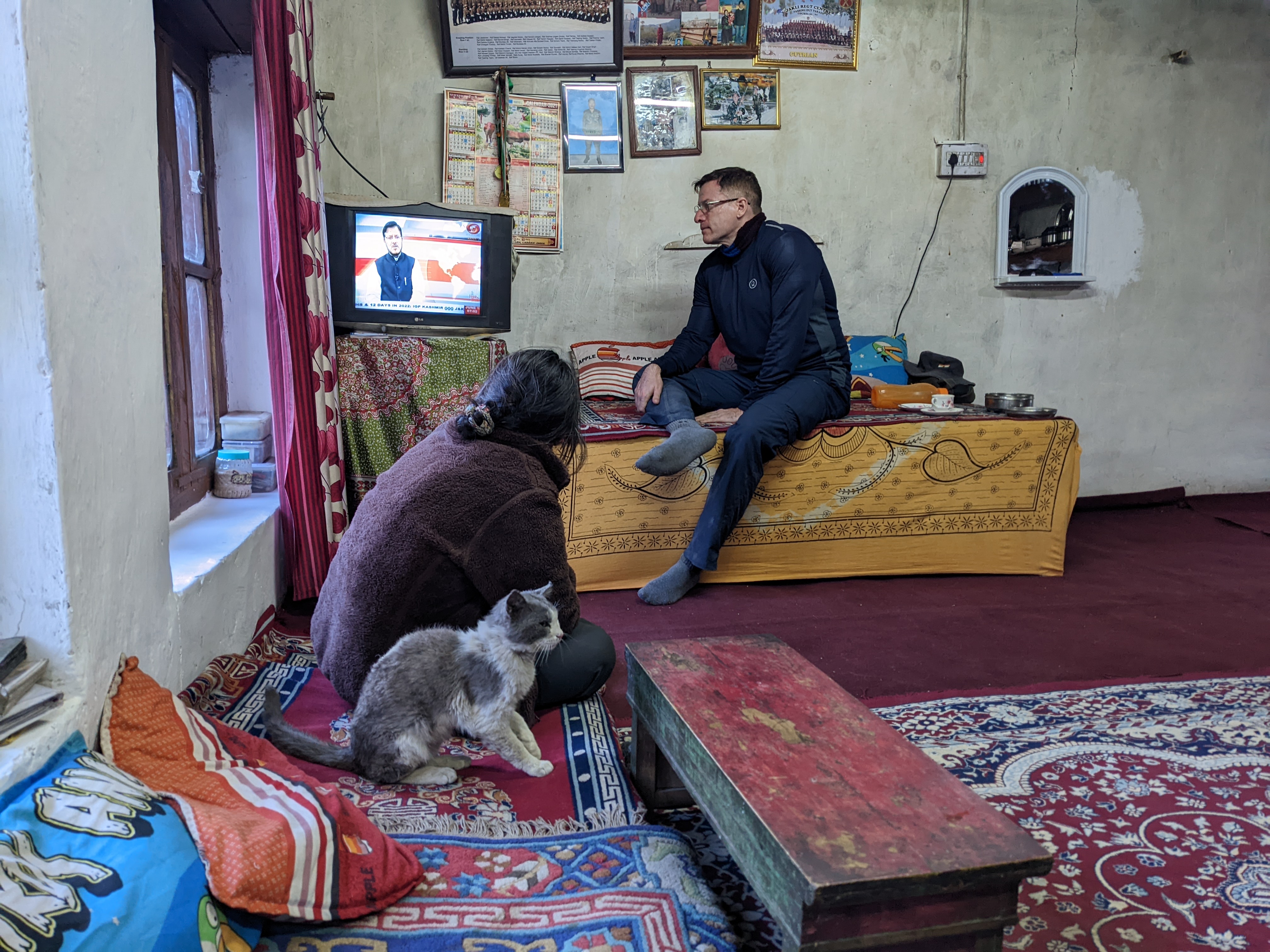
At 2:30 PM there was television afternoon news. The news only took about 15 minutes and then we watched what was obviously some sort of a fictional program in Ladakhi. I couldn’t tell if the setting was supposed to be in the past, or if it was just a celebration with traditional ceremonial dress. Regardless there were at least twenty characters. Believe it or not, I actually enjoyed watching it with her. This is not something I would ever watch on my own, but in the relative comfort of her kitchen and dining area, it was my own special cultural moment which I wouldn’t have experienced if I had continued on with the trek.

Full disclosure, I have no idea what was actually going on, but she seemed to be greeting people when she came in.
These seemed to be important characters. They talked a lot.
I didn’t understand it either, but suddenly these women were outside dancing. Maybe it was actually a different show. Again though, it was still interesting.

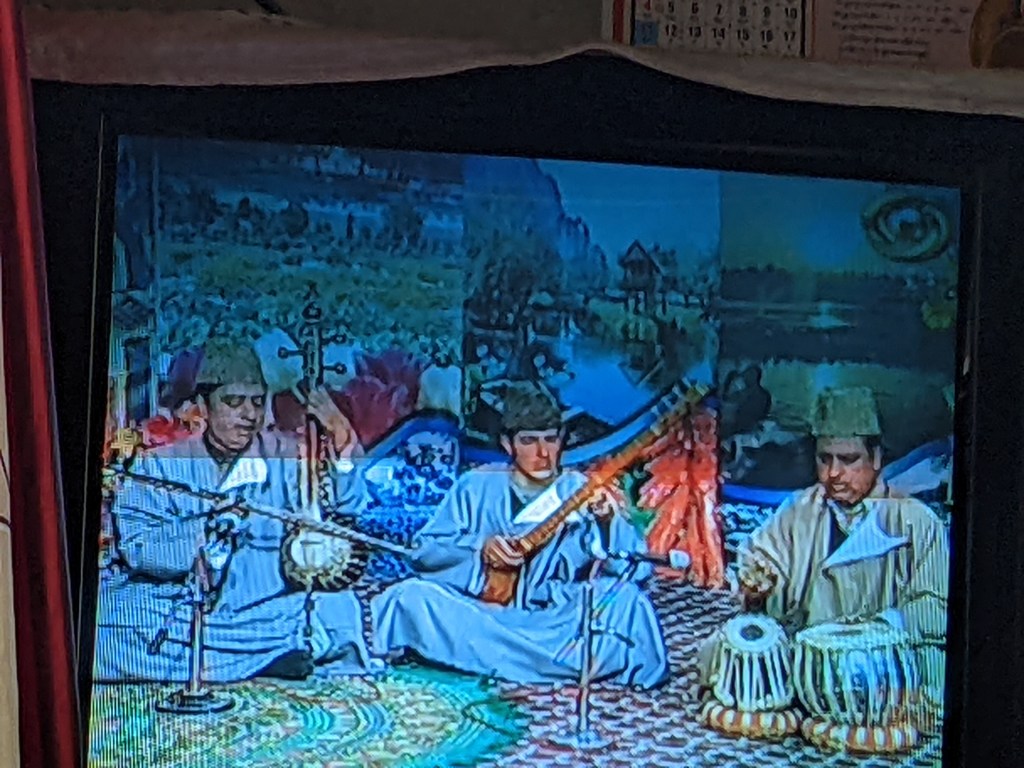
Shortly thereafter, the husband returned home for lunch and we all three watched a Kashmiri cultural program. Once again, this was something which I would never have watched on my own. But in the comfort of their cozy kitchen, it added to what was quickly becoming a most memorable and enjoyable relaxing day at home.

I remembered more than twenty years ago in Costa Rica when I had a bad ear infection and had to stay home resting by myself. I wasn’t up to reading nor writing and I had already slept as much as possible. The television had only one channel, and I happily watched it all day long between intermittent naps. Now with thousands if not more of on demand series, movies and documentaries at my fingertips, I frequently struggle to find anything to satisfy me for even 60 minutes. Is there a lesson to be learnt, or is that just the modern world?

Around 3:45 PM I realised I was going to have to confront a new challenge. Up until this time I had managed to use the squat toilet only for pee . . . Now there were definitely other needs. This would be my third attempt to really use a squat toilet in my entire life. The first time, in a very sterile Korean public bathroom, I had resorted to simply sitting on the floor. The second time, in a rustic Turkish diner in Istanbul, the space had been small enough that I could sort of brace myself against the wall and hang onto the door knob for dear life. However, as can be seen here, neither one of these options would be available in my present circumstances.

The toilet room was quite large, at least 2.5 x 2.5 meters

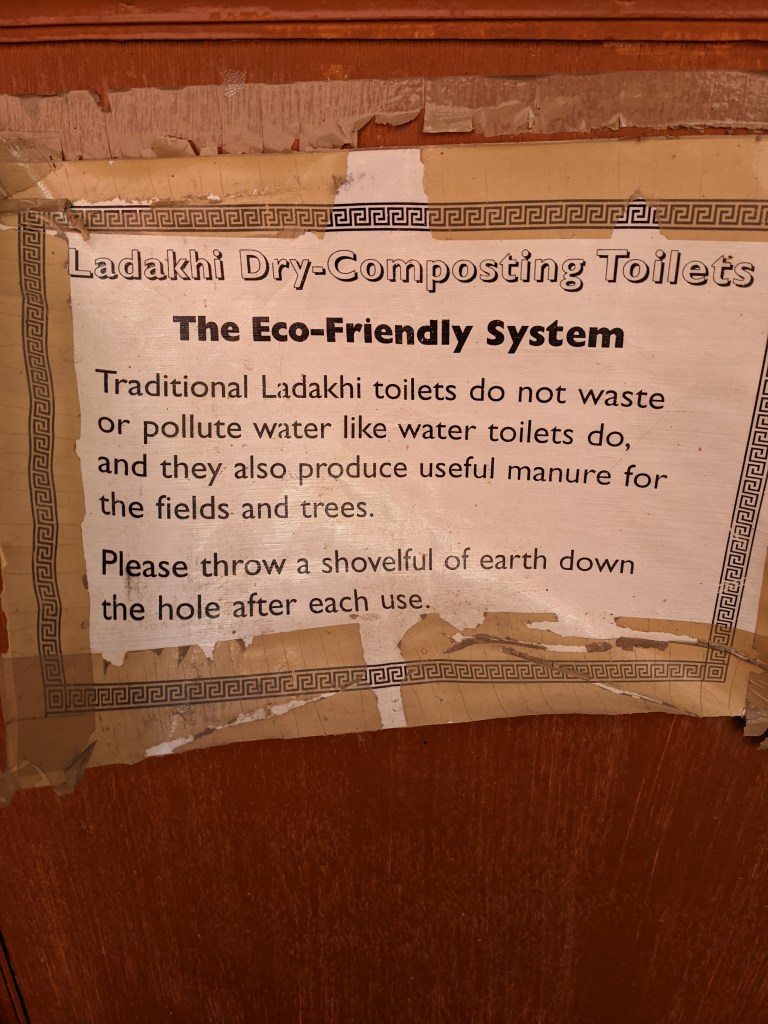
With my still stiff and aching legs, I contemplated the room and decided to apply cold rationality. Even in the best of circumstances I would have been hard pressed to squat adequately and aim appropriately. However, since the floor was dirt anyways, I figured that the issue of poor aim could be dealt with by simply scooping everything into the whole afterwards. A larger concern was potentially falling over and/or soiling my pants and underwear. The solution seemed self-evident. Completely remove both pants and underwear. But there was still the problem of balance, since the walls were too far away to brace. Then I saw the shovel, which in this case seemed to be very sturdily made; I figured I could use that as a support. A couple minutes later and success!

You may be surprised to learn that these were very fresh smelling toilets.

And in case you are curious, there were no issues with aim. Finish up, toss down a shovel of dirt, use my handy travel pack of wet wipes for an obvious purpose, redress and I had conquered the toilet. To finish up the whole endeavour, I washed my hands in the glacier run off water, using a bit of environmentally friendly soap for good measure.

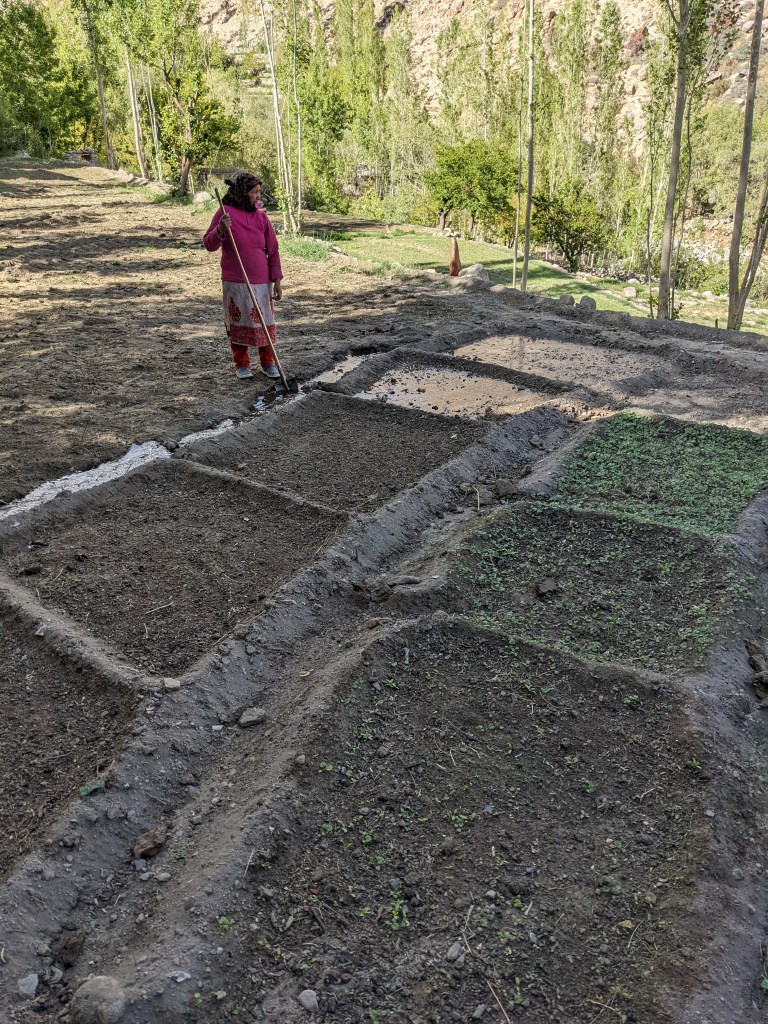
Having tended to my own immediate needs, I went out to see what my hosts were doing in the garden. At first I thought she was crazy the way she was more or less just sprinkling some seeds on the parched and dusty earth. How could anything grow in that? Plumes of dust came up as she walked around working in the field, returning from time to time to get additional seeds from her husband who appeared to be mending some sort of garden tool.  I was able to convey my doubts to the husband, but the most he could communicate was that water would come. While I’m all for wishful thinking, frankly, in this case it seemed a bit fantastical to think that rain would suddenly come down when it clearly had not done so for so long. Then I had the most delightful moment of learning, which I’m not sure whether or not you will be able to understand from the pictures.

She first diverted the water from the tiny stream of water from above. This water then fell into the small canals she had already made. As the water reached the area that needed water, she removed the dirt wall, and waited as the water slowly covered the ground. She then closed the dirt wall and moved on to the next plot.

Very shortly thereafter Seitan arrived to collect me along with Dorothée’s backpack. Of course he was offered the obligatory tea, and then we were on our way. I was pleasantly surprised to learn that Seitan spoke rather good English, and as we were going along for about an hour, I found out that he was not just a driver, but also the son of the woman who owns the homestay where I would be spending the next two evenings.

At 5:20 PM we arrived to the house where I was temporarily reunited with Dorothée, Betsy, Thinlas and of course Songnam.

We had a great evening playing with the baby, having a simple but pleasant dinner, finishing up with a bit of impromptu family dancing and then off to bed at 9:30 PM.

Choosing the music was a collaborative effort
Dorothée has moves
Again, a surprisingly comfortable bed, even though I had to sleep diagonally.

Again, I’m not sure what tomorrow will bring, but as I settle into my comfortable mattress on the floor, once again placing myself diagonally, I find myself to be incredibly thankful for every experience I’ve so far had on this trip. Things have not gone as I had planned, but so far what I’ve been given instead have been wonderful experiences with outstanding people who have made every moment a valuable memory. Here’s looking forward to tomorrow!

Betsy was clearly the preferred playmate

Ladakh trip interlude – sort of deep thoughts from the early morning hours of June 14, 2022

Hey everyone, if you are wanting more pretty pictures and clever commentary about the trip, you should probably skip this one and wait until the day 5 entry. For those of you who have been faithfully following along, you won’t be surprised that I was feeling especially contemplative at this point. Fair warning, there is also some repetition of incidents, especially from day 4.

Lessons learnt so far . . .

A lot of these overlap, and some also only apply to me. Furthermore, I already sort of knew some of these things, but this experience has made them more clear.

1) Being strong/athletic as it relates to specific activities, or even being an overall athlete, does not mean you will be able to handle all “sporting/athletic” activities. Or at any rate, you might need some preparation before doing so.

2) Overland (relatively flat, even through “rough terrain”) trekking is not the same as mountainous trekking.

3) Start small and then work your way up. I think I would have been fine with a three day “trek” of 3-4 hour mountain treks. However, knowing that the plan was to end up with a couple days of 10-13 hours of trekking, this was just too much for me. I even think I would have been fine with seven days of 3-4 hour mountainous terrain “treks”, but again, not this.

4) Slippery terrain is scary, especially when the fall is potentially far down with plenty of jagged rocks along the way. Yeah, this one isn’t a big revelation, but it’s definitely a truth. Betsy gave me a tip that made it easier, especially when going down, but it’s still scary. I suppose it’s easy enough to also turn this one into a metaphor; we all have our own slippery terrains, and many times we have a very legitimate reason for being afraid.

5) Recognise your limits and don’t be afraid to communicate them. I did feel bad about deciding to stop with “the trek” after only one of seven days, but I also had to make a mature decision to not “ruin” the experience for everyone else. Furthermore, I didn’t want to needlessly put myself in harm’s way. My breathing was fine, carrying the backpack was fine (if not super enjoyable), and my leg strength seemed to be holding out. Furthermore, my feet actually felt great, and still do (This is only remarkable because, this is evidently the biggest initial concern for most hikers/trekkers. Additionally, my shoes were strictly speaking not ideal trekking shoes, but they didn’t seem to be a problem for me.

However, and those who know me well will not be surprised, the muscle cramps were not fine. Yes, I was cautious and didn’t let any of them grow into full fledged cramps. I’ve had plenty of raging muscle cramps and definitely didn’t want to deal with that while being in a mountainous desert, further than two kilometres away from a road. It started with intermittent cramping in my right quadricep, then a bit later I started to have twinges in my left mid back. One of those actually became a proper cramp, but not a rager.  Connected to the same, many thanks to Betsy for staying back with me while that was happening, neither being overly solicitous nor disinterested, basically just keeping me company. After that calmed down and I continued at my slow, cautious pace, I started to feel mini cramps in my left hamstring. While this last one did not actually start until we reached the homestay, my forearms (which I had not used in any meaningful fashion during the day) also started to have mini cramps. In summary, the writing was on the wall.

As we started to reach a road again, I told Thinlas I was sorry, but I really didn’t think I could go down and up again. Her solution, which worked fine, was for her and I to stay on the road for the last kilometer or two; whereas, the others were on the road for awhile but then headed back down into the natural terrain. However, I realised that I simply couldn’t continue on. Maybe if it were just Thinlas and I, going there pace I could handle, it would work, but I didn’t want to drag everyone else down with me.

6) Having some disposable income is nice. Most people reading this blog fall into that category whether or not you realise it, and it might be worthwhile to contemplate on the same. Having a bit of disposable income means that we get to have more choices and that we are less vulnerable to adversity. I’m definitely not “wealthy” although I suppose by global averages I’m certainly “doing well”. Some of that is the result of life decisions I’ve made, but most of it is undoubtedly the result of underserved opportunities and support I’ve been given by virtue of birth . . . In summary, privilege.  Deciding to “lose” what I had paid for the trekking part of this trip wasn’t really a big deal for me. Even realising that it might mean spending another 2-4 hundred dollars to occupy myself otherwise didn’t really matter. What mattered was getting out of what for me, had become a bad situation.

7) Maybe trekking isn’t for me. Now for those of you who love trekking, or even specifically mountain trekking, please don’t pile on with the hate. This is a possible personal truth, not something which applies to anyone else. Putting aside the muscle cramps, which clearly are some sort of a medical issue which I will once again try to address upon returning home, I didn’t really see the point of what we were doing. Yes, I appreciated the amazing natural beauty, but for the most part, I could see that just fine from the road. Also, once I’d gone down one peak and up another a couple of times, I felt like it all looked pretty much the same. Pretty, yes, something I wanted to do all day long, not really. I’m sure there are many places that can only be seen and experienced through trekking, so I will reserve my judgement about those particular locales.

Furthermore, assuming that I did take on trekking as a personal goal, doing a whole carefully planned training regime, gradually working up to longer treks over more difficult terrain, is that something I really want? Yes, I do think I could do that, and that I could be successful, but why?

What ifs?

(1) I don’t know if it really would have made a difference, but I’ve been wondering if maybe I should have had a porter. Dorothée decided to do that sort of at the last moment before we departed, and at least for day 1 of the actual trek, it seemed to be working well for her. I however considered it and for myself, decided that if I couldn’t do it on my own, I would just bow out gracefully along the way. I felt like if I couldn’t do it carrying my own things, then I shouldn’t be doing it. Note, this only applies to ME and is not meant to be a judgement nor advice for anyone else. Even though I didn’t really feel that the pack weight was that much, would not having to carry it have meant that I would both have enjoyed more the trek and also have been able to complete the whole seven days? Connected to the same, should I have checked with Thinlas about the possibility of doing a rest day, and then continuing, but with the added assistance of a personal porter? Would I have then had a nice time the rest of the planned seven days? I just don’t know.

(2) Should I have just tried to push through? Maybe the cramps would have resolved on their own once my body stopped thinking it was in crisis. Hell, maybe I was self sabotaging as I remembered other times I had been in crisis due to out of control muscle cramps. Maybe I would have had a positive life changing experience on day 6. Or more likely, and I really believe this is more likely, would I first have really annoyed everyone as they tried to accommodate me and then caused a crisis by becoming truly incapacitated by muscle cramps or some other unforeseen issue at some point, forcing Thinlas to get a rescue team to remove me to safety and putting a pall on everyone else’s trip for the remaining time? While I will admit to having some doubts in the back of my head, overwhelmingly, at least today, I firmly stand by my decision. But no, at the end of the day, I don’t know what the alternative outcome would have been.

(3) Since I had known about the trip with a couple of months of advance notice, should I have scrapped my current gym routine and instead done something which would have better prepared me for the physical demands of mountainous trekking?  Would it have made a difference, and if so, how much of a difference? Again, I just don’t know.

A suggestion for homestay and tourism operators

(1) Asian toilets, are certainly legitimate waste disposal systems. Although perhaps not practical for widespread use in modern cities (I’m not really sure about this one), the uncomplicated composting toilets in Ladakh seem like a great idea; certainly they are less wasteful (no pun intended) and much more sustainable than the water flush systems which are the norm in most “modern cities” worldwide. Unfortunately, many (maybe most?) Visitors who did not grow up where these are common, will not reasonably be able to simply squat over an open hole to defecate. I get wanting to provide an authentic experience, but consider having a simple raised toilet seat available for outside visitors. It doesn’t have to be complicated, and could easily be made of locally available wood and would last a lifetime. It also would not at all detract from the outstanding composting system. When outside visitors arrive, I suggest first showing them the unaltered local option, but then showing them where they can get the raised seat if needed. Heck, although I’m not sure how this would work, you could even show visitors how to use the toilet without the seat addition. No doubt many would feel capable of handling the unaltered system, but many would appreciate the rescue option of the raised seat. I MAY be wrong about this, but I suspect a raised seat option might even be appreciated by some very infirm locals; maybe they already do this for sick/weak locals, but I don’t know about it. Again, I’m not in any way suggesting that people should change their own tried and true local systems, but if you want to accommodate outsiders of all types, this is something that would be so easy to do and yet would make so many people so very grateful.

Okay, it’s time to go back to sleep now. I will get this posted once I’m back to a place with internet. Again, I’m sorry if you found this interlude to be too introspective, but you were warned. Anyways, I promise that day 5 will get all of us back on track. See you there!

Ladakh trekking trip: Day 4 (13-Jun)

Hey there friends family and even random followers who may exist. Get prepared, because this a jam packed post: religion, nature, potential danger, some uncried tears, and more! Today was my first day ever of real mountain trekking. I had my concerns going into this, but was also looking forward to trying something new.

From left to right: Thinlas (our guide), Songnam (Dorothée’s porter and a guide in training, Dorothée, Betsy and Jay

Having finished a simple breakfast at the homestay, at 8:30 AM we piled into a van and headed off on a short road trip to Liker Monastery.  As seems to be the norm in Ladakh, the landscape along the road was simply majestic. The plan was to begin our day with a visit to Liker monastery and then begin the actual physical trek from that point.

A typical view as we were driving towards Liker monastery
A view of the monastery as we were approaching
Not a lot of traffic here. . .

To a certain extent, just as if you’ve seen one traditional Catholic cathedral, you’ve pretty much seen them all, much the same can be said for Tibetan influenced Buddhist monasteries. Of course there are many differences which would be obvious to an expert or even just a very discriminating viewer, still, you pretty much know what you are going to see. However, as it had been several months since I had seen a Buddhist monastery, seeing this one was much appreciated, especially since Thinlas demonstrated that she is not only a high quality experienced trekking guide, but also a very more than adequate general guide of this particular monastery.

Main entrance to the monastery
I understood that this was a representation of the different stages of “hell” and the cycle of rebirth. Evidently it is obligatory for the unenlightened to be reborn; whereas, the enlightened can CHOOSE to be reborn in order to guide others.
A gratuitous and unflattering selfie in the main temple hall
Behind Dorothée’s head is a representation of “the protector”. As I understood it, this is not a “god” but simply a standard artistic representation of “that which protects”.
The elephant on its stage to enlightenment. I had mixed feelings about the “unenlightened” being black, getting lighter as it became more enlightened, but I suppose it’s a standard if perhaps troubling metaphor.
All sorts of things are offered at the temple from beautiful flowers molded out of coloured butter to Fanta soft drinks

Further expounding on how valuable Thinlas was as a cultural guide, while I find guided tours with more than 4-6 participants to be pretty much a waste of time, an engaging guide can make otherwise meaningless sites come alive. So, if you have the money, and you are a small group, just pay for the guide. It really is worth it. I’ll admit that many times, even in the past couple of years, I have decided that I don’t really care enough to get a guide, but every time I’ve had one when I’ve been with a small group, I’ve definitely greatly benefited from the additional support.

A group picture from when the Dalai Lama had come to visit
A representation of Buddha and the founders of the monastery

Finally at 10:45 AM we set off on a proper trek. Starting out, while the ground was a little uneven at times, it was mostly flat. This was easy enough to handle. The terrain, while starkly beautiful as always, was for the most part unchanging; although, we did see a couple of isolated homes. Physically, everyone’s primary concern was to be protected from the Sun, and to a lesser degree from the pleasant but brisk air, which at times was dusty enough to warrant face coverings.

Especially as we started to go into the peaks, with what seemed to be a never ending cycle of going up and down relatively steep terrain, I could see the nearby road devoid of cars and wondered if that might actually be the wisest option. However, I also figured that unnecessary ups and downs might be the whole point of trekking. I suppose many people feel a sense of accomplishment . . . “Just did one more peak!” I unfortunately did not really feel this, but for the most part was doing alright.

Then we hit a couple of particularly slippery, at least for me and to a lesser degree for Dorothée, spots and I started to question (in a very tiny voice in my head) whether or not all of this really made sense. The prospect of unnecessarily tumbling or even just sliding down  the side of a rocky peak in an uncontrolled fashion didn’t seem all that fun. However, I did still recognise that I was in a relatively safe situation all things considered. A bit later on Betsy gave me a tip on how to handle those slippery situations when descending, and it was both physically and mentally much better after that.

Unfortunately, it was also at that time that I started to get the first twinges of a muscle cramps in my right quadricep. I suspect that these first ones were brought on by the initial mental tension and associated unnecessary physical strain of the slippery descents before Betsy had given me the tips. So I figured, now that we have that out of the way, I’ll be fine. Up and down we continued.

This primitive painting was a welcome addition to what for me at least was quickly becoming a monotonous (if still very beautiful) landscape

Then we came to a partially collapsed bridge over a small stream. I was reminded of some of my tourism in Guatemala in the early 2000’s as a large group of us hiked all the way up to the crater of an active volcano where one of the guide’s brothers had been killed two weeks earlier as rock from an eruption had hit and killed him. However, Thinlas tested the bridge, and pronounced it safe as long as we would go over one at a time. Seeing my hesitancy and also recognising that I weighed at least 50% more than anyone else, she suggested that I cross without my pack and that she would make two trips, one with my pack and the other with hers. This seemed to work fine, and I had to admit that even though it was halfway collapsed, the other side seemed very stable although at a strange angle.

Once across we opened our tiffins and had what was the most appreciated meal I’ve had in a very long time. Three pieces of thick Ladakhi flat bread, a serving of boiled (I think) mustard greens, a hard boiled egg, a boiled potato, and a banana. I was feeling alright, but my body wanted a longer rest before continuing. When I went to put on my pack, my hat and straps got tangled, and I started to get a minor cramp in my left, mid back. However, with Betsy’s help I got it straightened out and we were off again.

A much appreciated green area next to the stream

I was clearly lagging behind the others. Within a very short time, my body started to rebel more actively, and I got a rather severe, but not crisis level cramp in my mid left back. This was when I started to question whether or not I could continue. As luck would have it, this was not the best time to question, since at this point, one way or another I was still going to have to get to a road. Still, Betsy kindly stayed back with me awhile while I worked through the cramp. While waiting, we were treated to a visit by a rock lizard about 30 cm long, something I wouldn’t have seen had I still been walking. Finally, my back calmed down and I thought okay, this will work out.

Me pretending that things might still be okay
More of the constant peaks that we had to first go up, and then down again. . .

Now I was still walking a bit behind the others, but for obvious reasons, Thinlas was walking near me. While this was going on, I started to get a cramp in my left hamstring. I wasn’t checking the time while walking so I’m not sure of the exact timing of events. I was walking slowly, my feet felt perfectly fine, the pack on my back was not at all uncomfortable nor heavy feeling, but my muscles seemed to be shutting down, as intermittent cramps started to now be felt across my left hamstring, right quadricep, left mid back and then most oddly, my right forearm.  At this point they were intermittent twinges, but seemed to cycle through in a random yet recurring fashion.

Throughout the trip I had drunk plenty of water, already more than two liters, not counting all I had drunk in the morning. Certainly I had drunk much more than anyone else. So I don’t think a lack of water was to blame. Still, as we once again reached a point where a road crossed, I told Thinlas I was sorry, but I just couldn’t go down and up again. Should we somehow call a car or what should be done? Unfortunately, I thought I was finished.

Thinlas offered up a plan. She thought that if we were to stay on the road, I would be alright, or at any rate at least able to finish the walk for the day. There was a bit less than 2-3 km left if on the road. I told her that this was much appreciated, but I was clearly holding up everyone else, so should I simply go back to Leh, or what else did she think might be a viable plan? I was open to many options, but I didn’t think I could continue with the status quo, especially since future days were planned on being even more challenging, a couple days with 10-13 hours of planned trekking, much of it over more challenging terrain than had been encountered already. She then suggested that it might be possible to arrange for a car to take me to the next two scheduled homestays, and that I would even find nice ways to entertain myself with good things to see while waiting for the others to arrive from their treks, but after that I would probably need to decide to either return to Leh or whatever else I thought best, since they would be going to places no longer easily accessible by car.

After a bit, the others returned to the off-road trek, and Thinlas continued with me on the road until we reached Tashi Chosfail homestay in Yangthang village at 5:20 PM.

The homestay was pleasantly quaint and the hosts were incredibly welcoming. Had I not had the pall of knowing that this was both my first and last day of “the trek”, I would have found it to be wholly delightful. Pictures do a better job of describing than any of my inadequate words. Certainly I’m thankful I was able to get here.

Once we had all left our things in the sleeping area, we adjourned to the kitchen for several hours where we were constantly plied with two types of tea and a local type of homemade bread, permitted to help (in an admittedly small but still enjoyable way) with the preparation of dinner, and even watch the evening news (which we somehow convinced ourselves that we partially understood even though it was all in Ladakhi and then Urdu. Not having phone nor internet service, much less anything like a daily newspaper, the nightly news takes on an important function which has been lost for most of the rest of us. The food served was delicious, warming, and filling. Even though neither of our hosts really spoke much English nor even Hindi, they both managed to be incredibly welcoming. I think though that unless you speak either Ladakhi or Urdu, this is probably not the best place to come without a multilingual guide.

The oven and stove seen to the right uses for fuel
Everyone but me helped with the preparation of the noodles. I was just too worn out.
Betsy was particularly excited about the new noodle style
While I didn’t help cook, I was very pleased to eat!
Dorothée and Betsy agreed that the food was both filling and delicious.

The hosts manage all of the cooking and cleaning without any regular running water, but they maintain a very tidy, clean and most importantly extremely welcoming homestay. The food is good and despite initial appearances, the beds are comfortable. They even have a friendly, if rather insistent cat.

The only possible issue of concern/warning is about the toilet arrangements. Unsurprisingly, being a Ladakhi countryside home, they only have traditional composting toilets. These seem to be the norm throughout Ladakh. Certainly for low population areas, these seem to be excellent options. It would be good if the model could also be adopted to areas with a larger population density. The problem is that like many toilets found throughout Asia, these are squat toilets. This is fine if you know how and are physically able to use them, but many people who were not raised with the same either don’t know how to nor physically, without assistance, can’t use them.

Squat toilet at the first homestay

This could be easily remedied by having some sort of a simple wooden raised seating arrangement over the top of the hole. It could even be something portable which could easily be placed and removed as needed. If you were being particularly fancy, I’m sure some sort of a portable, collapsible raised seat could be made, but it probably makes more sense to just have a solid wooden construction which can be easily placed and removed as needed. At this particular homestay, since they have two toilets that I noticed, maybe they could just permanently convert one of them to have a raised seat. I realise this sounds petty, but I assure you it is not if you have to go but can’t figure it out or are physically not able to do do. Still, this is probably something which only affects a minority of visitors. Certainly almost all visitors from anywhere in Asia would be fine with the arrangements.

There had been a slightly more “sophisticated” toilet earlier in the day at the monastery.

Forgive me for the whole toilet interlude, but I think it’s relevant for many of you. As a minimum, it’s something useful to know. Moving on, after dinner there was a bit more light social time with of course more offers to have tea. That having been said, it didn’t take much prompting from Thinlas to move us towards the bedrooms. We were all tired, and Dorothée, Thinlas and Betsy were planning on being up by 7:00 AM at the latest. Songnam, Dorothée’s porter, was going to stay behind with me as there was a problem with her shoes, so Thinlas thought it would be better to have Songnam stay back while Thinlas would solve two problems at once: transport me to the next homestay and get Songnam better shoes before she caused more manage to her feet.

There’s always time for more tea in Ladakh

As was becoming a familiar pattern, Dorothée took three heavy blankets and I reluctantly allowed a second to be thrust upon me, but then immediately left it unused on the extra bed once we all turned in at 9:00 PM. Hearkening back to the toilet issue, we discovered that there was a flush type western style toilet in the bedroom building, but no running water. So maybe the plan is to eventually have that up and running for the guests who can’t handle the traditional toilet system. Oddly, we also discovered that the washroom (no toilet in there), also without running water was huge! Maybe Ladakhi people bathe as a family? I don’t know, and didn’t want to ask as it seemed like a potentially touchy subject.

My spacious bedroom

So anyways, we were all in our bedrooms by 9:05 PM. Happily, I found the mattress to be surprisingly comfortable; although I did need to sleep diagonal to comfortably accommodate my 1.8 meter (6 foot) frame. The one blanket was way more than enough, and I slept comfortably through the night.

Even though my “trek” is over, I still have several days left in Ladakh, and I’m looking forward to what each new day will bring. See you soon!

Mr cat was not pleased when I was assigned with the task of keeping him out of the kitchen while everyone else was preparing noodles.